Centre of Biotechnology and Microbiology, University of Peshawar, Peshawar, Pakistan.
School of Ecology and Environment, Hainan University, Haikou, Hainan, China.
Front Endocrinol (Lausanne). 2023 Jan 16;13:1084236. doi: 10.3389/fendo.2022.1084236. eCollection 2022.
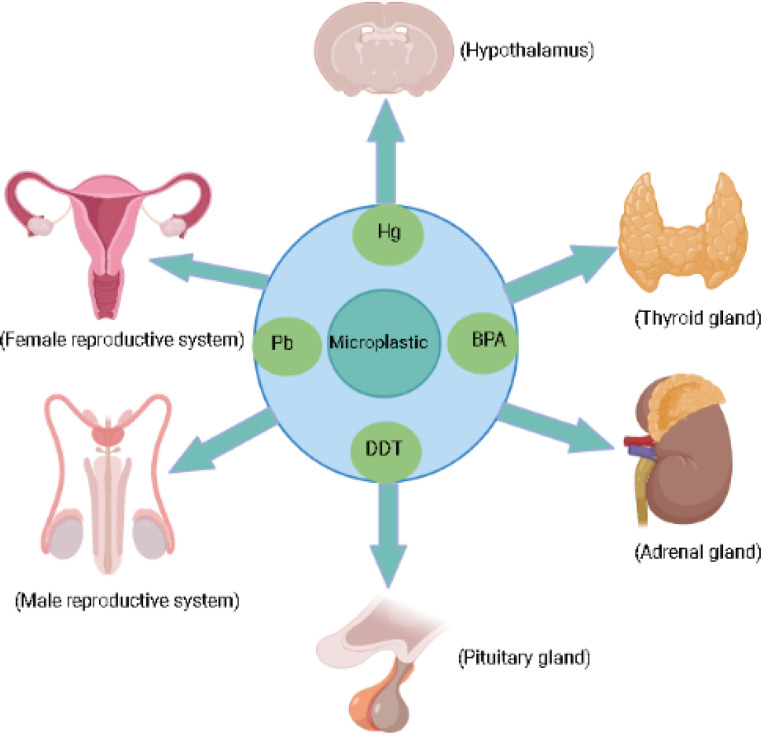
Over the years, the vaste expansion of plastic manufacturing has dramatically increased the environmental impact of microplastics [MPs] and nanoplastics [NPs], making them a threat to marine and terrestrial biota because they contain endocrine disrupting chemicals [EDCs] and other harmful compounds. MPs and NPs have deleteriouse impacts on mammalian endocrine components such as hypothalamus, pituitary, thyroid, adrenal, testes, and ovaries. MPs and NPs absorb and act as a transport medium for harmful chemicals such as bisphenols, phthalates, polybrominated diphenyl ether, polychlorinated biphenyl ether, organotin, perfluorinated compounds, dioxins, polycyclic aromatic hydrocarbons, organic contaminants, and heavy metals, which are commonly used as additives in plastic production. As the EDCs are not covalently bonded to plastics, they can easily leach into milk, water, and other liquids affecting the endocrine system of mammals upon exposure. The toxicity induced by MPs and NPs is size-dependent, as smaller particles have better absorption capacity and larger surface area, releasing more EDC and toxic chemicals. Various EDCs contained or carried by MPs and NPs share structural similarities with specific hormone receptors; hence they interfere with normal hormone receptors, altering the hormonal action of the endocrine glands. This review demonstrates size-dependent MPs' bioaccumulation, distribution, and translocation with potential hazards to the endocrine gland. We reviewed that MPs and NPs disrupt hypothalamic-pituitary axes, including the hypothalamic-pituitary-thyroid/adrenal/testicular/ovarian axis leading to oxidative stress, reproductive toxicity, neurotoxicity, cytotoxicity, developmental abnormalities, decreased sperm quality, and immunotoxicity. The direct consequences of MPs and NPs on the thyroid, testis, and ovaries are documented. Still, studies need to be carried out to identify the direct effects of MPs and NPs on the hypothalamus, pituitary, and adrenal glands.
多年来,塑料制造业的大规模扩张极大地增加了微塑料(MPs)和纳米塑料(NPs)的环境影响,使它们成为海洋和陆地生物群的威胁,因为它们含有内分泌干扰化学物质(EDCs)和其他有害化合物。 MPs 和 NPs 对哺乳动物的内分泌成分(如下丘脑、垂体、甲状腺、肾上腺、睾丸和卵巢)有有害影响。 MPs 和 NPs 吸收并充当有害物质(如双酚、邻苯二甲酸盐、多溴二苯醚、多氯联苯醚、有机锡、全氟化合物、二恶英、多环芳烃、有机污染物和重金属)的运输介质,这些物质通常用作塑料生产中的添加剂。由于 EDCs 未与塑料共价结合,因此它们很容易浸出到牛奶、水和其他液体中,在暴露于这些物质时会影响哺乳动物的内分泌系统。 MPs 和 NPs 引起的毒性与尺寸有关,因为较小的颗粒具有更好的吸收能力和更大的表面积,释放更多的 EDC 和有毒化学物质。 MPs 和 NPs 中所含或携带的各种 EDCs 与特定激素受体具有结构相似性;因此,它们会干扰正常的激素受体,改变内分泌腺的激素作用。 本综述表明 MPs 的生物累积、分布和转移与内分泌腺的潜在危害有关。 我们综述了 MPs 和 NPs 破坏下丘脑-垂体轴,包括下丘脑-垂体-甲状腺/肾上腺/睾丸/卵巢轴,导致氧化应激、生殖毒性、神经毒性、细胞毒性、发育异常、精子质量下降和免疫毒性。 记录了 MPs 和 NPs 对甲状腺、睾丸和卵巢的直接影响。 尽管如此,仍需要进行研究以确定 MPs 和 NPs 对下丘脑、垂体和肾上腺的直接影响。