MMGH Consulting GmbH, Geneva, Switzerland.
MMGH Consulting GmbH, Zurich, Switzerland.
Front Public Health. 2023 Jan 16;10:1037157. doi: 10.3389/fpubh.2022.1037157. eCollection 2022.
Progress toward measles and rubella (MR) elimination has stagnated as countries are unable to reach the required 95% vaccine coverage. Microarray patches (MAPs) are anticipated to offer significant programmatic advantages to needle and syringe (N/S) presentation and increase MR vaccination coverage. A demand forecast analysis of the programmatic doses required (PDR) could accelerate MR-MAP development by informing the size and return of the investment required to manufacture MAPs.
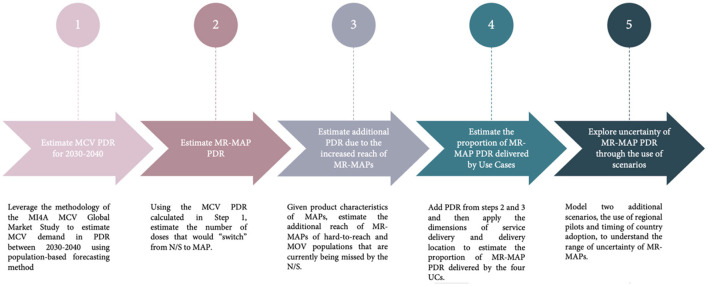
Unconstrained global MR-MAP demand for 2030-2040 was estimated for three scenarios, for groups of countries with similar characteristics (archetypes), and four types of uses of MR-MAPs (use cases). The base scenario 1 assumed that MR-MAPs would replace a share of MR doses delivered by N/S, and that MAPs can reach a proportion of previously unimmunised populations. Scenario 2 assumed that MR-MAPs would be piloted in selected countries in each region of the World Health Organization (WHO); and scenario 3 explored introduction of MR-MAPs earlier in countries with the lowest measles vaccine coverage and highest MR disease burden. We conducted sensitivity analyses to measure the impact of data uncertainty.
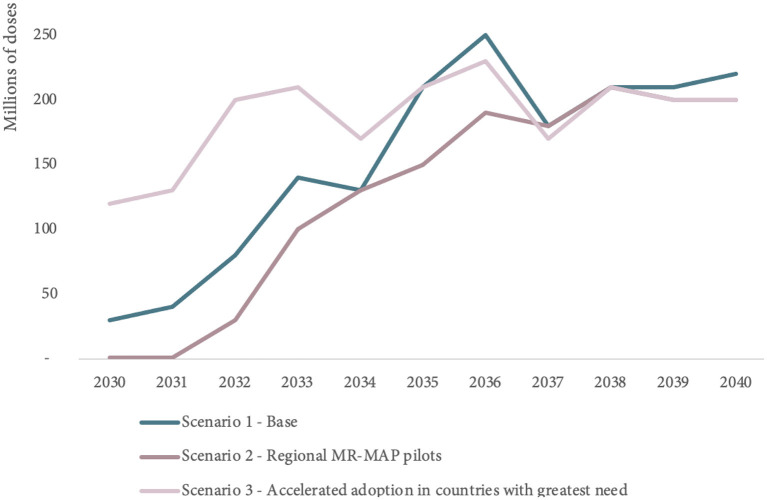
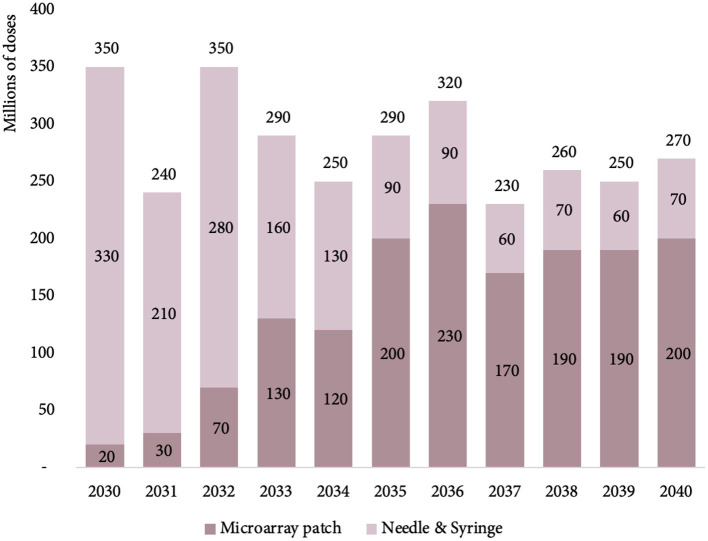
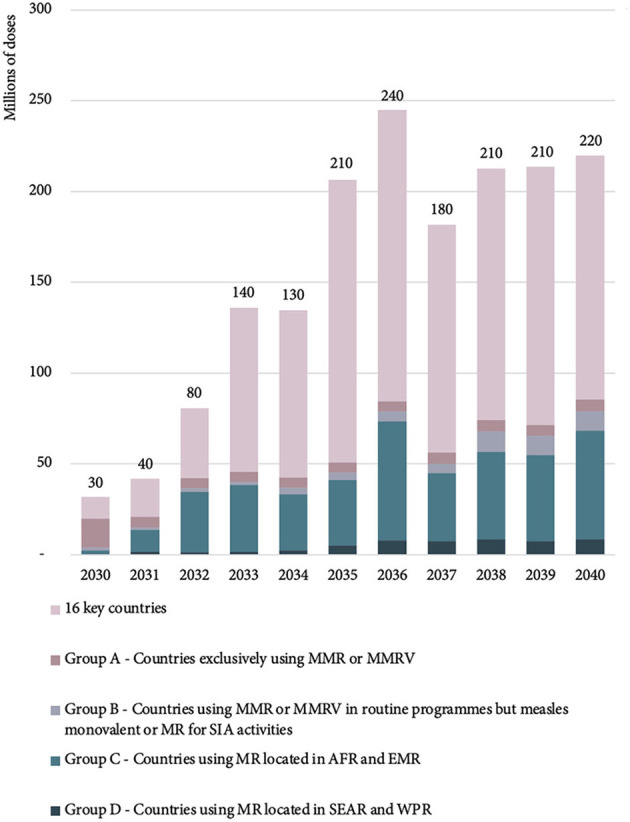
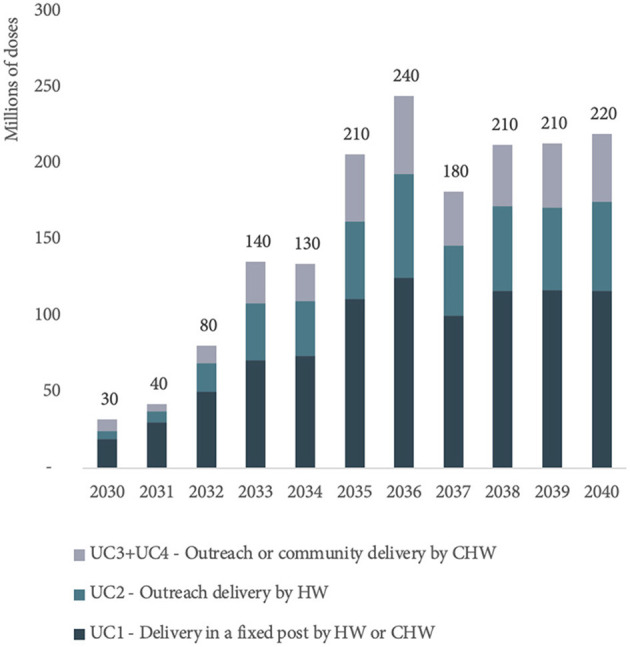
For the base scenario (1), the estimated global PDR for MR-MAPs was forecasted at 30 million doses in 2030 and increased to 220 million doses by 2040. Compared to scenario 1, scenario 2 resulted in an overall decrease in PDR of 18%, and scenario 3 resulted in a 21% increase in PDR between 2030 and 2040. Sensitivity analyses revealed that assumptions around the anticipated reach or coverage of MR-MAPs, particularly in the hard-to-reach and MOV populations, and the market penetration of MR-MAPs significantly impacted the estimated PDR.
Significant demand is expected for MR-MAPs between 2030 and 2040, however, efforts are required to address remaining data quality, uncertainties and gaps that underpin the assumptions in this analysis.
由于各国无法达到所需的 95%疫苗覆盖率,麻疹和风疹(MR)消除工作进展已经停滞。微阵列贴剂(MAP)有望为针和注射器(N/S)呈现带来重大计划优势,并增加 MR 疫苗接种覆盖率。对所需计划剂量(PDR)的需求预测分析可以通过告知制造 MAP 所需的规模和投资回报来加速 MR-MAP 的开发。
为三种情况估算了 2030-2040 年全球对 MR-MAP 的无约束需求,这些情况针对具有相似特征(原型)的国家群体,并针对 MR-MAP 的四种用途(用例)。基础情况 1 假设 MR-MAP 将取代部分通过 N/S 接种的 MR 剂量,并且 MAP 可以覆盖到以前未免疫的人群。情况 2 假设将在世界卫生组织(WHO)的每个区域中选择的国家进行 MR-MAP 试点;情况 3 则探索了在麻疹疫苗覆盖率最低和麻疹疾病负担最高的国家更早引入 MR-MAP 的情况。我们进行了敏感性分析,以衡量数据不确定性的影响。
对于基础情况(1),预计 2030 年全球对 MR-MAP 的 PDR 将预测为 3000 万剂,到 2040 年增加到 2.2 亿剂。与情况 1 相比,情况 2 导致 PDR 总体减少了 18%,情况 3 导致 2030 年至 2040 年间 PDR 增加了 21%。敏感性分析表明,对 MR-MAP 预期的覆盖范围或接种率的假设,特别是在难以接触到的和移动人群中,以及 MR-MAP 的市场渗透率,对估计的 PDR 有重大影响。
预计 2030 年至 2040 年期间对 MR-MAP 的需求将大幅增加,但需要努力解决支撑本分析假设的剩余数据质量、不确定性和差距。