Chowdhury Jamil, Ferdous Jannatul, Lihavainen Jenna, Albrectsen Benedicte Riber, Lundberg-Felten Judith
Umeå Plant Science Center, Department of Plant Physiology, Umeå University, Umeå, Sweden.
Umeå Plant Science Center, Department of Forest Genetics and Plant Physiology, Swedish University of Agricultural Sciences, Umeå, Sweden.
Front Plant Sci. 2023 Jan 16;13:1060804. doi: 10.3389/fpls.2022.1060804. eCollection 2022.
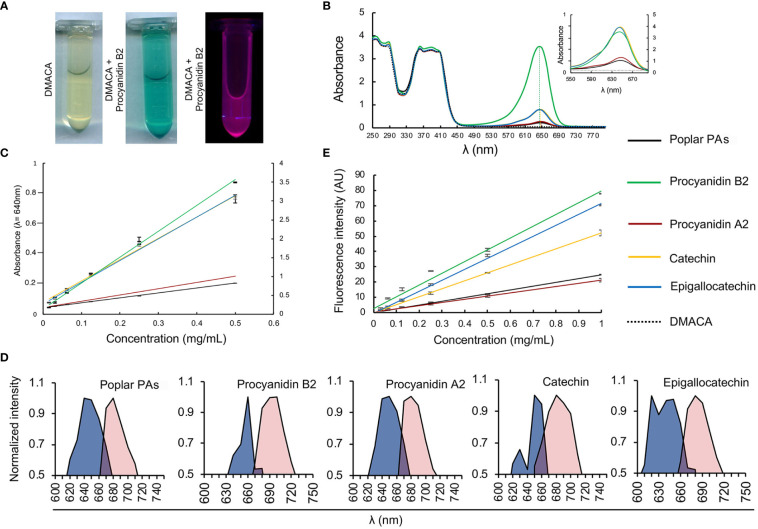
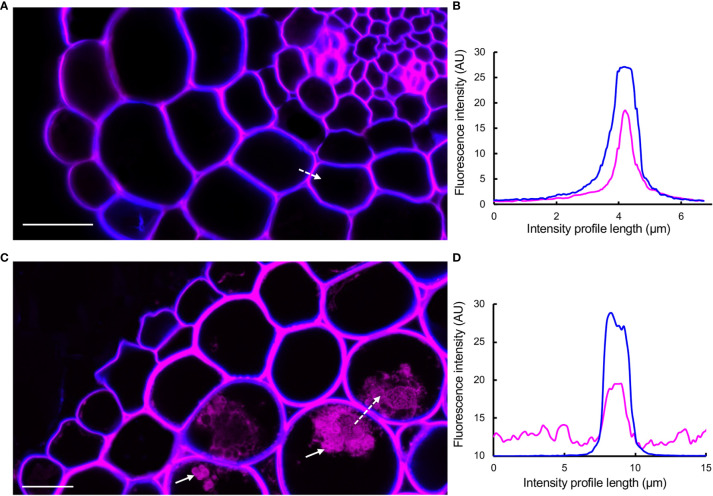
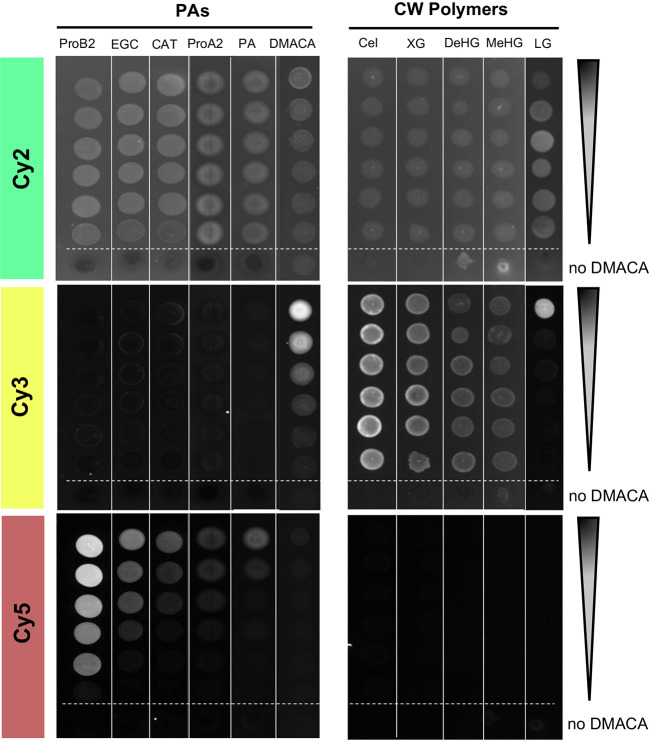
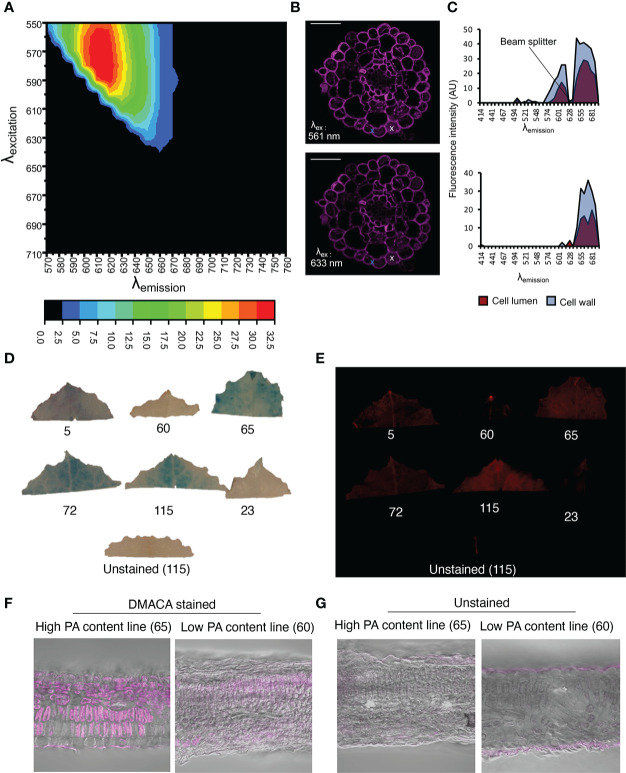
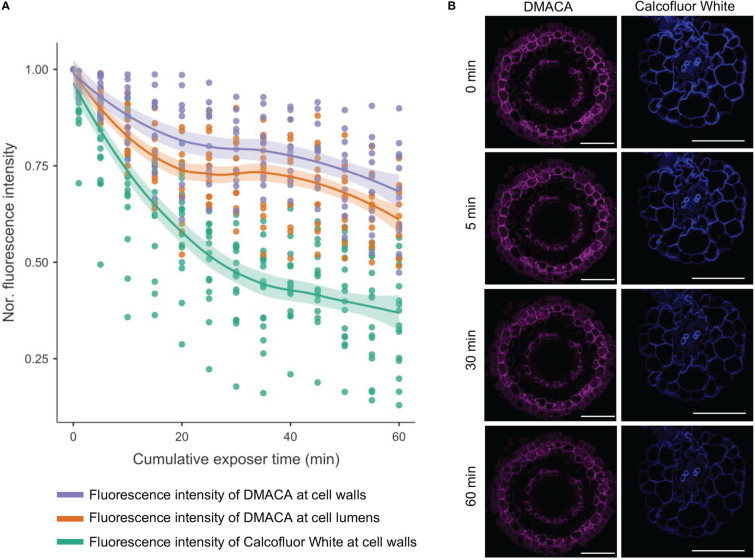
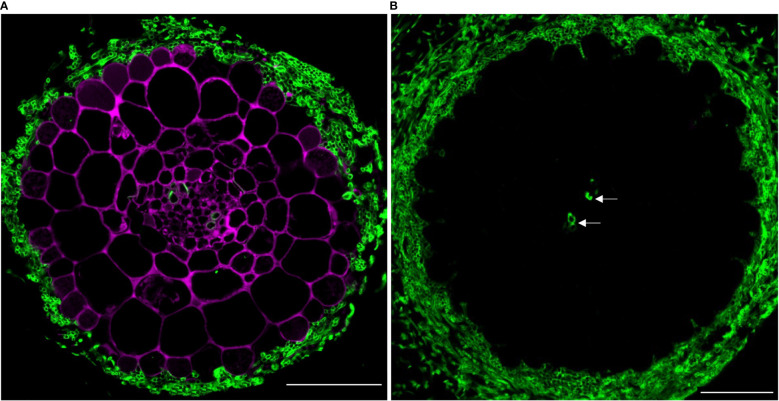
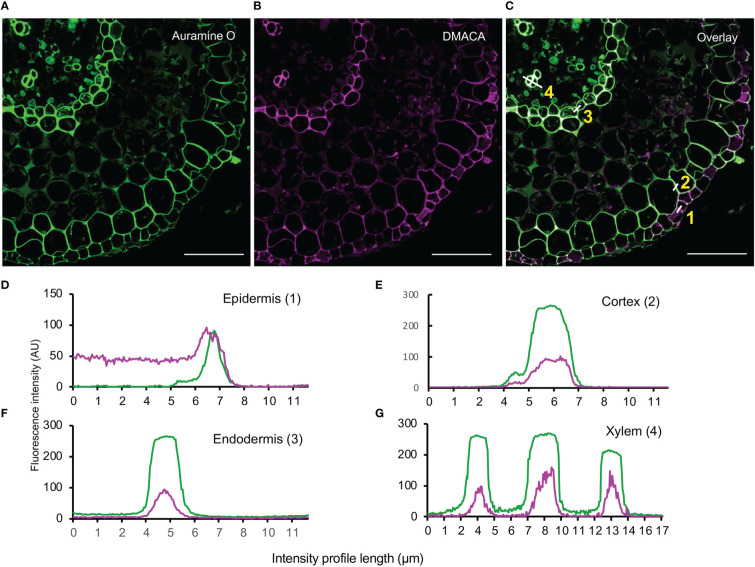
Proanthocyanidins (PAs) are polymeric phenolic compounds found in plants and used in many industrial applications. Despite strong evidence of herbivore and pathogen resistance-related properties of PAs, their function is not fully understood. Determining the location and dynamics of PAs in plant tissues and cellular compartments is crucial to understand their mode of action. Such an approach requires microscopic localization with fluorescent dyes that specifically bind to PAs. Such dyes have hitherto been lacking. Here, we show that 4-dimethylaminocinnamaldehyde (DMACA) can be used as a PA-specific fluorescent dye that allows localization of PAs at high resolution in cell walls and inside cells using confocal microscopy, revealing features of previously unreported wall-bound PAs. We demonstrate several novel usages of DMACA as a fluorophore by taking advantage of its double staining compatibility with other fluorescent dyes. We illustrate the use of the dye alone and its co-localization with cell wall polymers in different root tissues. The easy-to-use fluorescent staining method, together with its high photostability and compatibility with other fluorogenic dyes, makes DMACA a valuable tool for uncovering the biological function of PAs at a cellular level in plant tissues. DMACA can also be used in other plant tissues than roots, however care needs to be taken when tissues contain compounds that autofluoresce in the red spectral region which can be confounded with the PA-specific DMACA signal.
原花青素(PAs)是存在于植物中的聚合酚类化合物,在许多工业应用中都有使用。尽管有充分证据表明PAs具有与食草动物和病原体抗性相关的特性,但其功能尚未完全了解。确定PAs在植物组织和细胞区室中的位置和动态对于理解其作用方式至关重要。这种方法需要使用与PAs特异性结合的荧光染料进行微观定位。然而,迄今为止还缺乏这样的染料。在这里,我们表明4-二甲基氨基肉桂醛(DMACA)可以用作PA特异性荧光染料,通过共聚焦显微镜在细胞壁和细胞内以高分辨率定位PAs,揭示了以前未报道的壁结合PAs的特征。我们利用DMACA与其他荧光染料的双重染色兼容性,展示了它作为荧光团的几种新用途。我们举例说明了单独使用该染料及其与不同根组织中细胞壁聚合物的共定位情况。这种易于使用的荧光染色方法,连同其高光稳定性以及与其他荧光染料的兼容性,使DMACA成为在植物组织细胞水平上揭示PAs生物学功能的有价值工具。DMACA也可用于根以外的其他植物组织,然而,当组织含有在红色光谱区域自发荧光的化合物时需要小心,这些化合物可能会与PA特异性DMACA信号混淆。