School of Biological Sciences, University of Edinburgh, Edinburgh EH9 3FF, United Kingdom.
College of Chemical and Biological Engineering & ZJU-Hangzhou Global Scientific and Technological Innovation Center, Zhejiang University, Hangzhou 310058, China.
ACS Synth Biol. 2023 Feb 17;12(2):596-607. doi: 10.1021/acssynbio.2c00615. Epub 2023 Feb 2.
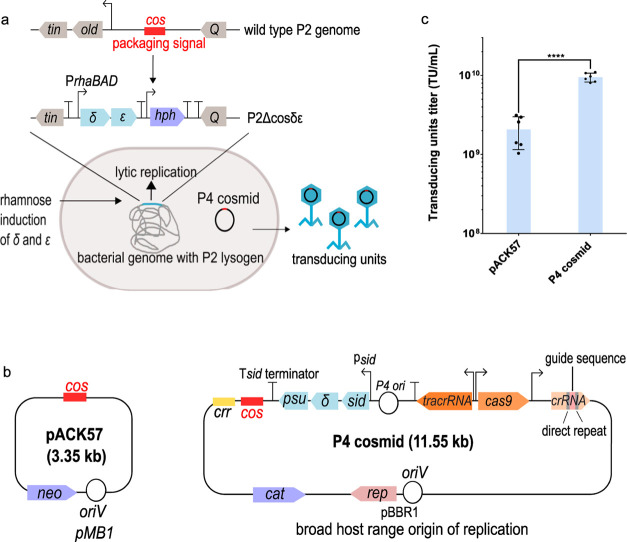
Bacteriophages can be reprogrammed to deliver antimicrobials for therapeutic and biocontrol purposes and are a promising alternative treatment to antimicrobial-resistant bacteria. Here, we developed a bacteriophage P4 cosmid system for the delivery of a Cas9 antimicrobial into clinically relevant human gut pathogens and O157:H7. Our P4 cosmid design produces a high titer of cosmid-transducing units without contamination by a helper phage. Further, we demonstrate that genetic engineering of the phage tail fiber improves the transduction efficiency of cosmid DNA in M90T as well as allows recognition of a nonnative host, O157:H7. We show that the transducing units with the chimeric tails enhanced the overall Cas9-mediated killing of both pathogens. This study demonstrates the potential of our P4 cosmid system as a DNA sequence-specific antimicrobial against clinically relevant gut pathogenic bacteria.
噬菌体可以被重新编程以递送用于治疗和生物防治目的的抗菌药物,并且是治疗对抗菌药物有抗药性的细菌的一种很有前途的替代方法。在这里,我们开发了一种噬菌体 P4 粘粒系统,用于将 Cas9 抗菌药物递送至临床上相关的人类肠道病原体和 O157:H7。我们的 P4 粘粒设计产生了高滴度的无辅助噬菌体污染的粘粒转导单位。此外,我们证明了噬菌体尾部纤维的基因工程可以提高 M90T 中粘粒 DNA 的转导效率,并允许识别非天然宿主 O157:H7。我们表明,带有嵌合尾巴的转导单位增强了两种病原体的 Cas9 介导的杀伤作用。这项研究证明了我们的 P4 粘粒系统作为针对临床相关肠道致病菌的 DNA 序列特异性抗菌药物的潜力。