Department of Health Research Methods, Evidence, and Impact, Faculty of Health Sciences, McMaster University, Michael G. DeGroote Centre for Learning and Discovery, Room 2112, 1280 Main Street West, Hamilton, ON, L8S 4K1, Canada.
BMC Complement Med Ther. 2023 Feb 2;23(1):32. doi: 10.1186/s12906-023-03856-6.
Despite the increased use of social media to share health-related information and the substantial impact that complementary and alternative medicine (CAM) can have on individuals' health and wellbeing, currently, to our knowledge, there is no review that compiles research on how social media is used in the context of CAM. The objective of this study was to summarize what are the ways in which social media is used in the context of CAM.
A scoping review was conducted, following Arksey and O'Malley's five-stage methodological framework. MEDLINE, EMBASE, PsycINFO, AMED, and CINAHL databases were systematically searched from inception until October 3, 2020, in addition to the Canadian Agency for Drugs and Technology in Health (CADTH) website. Eligible studies had to have investigated how at least one social media platform is used in the context of a single or multiple types of CAM treatments.
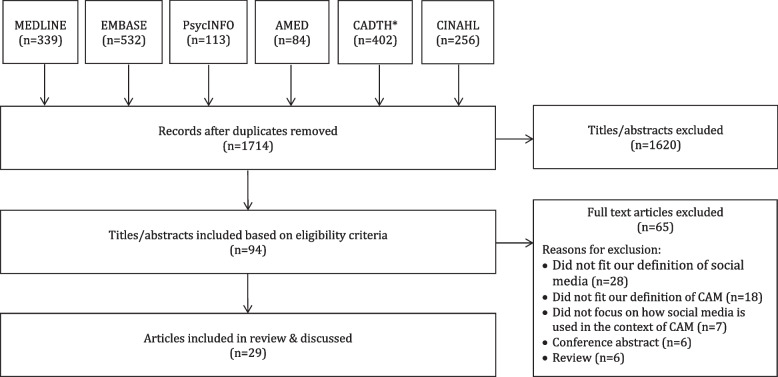
Searches retrieved 1714 items following deduplication, of which 1687 titles and abstracts were eliminated, leaving 94 full-text articles to be considered. Of those, 65 were not eligible, leaving a total of 29 articles eligible for review. Three themes emerged from our analysis: 1) social media is used to share user/practitioner beliefs, attitudes, and experiences about CAM, 2) social media acts as a vehicle for the spread of misinformation about CAM, and 3) there are unique challenges with social media research in the context of CAM.
In addition to social media being a useful tool to share user/practitioner beliefs, attitudes, and experiences about CAM, it has shown to be accessible, effective, and a viable option in delivering CAM therapies and information. Social media has also been shown to spread a large amount of misleading and false information in the context of CAM. Additionally, this review highlights the challenges with conducting social media research in the context of CAM, particularly in collecting a representative sample.
尽管社交媒体在分享健康相关信息方面的使用日益增多,而且补充和替代医学(CAM)对个人的健康和幸福有着重大影响,但据我们所知,目前尚无综述综合研究社交媒体在 CAM 背景下的使用情况。本研究的目的是总结社交媒体在 CAM 背景下的使用方式。
我们采用 Arksey 和 O'Malley 的五阶段方法框架进行了范围综述。除了加拿大药物和技术健康评估机构(CADTH)网站外,我们还系统地检索了 MEDLINE、EMBASE、PsycINFO、AMED 和 CINAHL 数据库,检索时间从建库起至 2020 年 10 月 3 日。合格的研究必须调查至少一个社交媒体平台在单一或多种类型的 CAM 治疗中的使用情况。
经过去重后,搜索共检索到 1714 项,其中 1687 项标题和摘要被排除,留下 94 篇全文文章进行考虑。其中 65 篇不符合条件,最终共有 29 篇文章符合审查条件。我们的分析中出现了三个主题:1)社交媒体用于分享用户/从业者对 CAM 的信仰、态度和经验;2)社交媒体成为传播关于 CAM 的错误信息的媒介;3)在 CAM 背景下进行社交媒体研究存在独特的挑战。
除了社交媒体是分享用户/从业者对 CAM 的信仰、态度和经验的有用工具外,它还显示出在传播 CAM 疗法和信息方面具有可及性、有效性和可行性。社交媒体在 CAM 背景下也显示出传播大量误导和虚假信息的能力。此外,本综述强调了在 CAM 背景下进行社交媒体研究的挑战,特别是在收集代表性样本方面。