Mei Lihong, Zhang Zhihua, Li Xushuo, Yang Ying, Qi Ruixue
Department of Dermatology, Jinshan Hospital, Fudan University, Shanghai, China.
Department of Echocardiography, Jinshan Hospital, Fudan University, Shanghai, China.
Front Oncol. 2023 Jan 17;12:1025046. doi: 10.3389/fonc.2022.1025046. eCollection 2022.
To explore potential metabolomics biomarker in predicting the efficiency of the chemo-immunotherapy in patients with advanced non-small cell lung cancer (NSCLC).
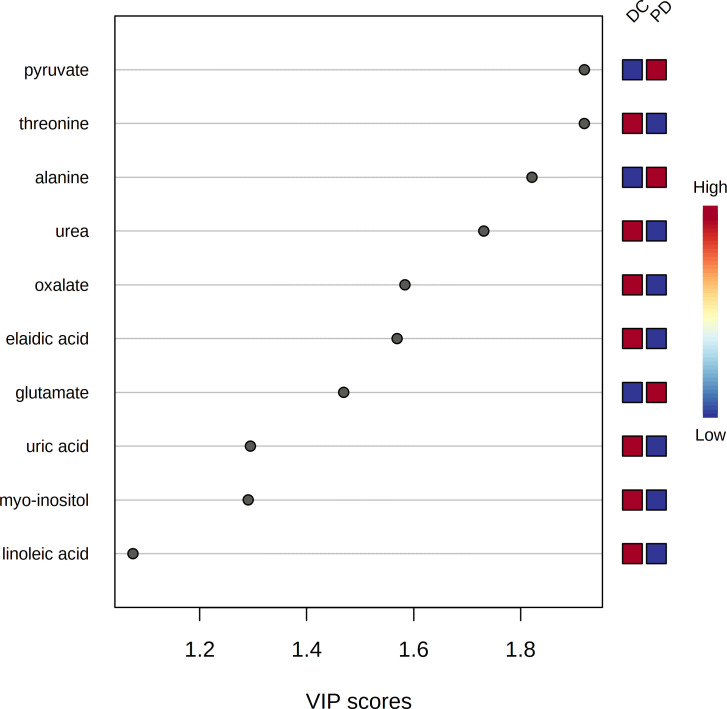
A total of 83 eligible patients were assigned to receive chemo-immunotherapy. Serum samples were prospectively collected before the treatment to perform metabolomics profiling analyses under the application of gas chromatography mass spectrometry (GC-MS). The key metabolites were identified using projection to latent structures discriminant analysis (PLS-DA). The key metabolites were used for predicting the chemo-immunotherapy efficiency in advanced NSCLC patients.
Seven metabolites including pyruvate, threonine, alanine, urea, oxalate, elaidic acid and glutamate were identified as the key metabolites to the chemo-immunotherapy response. The receiver operating characteristic curves (AUC) were 0.79 (95% CI: 0.69-0.90), 0.60 (95% CI: 0.48-0.73), 0.69 (95% CI: 0.57-0.80), 0.63 (95% CI: 0.51-0.75), 0.60 (95% CI: 0.48-0.72), 0.56 (95% CI: 0.43-0.67), and 0.67 (95% CI: 0.55-0.80) for the key metabolites, respectively. A binary logistic regression was used to construct a combined biomarker model to improve the discriminating efficiency. The AUC was 0.86 (95% CI: 0.77-0.94) for the combined biomarker model. Pathway analyses showed that urea cycle, glucose-alanine cycle, glycine and serine metabolism, alanine metabolism, and glutamate metabolism were the key metabolic pathway to the chemo-immunotherapy response in patients with advanced NSCLC.
Metabolomics analyses of key metabolites and pathways revealed that GC-MS could be used to predict the efficiency of chemo-immunotherapy. Pyruvate, threonine, alanine, urea, oxalate, elaidic acid and glutamate played a central role in the metabolic of PD patients with advanced NSCLC.
探索潜在的代谢组学生物标志物以预测晚期非小细胞肺癌(NSCLC)患者化学免疫疗法的疗效。
总共83名符合条件的患者被分配接受化学免疫疗法。在治疗前前瞻性收集血清样本,在气相色谱 - 质谱联用(GC-MS)应用下进行代谢组学分析。使用潜在结构判别分析(PLS-DA)鉴定关键代谢物。这些关键代谢物用于预测晚期NSCLC患者的化学免疫疗法疗效。
七种代谢物,包括丙酮酸、苏氨酸、丙氨酸、尿素、草酸盐、反油酸和谷氨酸,被鉴定为化学免疫疗法反应的关键代谢物。关键代谢物的受试者工作特征曲线(AUC)分别为0.79(95%CI:0.69 - 0.90)、0.60(95%CI:0.48 - 0.73)、0.69(95%CI:0.57 - 0.80)、0.63(95%CI:0.51 - 0.75)、0.60(95%CI:0.48 - 0.72)、0.56(95%CI:0.43 - 0.67)和0.67(95%CI:0.55 - 0.80)。使用二元逻辑回归构建组合生物标志物模型以提高鉴别效率。组合生物标志物模型的AUC为0.86(95%CI:0.77 - 0.94)。通路分析表明,尿素循环、葡萄糖 - 丙氨酸循环、甘氨酸和丝氨酸代谢、丙氨酸代谢以及谷氨酸代谢是晚期NSCLC患者化学免疫疗法反应的关键代谢途径。
关键代谢物和通路的代谢组学分析表明,GC-MS可用于预测化学免疫疗法的疗效。丙酮酸、苏氨酸、丙氨酸、尿素、草酸盐、反油酸和谷氨酸在晚期NSCLC患者的代谢中起核心作用。