Liew Wen Jie Melvin, Wong Yee Shan, Parikh Atul N, Venkatraman Subbu S, Cao Ye, Czarny Bertrand
School of Materials Science and Engineering, Nanyang Technological University, Singapore, Singapore.
Biomedical Engineering, School of Engineering, Temasek Polytechnic, Singapore, Singapore.
Front Bioeng Biotechnol. 2023 Jan 17;11:1113236. doi: 10.3389/fbioe.2023.1113236. eCollection 2023.
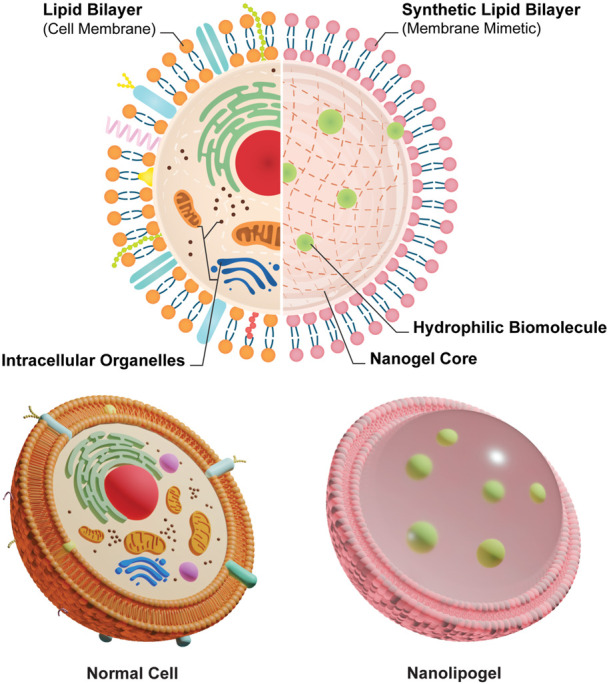
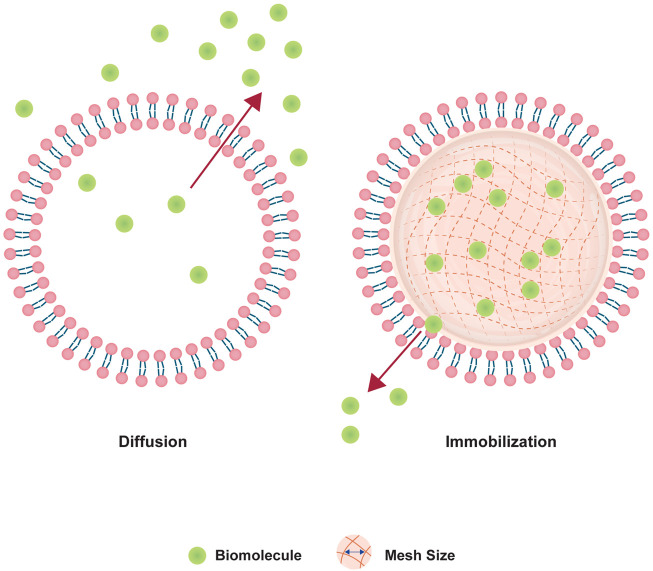
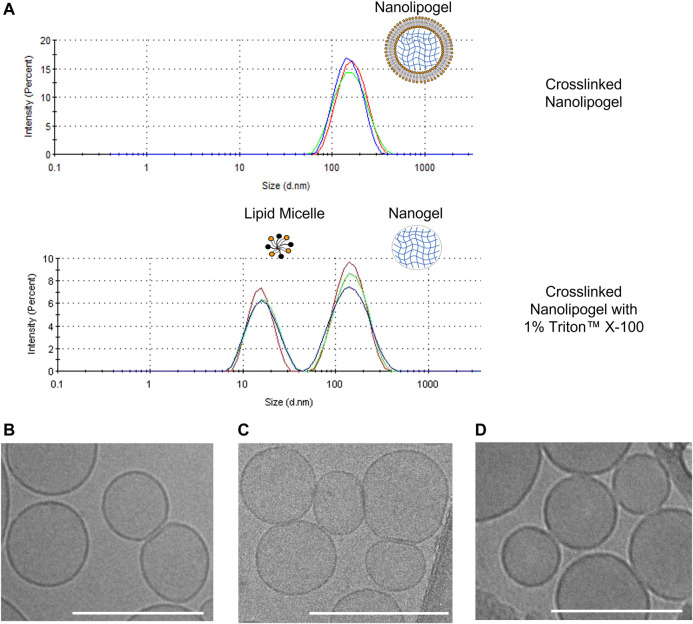
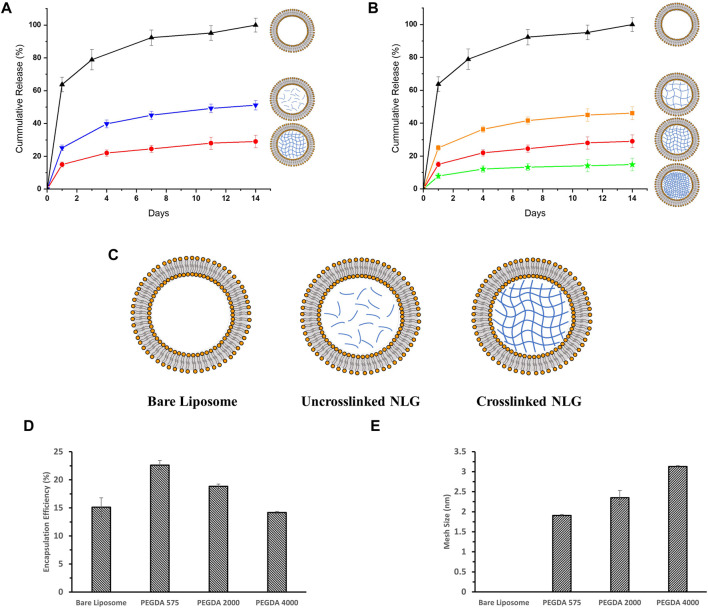
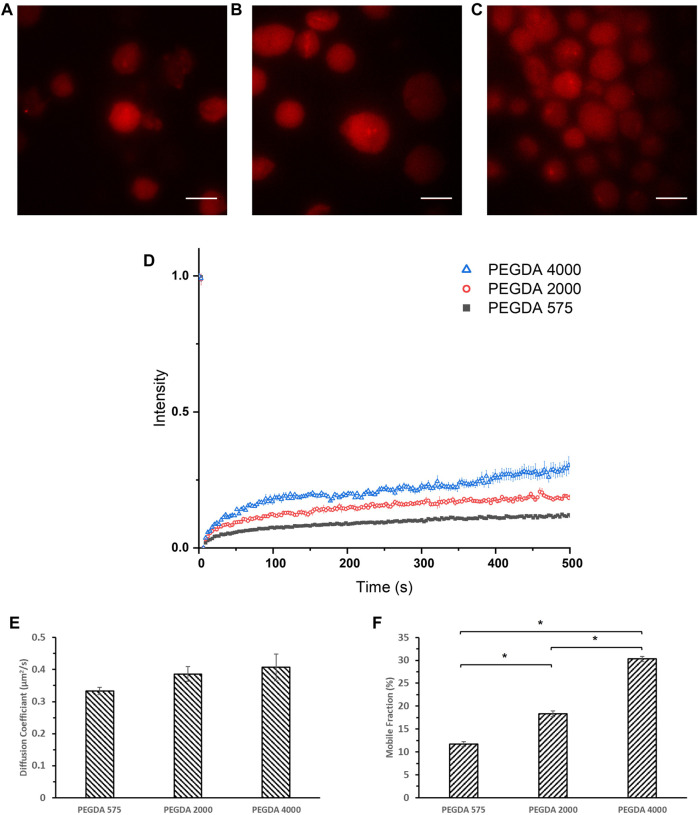
Lipid based nanoparticulate formulations have been widely used for the encapsulation and sustain release of hydrophilic drugs, but they still face challenges such as high initial burst release. Nanolipogel (NLG) emerges as a potential system to encapsulate and deliver hydrophilic drug while suppressing its initial burst release. However, there is a lack of characterization of the drug release mechanism from NLGs. In this work, we present a study on the release mechanism of hydrophilic Dextran-Fluorescein Isothiocyanate (DFITC) from Poly (ethylene glycol) Diacrylate (PEGDA) NLGs by using different molecular weights of PEGDA to vary the mesh size of the nanogel core, drawing inspiration from the macromolecular crowding effect in cells, which can be viewed as a mesh network of undefined sizes. The effect is then further characterized and validated by studying the diffusion of DFITC within the nanogel core using Fluorescence Recovery after Photobleaching (FRAP), on our newly developed cell derived microlipogels (MLG). This is in contrast to conventional FRAP works on cells or bulk hydrogels, which is limited in our application. Our work showed that the mesh size of the NLGs can be controlled by using different Mw of PEGDA, such as using a smaller MW to achieve higher crosslinking density, which will lead to having smaller mesh size for the crosslinked nanogel, and the release of hydrophilic DFITC can be sustained while suppressing the initial burst release, up to 10-fold more for crosslinked PEGDA 575 NLGs. This is further validated by FRAP which showed that the diffusion of DFITC is hindered by the decreasing mesh sizes in the NLGs, as a result of lower mobile fractions. These findings will be useful for guiding the design of PEGDA NLGs to have different degree of suppression of the initial burst release as well as the cumulative release, for a wide array of applications. This can also be extended to other different types of nanogel cores and other nanogel core-based nanoparticles for encapsulation and release of hydrophilic biomolecules.
基于脂质的纳米颗粒制剂已被广泛用于亲水性药物的包封和缓释,但它们仍然面临诸如高初始突释等挑战。纳米脂质凝胶(NLG)作为一种潜在的系统出现,可用于包封和递送亲水性药物,同时抑制其初始突释。然而,目前缺乏对NLG药物释放机制的表征。在这项工作中,我们通过使用不同分子量的聚乙二醇二丙烯酸酯(PEGDA)来改变纳米凝胶核心的网孔大小,对聚乙二醇二丙烯酸酯(PEGDA)NLG中亲水性异硫氰酸荧光素葡聚糖(DFITC)的释放机制进行了研究,灵感来源于细胞中的大分子拥挤效应,细胞可被视为一个大小不确定的网状网络。然后,通过使用光漂白后荧光恢复(FRAP)技术研究DFITC在我们新开发的细胞衍生微脂质凝胶(MLG)的纳米凝胶核心内的扩散,进一步表征和验证了这种效应。这与传统的在细胞或本体水凝胶上进行的FRAP研究形成对比,传统研究在我们的应用中存在局限性。我们的工作表明,可以通过使用不同分子量的PEGDA来控制NLG的网孔大小,例如使用较小的分子量来实现更高的交联密度,这将导致交联纳米凝胶的网孔尺寸更小,亲水性DFITC的释放可以在抑制初始突释的同时得以持续,交联的PEGDA 575 NLG的突释抑制倍数高达10倍。FRAP进一步验证了这一点,结果表明由于可移动部分减少,NLG中网孔尺寸的减小阻碍了DFITC的扩散。这些发现将有助于指导PEGDA NLG的设计,使其在广泛的应用中对初始突释以及累积释放具有不同程度的抑制作用。这也可以扩展到其他不同类型的纳米凝胶核心以及其他基于纳米凝胶核心的纳米颗粒,用于亲水性生物分子的包封和释放。