Robert D. and Patricia E. Kern Center for the Science of Healthcare Delivery, Mayo Clinic, Rochester, MN, USA.
Community Internal Medicine, Mayo Clinic, Rochester, MN, USA.
BMC Palliat Care. 2023 Feb 3;22(1):9. doi: 10.1186/s12904-022-01113-0.
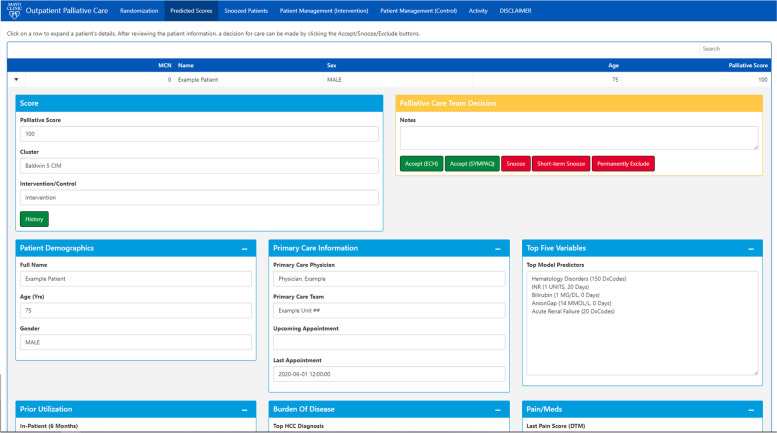
As primary care populations age, timely identification of palliative care need is becoming increasingly relevant. Previous studies have targeted particular patient populations with life-limiting disease, but few have focused on patients in a primary care setting. Toward this end, we propose a stepped-wedge pragmatic randomized trial whereby a machine learning algorithm identifies patients empaneled to primary care units at Mayo Clinic (Rochester, Minnesota, United States) with high likelihood of palliative care need.
42 care team units in 9 clusters were randomized to 7 wedges, each lasting 42 days. For care teams in treatment wedges, palliative care specialists review identified patients, making recommendations to primary care providers when appropriate. Care teams in control wedges receive palliative care under the standard of care.
This pragmatic trial therefore integrates machine learning into clinical decision making, instead of simply reporting theoretical predictive performance. Such integration has the possibility to decrease time to palliative care, improving patient quality of life and symptom burden.
Clinicaltrials.gov NCT04604457 , restrospectively registered 10/26/2020.
v0.5, dated 9/23/2020.
随着初级保健人群的老龄化,及时确定姑息治疗需求变得越来越重要。先前的研究针对的是患有绝症的特定患者群体,但很少有研究关注初级保健环境中的患者。为此,我们提出了一项阶梯式实用随机试验,通过机器学习算法识别明尼苏达州罗切斯特市梅奥诊所(Mayo Clinic)初级保健单位中极有可能需要姑息治疗的患者。
42 个护理团队单位分为 9 个集群,随机分为 7 个楔形,每个楔形持续 42 天。对于治疗楔形中的护理团队,姑息治疗专家会审查确定的患者,并在适当情况下向初级保健提供者提出建议。对照楔形中的护理团队接受标准的姑息治疗。
因此,这项实用试验将机器学习整合到临床决策中,而不是简单地报告理论预测性能。这种整合有可能缩短姑息治疗的时间,提高患者的生活质量和症状负担。
Clinicaltrials.gov NCT04604457,于 2020 年 10 月 26 日进行回顾性注册。
v0.5,日期为 2020 年 9 月 23 日。