• 文献检索
  • 文档翻译
  • 深度研究
  • 学术资讯
  • Suppr Zotero 插件Zotero 插件
  • 邀请有礼
  • 套餐&价格
  • 历史记录
应用&插件
Suppr Zotero 插件Zotero 插件浏览器插件Mac 客户端Windows 客户端微信小程序
定价
高级版会员购买积分包购买API积分包
服务
文献检索文档翻译深度研究API 文档MCP 服务
关于我们
关于 Suppr公司介绍联系我们用户协议隐私条款
关注我们

Suppr 超能文献

核心技术专利:CN118964589B侵权必究
粤ICP备2023148730 号-1Suppr @ 2026

文献检索

告别复杂PubMed语法,用中文像聊天一样搜索,搜遍4000万医学文献。AI智能推荐,让科研检索更轻松。

立即免费搜索

文件翻译

保留排版,准确专业,支持PDF/Word/PPT等文件格式,支持 12+语言互译。

免费翻译文档

深度研究

AI帮你快速写综述,25分钟生成高质量综述,智能提取关键信息,辅助科研写作。

立即免费体验

青少年期的童年期心理虐待与关系攻击:一个有调节的链式中介模型。

Childhood psychological abuse and relational aggression among adolescents: A moderated chain mediation model.

作者信息

Li Ting, Huang Yuhuai, Jiang Meiru, Ma Shutao, Ma Yankun

机构信息

School of Education, Guangzhou University, Guangzhou, China.

Nansha Tianyuan Campus of Guangzhou High School, Guangzhou, China.

出版信息

Front Psychol. 2023 Jan 18;13:1082516. doi: 10.3389/fpsyg.2022.1082516. eCollection 2022.

DOI:10.3389/fpsyg.2022.1082516
PMID:36743607
原文链接:https://pmc.ncbi.nlm.nih.gov/articles/PMC9890550/
Abstract

INTRODUCTION

Adolescents are in a period when a marked upward trend of adolescents relational aggression. Even though previous studies have found that childhood psychological abuse experience is an important factor influencing adolescent relational aggression, it is unclear when and under what circumstances childhood psychological abuse impacts adolescent relational aggression. This study constructed a moderated chain mediation model to investigate the influence of childhood psychological abuse on relational aggression among Chinese adolescents and its internal mechanism.

METHODS

Data from 1868 (923 male and 945 female, M = 14.31, SD = 1.60) Chinese adolescents in two full-time middle schools in Guangzhou were collected via a cross-sectional survey in 2020. Adolescents reported on childhood psychological abuse, relational aggression, rejection sensitivity relational victimization and cognitive reappraisal.

RESULTS

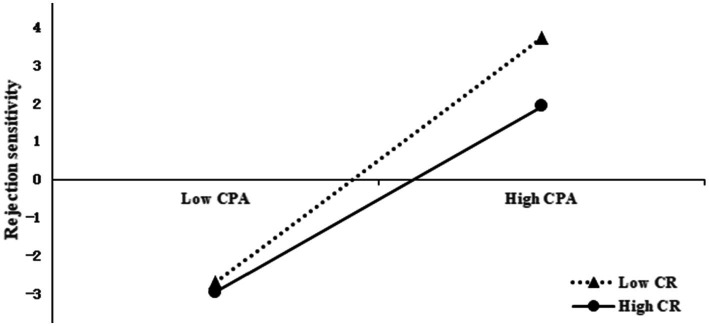
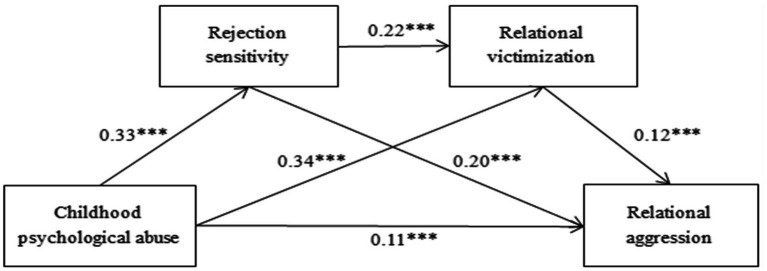
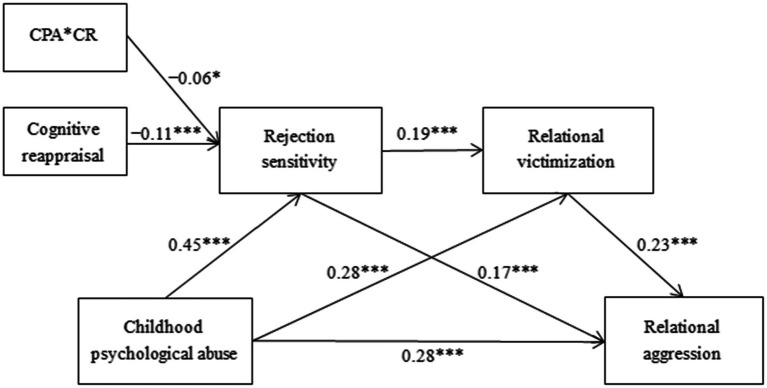
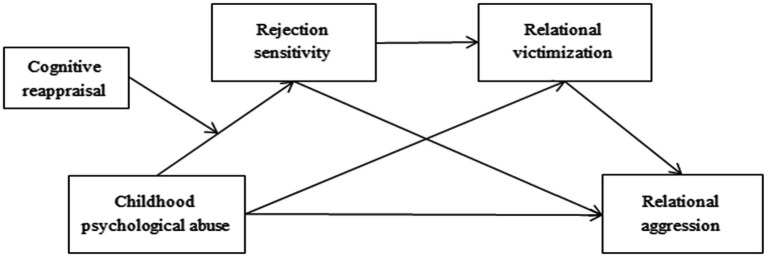
The results demonstrated that: (1) childhood psychological abuse was significantly positively related to relational aggression; (2) childhood psychological abuse was significantly linked with adolescents' relational aggression through the separate mediating effects of rejection sensitivity and relational victimization, as well as through the chain mediating effects of rejection sensitivity and relational victimization; (3) the chain mediated effect of childhood psychological abuse on relational aggression through rejection sensitivity and relational victimization was moderated by cognitive reappraisal.

CONCLUSION

These findings indicate that childhood psychological abuse, as a kind of poor parenting style, has influence on adolescents' internal personality (rejection sensitivity) and external behavior development (relational victimization and relational aggression). This study is helpful to demonstrate the protective effect of cognitive reappraisal and reveal the internal mechanism of childhood psychological abuse on relational aggression.

摘要

引言

青少年正处于关系攻击行为显著上升的时期。尽管先前的研究发现童年期心理虐待经历是影响青少年关系攻击行为的一个重要因素,但尚不清楚童年期心理虐待在何时以及何种情况下会影响青少年的关系攻击行为。本研究构建了一个有调节的链式中介模型,以探讨童年期心理虐待对中国青少年关系攻击行为的影响及其内在机制。

方法

2020年通过横断面调查收集了来自广州两所全日制中学的1868名中国青少年(923名男性和945名女性,M = 14.31,SD = 1.60)的数据。青少年报告了童年期心理虐待、关系攻击行为、拒绝敏感性、关系型受害经历和认知重评情况。

结果

结果表明:(1)童年期心理虐待与关系攻击行为显著正相关;(2)童年期心理虐待通过拒绝敏感性和关系型受害经历的单独中介效应以及通过拒绝敏感性和关系型受害经历的链式中介效应与青少年的关系攻击行为显著相关;(3)童年期心理虐待通过拒绝敏感性和关系型受害经历对关系攻击行为的链式中介效应受到认知重评的调节。

结论

这些研究结果表明,童年期心理虐待作为一种不良的养育方式,会影响青少年的内在人格(拒绝敏感性)和外在行为发展(关系型受害经历和关系攻击行为)。本研究有助于证明认知重评的保护作用,并揭示童年期心理虐待对关系攻击行为的内在机制。
https://cdn.ncbi.nlm.nih.gov/pmc/blobs/bb1c/9890550/30f966dcea21/fpsyg-13-1082516-g004.jpg
https://cdn.ncbi.nlm.nih.gov/pmc/blobs/bb1c/9890550/1f9cfd2d988d/fpsyg-13-1082516-g001.jpg
https://cdn.ncbi.nlm.nih.gov/pmc/blobs/bb1c/9890550/d34a69a9f837/fpsyg-13-1082516-g002.jpg
https://cdn.ncbi.nlm.nih.gov/pmc/blobs/bb1c/9890550/ba3cfed482d6/fpsyg-13-1082516-g003.jpg
https://cdn.ncbi.nlm.nih.gov/pmc/blobs/bb1c/9890550/30f966dcea21/fpsyg-13-1082516-g004.jpg
https://cdn.ncbi.nlm.nih.gov/pmc/blobs/bb1c/9890550/1f9cfd2d988d/fpsyg-13-1082516-g001.jpg
https://cdn.ncbi.nlm.nih.gov/pmc/blobs/bb1c/9890550/d34a69a9f837/fpsyg-13-1082516-g002.jpg
https://cdn.ncbi.nlm.nih.gov/pmc/blobs/bb1c/9890550/ba3cfed482d6/fpsyg-13-1082516-g003.jpg
https://cdn.ncbi.nlm.nih.gov/pmc/blobs/bb1c/9890550/30f966dcea21/fpsyg-13-1082516-g004.jpg

相似文献

1
Childhood psychological abuse and relational aggression among adolescents: A moderated chain mediation model.青少年期的童年期心理虐待与关系攻击:一个有调节的链式中介模型。
Front Psychol. 2023 Jan 18;13:1082516. doi: 10.3389/fpsyg.2022.1082516. eCollection 2022.
2
Forms of aggression, peer relationships, and relational victimization among Chinese adolescent girls and boys: roles of prosocial behavior.中国青少年女孩和男孩的攻击形式、同伴关系及关系型受害:亲社会行为的作用
Front Psychol. 2015 Aug 21;6:1264. doi: 10.3389/fpsyg.2015.01264. eCollection 2015.
3
Parental Corporal Punishment and Peer Victimization in Middle Childhood: A Sex-Moderated Mediation Model of Aggression.童年中期的父母体罚与同伴侵害:攻击行为的性别调节中介模型
Front Psychol. 2021 Feb 26;11:573329. doi: 10.3389/fpsyg.2020.573329. eCollection 2020.
4
Heightened emotional sensitivity intensifies associations between relational aggression and victimization among girls but not boys: a longitudinal study.情绪敏感性增强会强化女孩(而非男孩)之间关系性攻击与受侵害之间的关联:一项纵向研究。
Dev Psychopathol. 2014 Aug;26(3):661-73. doi: 10.1017/S0954579414000303.
5
Relational aggression and victimization during adolescence: A meta-analytic review of unique associations with popularity, peer acceptance, rejection, and friendship characteristics.青少年时期的关系型攻击和受害:对与受欢迎程度、同伴接纳、拒绝和友谊特征的独特关联的元分析综述。
J Adolesc. 2020 Apr;80:41-52. doi: 10.1016/j.adolescence.2019.12.012. Epub 2020 Feb 12.
6
The Relationship Between Parental Phubbing and Interpersonal Aggression in Adolescents: The Role of Rejection Sensitivity and School Climate.父母忽视与青少年人际攻击的关系:拒绝敏感性和学校氛围的作用。
J Interpers Violence. 2023 Jun;38(11-12):7630-7655. doi: 10.1177/08862605221145722. Epub 2023 Jan 12.
7
Dwelling on it may make it worse: the links between relational victimization, relational aggression, rumination, and depressive symptoms in adolescents.对此念念不忘可能会使情况更糟:青少年中关系型受害、关系型攻击、沉思与抑郁症状之间的联系。
Dev Psychopathol. 2014 Aug;26(3):735-47. doi: 10.1017/S0954579414000352.
8
Victimization and Relational Aggression in Adolescent Romantic Relationships: The Influence of Parental and Peer Behaviors, and Individual Adjustment.青少年恋爱关系中的受害经历与关系攻击行为:父母及同伴行为的影响与个体适应
J Youth Adolesc. 2008 Mar 1;37(3):359-372. doi: 10.1007/s10964-007-9269-0.
9
Peer victimization and peer rejection during early childhood.幼儿期的同伴侵害与同伴排斥。
J Clin Child Adolesc Psychol. 2015;44(3):380-92. doi: 10.1080/15374416.2014.940622. Epub 2014 Aug 18.
10
Why rejection sensitivity leads to adolescents' loneliness: Differential exposure, reactivity, and exposure-reactivity models.为何拒绝敏感性会导致青少年孤独:差异暴露、反应性及暴露-反应性模型。
J Adolesc. 2025 Jan;97(1):137-147. doi: 10.1002/jad.12405. Epub 2024 Sep 20.

引用本文的文献

1
Childhood psychological abuse influences adolescent aggression through mentalizing and alexithymia sequential mediation.童年期心理虐待通过心理化和述情障碍的顺序中介作用影响青少年的攻击性。
Sci Rep. 2025 Jul 2;15(1):23321. doi: 10.1038/s41598-025-07449-w.
2
Emotional Abuse to Delinquent Tendencies: Comparative Study on Juveniles and Students in Punjab, Pakistan.情感虐待与犯罪倾向:巴基斯坦旁遮普省青少年与学生的比较研究
J Korean Acad Child Adolesc Psychiatry. 2025 Jan 1;36(1):36-46. doi: 10.5765/jkacap.240029.
3
Dimensional model of adolescent personality pathology, reflective functioning, and emotional maltreatment.

本文引用的文献

1
Relational aggression and victimization during adolescence: A meta-analytic review of unique associations with popularity, peer acceptance, rejection, and friendship characteristics.青少年时期的关系型攻击和受害:对与受欢迎程度、同伴接纳、拒绝和友谊特征的独特关联的元分析综述。
J Adolesc. 2020 Apr;80:41-52. doi: 10.1016/j.adolescence.2019.12.012. Epub 2020 Feb 12.
2
The social anatomy of adverse childhood experiences and aggression in a representative sample of young adults in the U.S.美国代表性青年成年人样本中不良儿童经历与攻击行为的社会解剖
Child Abuse Negl. 2019 Feb;88:15-27. doi: 10.1016/j.chiabu.2018.10.016. Epub 2018 Nov 12.
3
青少年人格病理学、反思功能和情感虐待的维度模型。
Front Psychiatry. 2024 Jan 10;14:1302137. doi: 10.3389/fpsyt.2023.1302137. eCollection 2023.
4
Developmental Pathway from Childhood Abuse to Adolescent Peer Victimization: The Role of Rejection Sensitivity and Aggression.从儿童期虐待到青少年同伴侵害的发展途径:拒绝敏感性和攻击的作用。
J Youth Adolesc. 2023 Nov;52(11):2370-2383. doi: 10.1007/s10964-023-01833-3. Epub 2023 Aug 10.
A Longitudinal Rejection Sensitivity Model of Depression and Aggression: Unique Roles of Anxiety, Anger, Blame, Withdrawal and Retribution.
抑郁与攻击行为的纵向拒绝敏感性模型:焦虑、愤怒、责备、退缩和报复的独特作用。
J Abnorm Child Psychol. 2016 Oct;44(7):1291-307. doi: 10.1007/s10802-016-0127-y.
4
Adverse childhood experiences, family functioning and adolescent health and emotional well-being.童年不良经历、家庭功能与青少年健康及情绪幸福感。
Public Health. 2016 Mar;132:72-8. doi: 10.1016/j.puhe.2015.10.034. Epub 2015 Dec 22.
5
Links of justice and rejection sensitivity with aggression in childhood and adolescence.童年和青少年时期正义与拒绝敏感性与攻击性之间的联系。
Aggress Behav. 2015 Jul-Aug;41(4):353-68. doi: 10.1002/ab.21556. Epub 2014 Aug 18.
6
Heightened emotional sensitivity intensifies associations between relational aggression and victimization among girls but not boys: a longitudinal study.情绪敏感性增强会强化女孩(而非男孩)之间关系性攻击与受侵害之间的关联:一项纵向研究。
Dev Psychopathol. 2014 Aug;26(3):661-73. doi: 10.1017/S0954579414000303.
7
Associations between childhood abuse and interpersonal aggression and suicide attempt among U.S. adults in a national study.一项全国性研究中美国成年人童年期受虐经历与人际攻击及自杀未遂之间的关联。
Child Abuse Negl. 2014 Aug;38(8):1389-98. doi: 10.1016/j.chiabu.2014.02.011. Epub 2014 Mar 21.
8
Bullying in the digital age: a critical review and meta-analysis of cyberbullying research among youth.数字时代的欺凌行为:对青少年网络欺凌研究的批判性回顾和元分析。
Psychol Bull. 2014 Jul;140(4):1073-137. doi: 10.1037/a0035618. Epub 2014 Feb 10.
9
Acute stress, depression, and anxiety symptoms among English and Spanish speaking children with recent trauma exposure.近期遭受创伤的英语和西班牙语儿童中的急性应激、抑郁和焦虑症状。
J Clin Psychol Med Settings. 2014 Mar;21(1):66-71. doi: 10.1007/s10880-013-9382-z.
10
Onset to First Alcohol Use in Early Adolescence: A Network Diffusion Model.青少年早期首次饮酒的起始:一种网络扩散模型。
J Res Adolesc. 2013 Sep 1;23(3):487-499. doi: 10.1111/jora.12064.