Ishfaq Nimrah, Kamal Anila
Department of Professional Psychology, Bahria University-Islamabad Campus, Islamabad, Pakistan.
Rawalpindi Women University, Rawalpindi, Pakistan.
J Korean Acad Child Adolesc Psychiatry. 2025 Jan 1;36(1):36-46. doi: 10.5765/jkacap.240029.
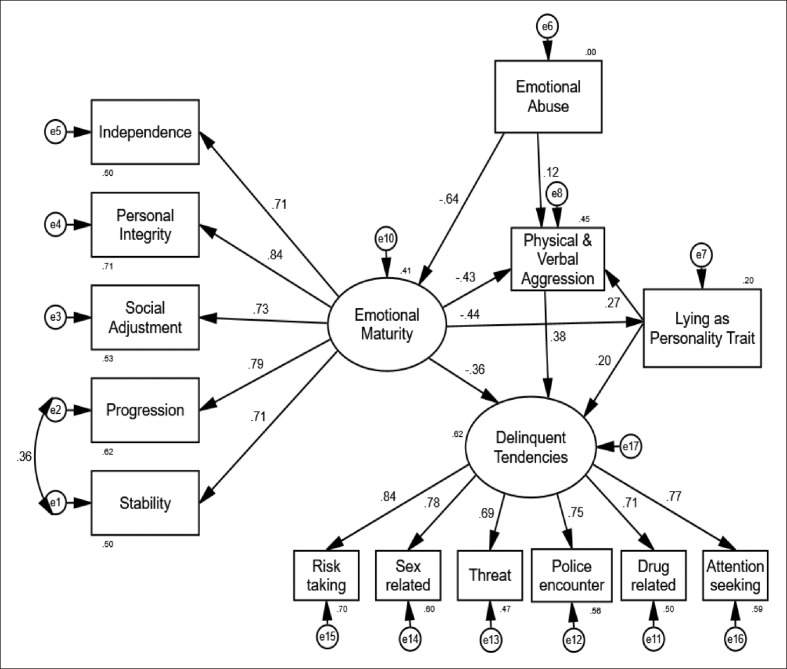
This study aimed to explain the roles of physical and verbal aggression, emotional immaturity, and lying behavior in the predictive relationship between emotional abuse and delinquent tendencies among juveniles and students in Punjab, Pakistan.
Data were collected from 232 juveniles incarcerated in the Borstal Jails of Faisalabad and Bahawalpur. A comparative sample of 276 students from government schools was collected through purposive sampling. The comparative sample was matched for socioeconomic status, gender, location, and age. Translated (Urdu) versions of the standardized scales were used to measure the respective constructs. Path analysis was conducted to determine the mediating effects of lying (as a personality trait), emotional immaturity, and physical-verbal aggression on the relationship between emotional abuse and delinquent tendencies. Multigroup analysis was performed to determine the strength and significance of each path for juveniles and students.
Emotional abuse positively predicted delinquent tendencies and emotional maturity, lying as a personality trait, and physical-verbal aggression mediated this relationship among juveniles and students. A decline in emotional maturity was a stronger predictor of delinquent tendencies among juveniles, whereas physical-verbal aggression played a stronger role for students.
This study demonstrates the indirect effects of emotional abuse on delinquent tendencies. This study also highlights the intense effect of emotional abuse on juvenile delinquents' emotional maturity and supports the importance of utilizing positive methods when dealing with adolescents, especially school personnel and clinical psychologists who interact with adolescents with problematic behaviors.
本研究旨在解释身体攻击、言语攻击、情绪不成熟和说谎行为在巴基斯坦旁遮普省青少年和学生情感虐待与犯罪倾向之间的预测关系中所起的作用。
数据收集自费萨拉巴德和巴哈瓦尔布尔少年犯教养所的232名青少年。通过目的抽样收集了来自政府学校的276名学生的对照样本。对照样本在社会经济地位、性别、地点和年龄方面进行了匹配。使用标准化量表的翻译(乌尔都语)版本来测量各自的构念。进行路径分析以确定说谎(作为一种人格特质)、情绪不成熟和身体 - 言语攻击对情感虐待与犯罪倾向之间关系的中介作用。进行多组分析以确定青少年和学生每条路径的强度和显著性。
情感虐待正向预测犯罪倾向以及情绪成熟度、作为人格特质的说谎行为,身体 - 言语攻击在青少年和学生中调节了这种关系。情绪成熟度下降是青少年犯罪倾向更强的预测因素,而身体 - 言语攻击对学生的作用更强。
本研究证明了情感虐待对犯罪倾向的间接影响。本研究还强调了情感虐待对青少年犯罪者情绪成熟度的强烈影响,并支持在与青少年打交道时,特别是与有问题行为的青少年互动的学校工作人员和临床心理学家,采用积极方法的重要性。