Grover Elise, Allshouse William, Lund Andrea, Liu Yang, Paull Sara, James Katherine, Crooks James, Carlton Elizabeth
Colorado School of Public Health.
Sichuan Center for Disease Control and Prevention.
Res Sq. 2023 Jan 27:rs.3.rs-2511279. doi: 10.21203/rs.3.rs-2511279/v1.
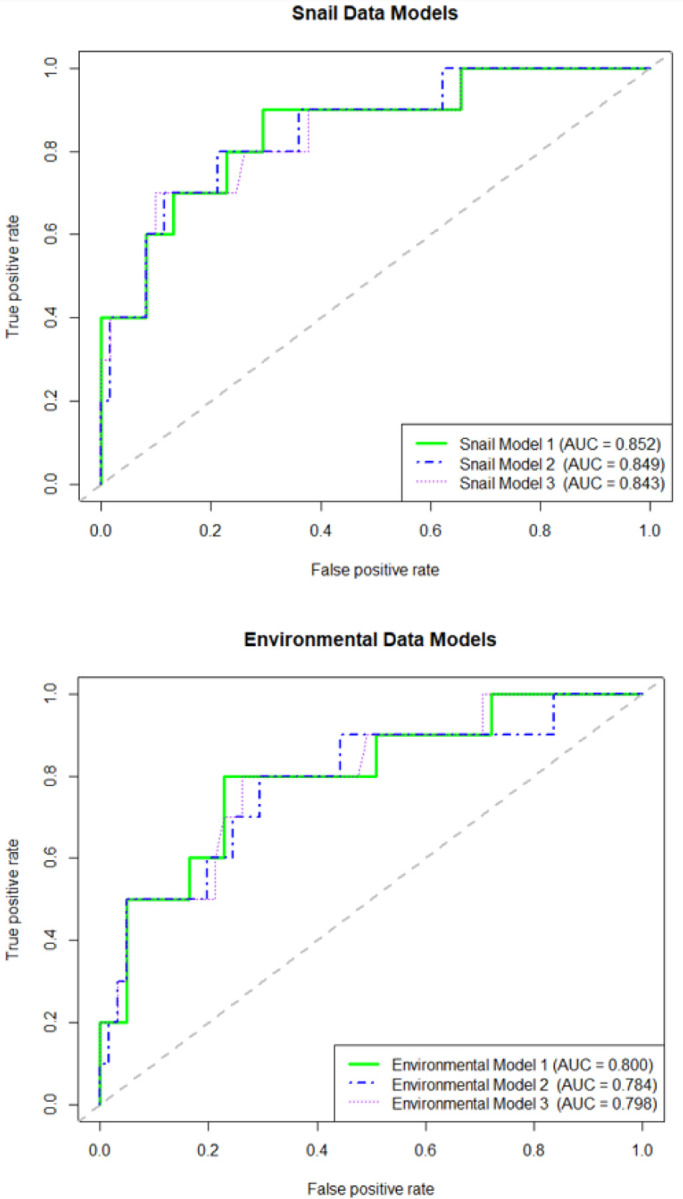
Although the presence of intermediate snails is a necessary condition for local schistosomiasis transmission to occur, using them as surveillance targets in areas approaching elimination is challenging because the patchy and dynamic quality of snail host habitats makes collecting and testing snails labor-intensive. Meanwhile, geospatial analyses that rely on remotely sensed data are becoming popular tools for identifying environmental conditions that contribute to pathogen emergence and persistence. In this study, we assessed whether open-source environmental data can be used to predict the presence of human infections among households with a similar or improved degree of accuracy compared to prediction models developed using data from comprehensive snail surveys. To do this, we used infection data collected from rural communities in Southwestern China in 2016 to develop and compare the predictive performance of two Random Forest machine learning models: one built using snail survey data, and one using open-source environmental data. The environmental data models outperformed the snail data models in predicting household infection with an estimated accuracy and Cohen’s kappa value of 0.89 and 0.49, respectively, in the environmental model, compared to an accuracy and kappa of 0.86 and 0.37 for the snail model. The Normalized Difference in Water Index (NDWI) within half to one kilometer of the home and the distance from the home to the nearest road were among the top performing predictors in our final model. Homes were more likely to have infected residents if they were further from roads, or nearer to waterways. Our results suggest that in low-transmission environments, investing in training geographic information systems professionals to leverage open-source environmental data could yield more accurate identification of pockets of human infection than using snail surveys. Furthermore, the variable importance measures from our models point to aspects of the local environment that may indicate increased risk of schistosomiasis. For example, households were more likely to have infected residents if they were further from roads or were surrounded by more surface water, highlighting areas to target in future surveillance and control efforts.
虽然中间宿主螺的存在是当地血吸虫病传播发生的必要条件,但在接近消除血吸虫病的地区将其作为监测目标具有挑战性,因为螺宿主栖息地的零散性和动态性使得收集和检测螺类的工作强度很大。与此同时,依赖遥感数据的地理空间分析正成为识别有助于病原体出现和持续存在的环境条件的常用工具。在本研究中,我们评估了与使用全面螺类调查数据开发的预测模型相比,开源环境数据是否可用于以相似或更高的准确度预测家庭中的人类感染情况。为此,我们使用了2016年从中国西南部农村社区收集的感染数据,来开发和比较两个随机森林机器学习模型的预测性能:一个模型使用螺类调查数据构建,另一个使用开源环境数据构建。在预测家庭感染方面,环境数据模型优于螺类数据模型,环境模型的估计准确度和科恩kappa值分别为0.89和0.49,而螺类模型的准确度和kappa值分别为0.86和0.37。在我们的最终模型中,房屋周围半公里到一公里范围内的归一化水体指数(NDWI)以及房屋到最近道路的距离是表现最佳的预测因子。如果房屋离道路较远或离水道较近,则其居民感染的可能性更大。我们的结果表明,在低传播环境中,投资培训地理信息系统专业人员以利用开源环境数据,可能比使用螺类调查更准确地识别出人类感染聚集区。此外,我们模型中的变量重要性度量指出了当地环境中可能表明血吸虫病风险增加的方面。例如,如果家庭离道路较远或被更多地表水包围,则其居民感染的可能性更大,这突出了未来监测和控制工作的重点区域。