
新冠病毒病例与 SARS-CoV-2 污水浓度在时间和空间上的动态关系:对模型训练数据集的考虑。
The dynamic relationship between COVID-19 cases and SARS-CoV-2 wastewater concentrations across time and space: Considerations for model training data sets.
机构信息
TUM School of Engineering and Design, Technical University of Munich, Germany.
Civil and Environmental Engineering, University of California, Berkeley, CA, USA.
出版信息
Sci Total Environ. 2023 May 1;871:162069. doi: 10.1016/j.scitotenv.2023.162069. Epub 2023 Feb 7.
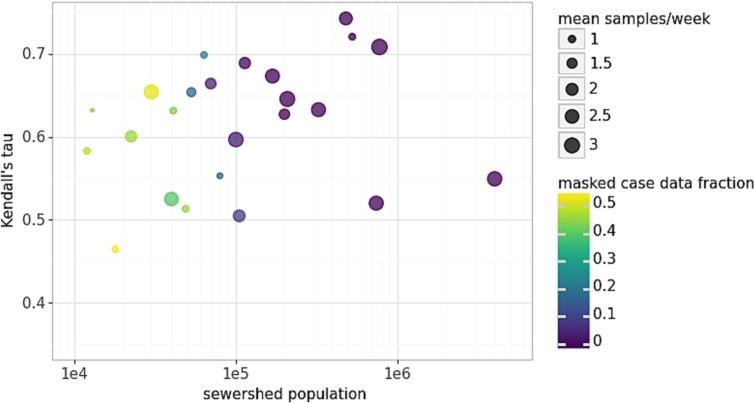
During the COVID-19 pandemic, wastewater-based surveillance has been used alongside diagnostic testing to monitor infection rates. With the decline in cases reported to public health departments due to at-home testing, wastewater data may serve as the primary input for epidemiological models, but training these models is not straightforward. We explored factors affecting noise and bias in the ratio between wastewater and case data collected in 26 sewersheds in California from October 2020 to March 2022. The strength of the relationship between wastewater and case data appeared dependent on sampling frequency and population size, but was not increased by wastewater normalization to flow rate or case count normalization to testing rates. Additionally, the lead and lag times between wastewater and case data varied over time and space, and the ratio of log-transformed individual cases to wastewater concentrations changed over time. This ratio decreased between the Epsilon/Alpha and Delta variant surges of COVID-19 and increased during the Omicron BA.1 variant surge, and was also related to the diagnostic testing rate. Based on this analysis, we present a framework of scenarios describing the dynamics of the case to wastewater ratio to aid in data handling decisions for ongoing modeling efforts.
在 COVID-19 大流行期间,基于废水的监测已与诊断性检测一起用于监测感染率。由于在家中进行的检测,向公共卫生部门报告的病例数量有所下降,废水数据可能成为流行病学模型的主要输入,但训练这些模型并不简单。我们探索了影响 2020 年 10 月至 2022 年 3 月在加利福尼亚州 26 个污水流域收集的废水和病例数据之间的比率的噪声和偏差的因素。废水和病例数据之间关系的强度似乎取决于采样频率和人口规模,但通过将废水归一化为流量或病例计数归一化为检测率并不能增强这种关系。此外,废水和病例数据之间的滞后时间随时间和空间而变化,并且个体病例的对数变换与废水浓度之间的比值随时间而变化。该比值在 COVID-19 的 Epsilon/Alpha 和 Delta 变体激增期间下降,并在 Omicron BA.1 变体激增期间上升,并且还与诊断性检测率有关。基于此分析,我们提出了一个描述病例与废水比值动态的情景框架,以帮助处理正在进行的建模工作中的数据。




 Zotero 插件