Department of Public Health, Environments and Society, London School of Hygiene & Tropical Medicine, London, WC1H 9SH, United Kingdom.
Department of Digital Humanities, King's College London, Strand, London, WC2R 2LS, United Kingdom.
Health Place. 2023 Mar;80:102976. doi: 10.1016/j.healthplace.2023.102976. Epub 2023 Feb 6.
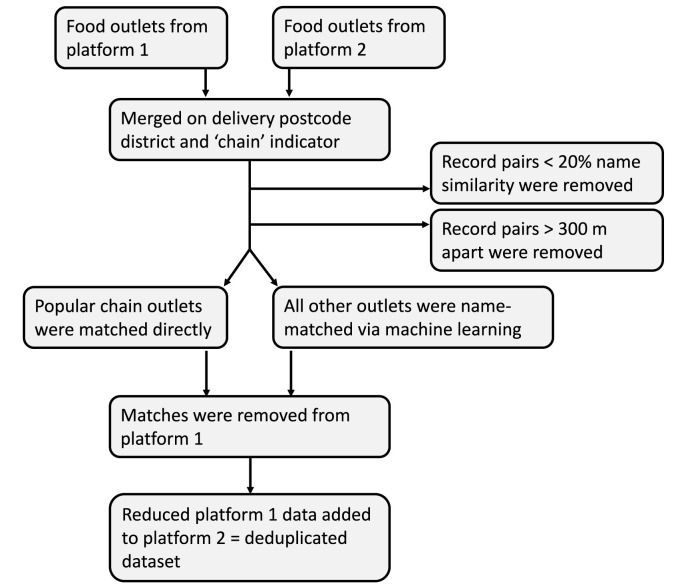
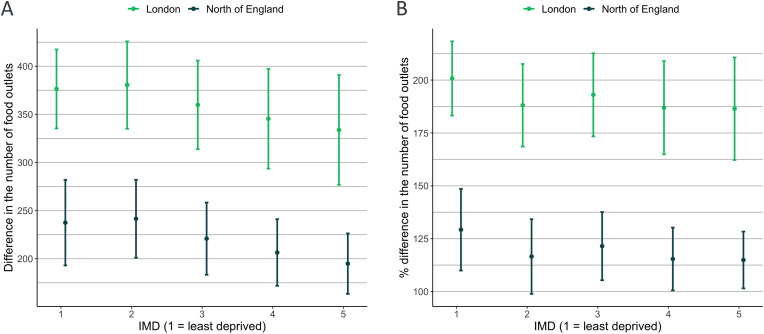
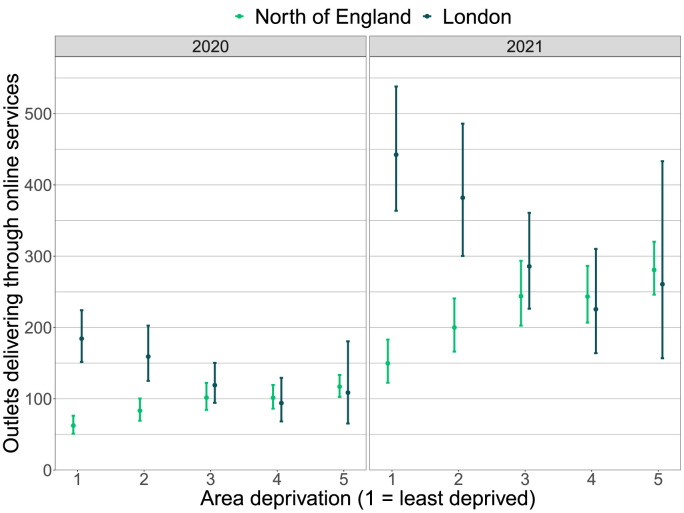
Online food delivery services facilitate access to unhealthy foods and have proliferated during the COVID-19 pandemic. This study explores associations between neighbourhood deprivation and exposure to online food delivery services and changes in exposure by deprivation during the first year of the pandemic. Data on food outlets delivering to 661 postcode districts in London and the North of England in 2020 and 2021 were collected from three online delivery platforms. The association between area deprivation and overall exposure to online food delivery services was moderated by region, with evidence of a positive relationship between count of outlets and deprivation in the North of England, and a negative relationship in London. There was no association between area deprivation and growth of online food delivery services. Associations between neighbourhood deprivation and exposure to the digital food environment vary geographically. Consequently, policies aimed at the digital food environment need to be tailored to the local context.
在线食品配送服务使人们更容易获得不健康食品,并且在 COVID-19 大流行期间迅速普及。本研究探讨了社区贫困程度与在线食品配送服务接触程度之间的关联,以及在大流行的第一年中,贫困程度对接触程度的变化。2020 年和 2021 年,从三个在线配送平台收集了伦敦和英格兰北部 661 个邮政编码区的食品店数据。地区贫困程度与整体在线食品配送服务接触程度之间的关联受到区域的调节,在英格兰北部,网点数量与贫困程度之间存在正相关关系,而在伦敦则呈负相关关系。地区贫困程度与在线食品配送服务的增长之间没有关联。社区贫困程度与数字食品环境暴露程度之间的关联在地理上存在差异。因此,针对数字食品环境的政策需要根据当地情况进行调整。