Bwalya John, Kim Kook-Hyung
Department of Agriculture Biotechnology, College of Agriculture and Life Sciences, Seoul National University, Seoul 08826, Korea.
Plant Genomics and Breeding Institute, Seoul National University, Seoul 08826, Korea.
Plant Pathol J. 2023 Feb;39(1):28-38. doi: 10.5423/PPJ.RW.10.2022.0139. Epub 2023 Feb 1.
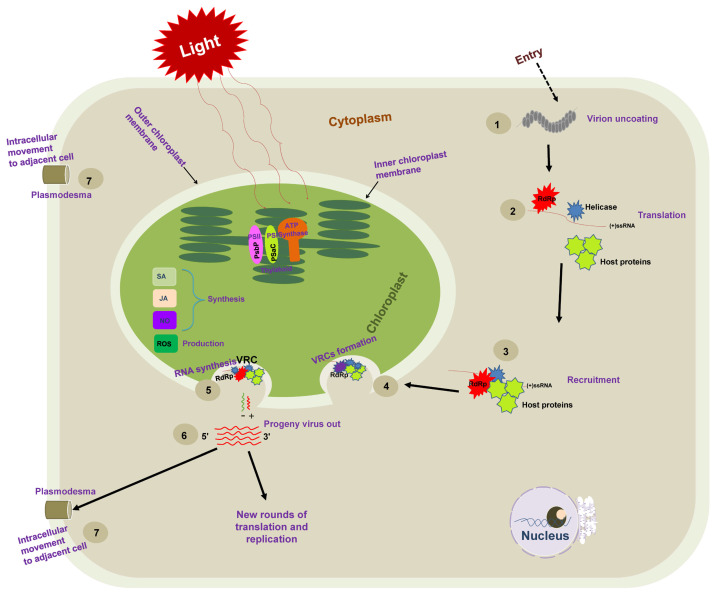
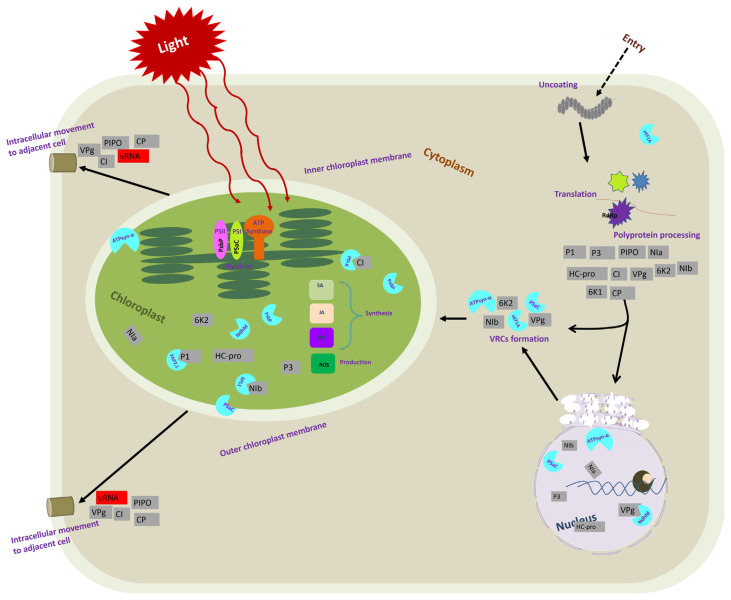
Plant viruses are responsible for worldwide production losses of numerous economically important crops. The most common plant RNA viruses are positivesense single-stranded RNA viruses [(+)ss RNA viruses]. These viruses have small genomes that encode a limited number of proteins. The viruses depend on their host's machinery for the replication of their RNA genome, assembly, movement, and attraction to the vectors for dispersal. Recently researchers have reported that chloroplast proteins are crucial for replicating (+)ss plant RNA viruses. Some chloroplast proteins, including translation initiation factor [eIF(iso)4E] and 75 DEAD-box RNA helicase RH8, help viruses fulfill their infection cycle in plants. In contrast, other chloroplast proteins such as PAP2.1, PSaC, and ATPsyn-α play active roles in plant defense against viruses. This is also consistent with the idea that reactive oxygen species, salicylic acid, jasmonic acid, and abscisic acid are produced in chloroplast. However, knowledge of molecular mechanisms and functions underlying these chloroplast host factors during the virus infection is still scarce and remains largely unknown. Our review briefly summarizes the latest knowledge regarding the possible role of chloroplast in plant virus replication, emphasizing chloroplast-related proteins. We have highlighted current advances regarding chloroplast-related proteins' role in replicating plant (+)ss RNA viruses.
植物病毒导致全球许多经济上重要的作物产量损失。最常见的植物RNA病毒是正链单链RNA病毒[(+)ss RNA病毒]。这些病毒的基因组较小,编码的蛋白质数量有限。病毒依赖宿主的机制来复制其RNA基因组、进行组装、移动以及吸引传播媒介进行传播。最近,研究人员报告说,叶绿体蛋白对于复制(+)ss植物RNA病毒至关重要。一些叶绿体蛋白,包括翻译起始因子[eIF(iso)4E]和75个DEAD盒RNA解旋酶RH8,帮助病毒在植物中完成其感染周期。相反,其他叶绿体蛋白,如PAP2.1、PSaC和ATPsyn-α在植物防御病毒中发挥积极作用。这也与叶绿体中产生活性氧、水杨酸、茉莉酸和脱落酸的观点一致。然而,关于这些叶绿体宿主因子在病毒感染过程中的分子机制和功能的知识仍然很少,在很大程度上仍然未知。我们的综述简要总结了关于叶绿体在植物病毒复制中可能作用的最新知识,重点强调了与叶绿体相关的蛋白质。我们突出了与叶绿体相关的蛋白质在复制植物(+)ss RNA病毒中作用的当前进展。