• 文献检索
  • 文档翻译
  • 深度研究
  • 学术资讯
  • Suppr Zotero 插件Zotero 插件
  • 邀请有礼
  • 套餐&价格
  • 历史记录
应用&插件
Suppr Zotero 插件Zotero 插件浏览器插件Mac 客户端Windows 客户端微信小程序
定价
高级版会员购买积分包购买API积分包
服务
文献检索文档翻译深度研究API 文档MCP 服务
关于我们
关于 Suppr公司介绍联系我们用户协议隐私条款
关注我们

Suppr 超能文献

核心技术专利:CN118964589B侵权必究
粤ICP备2023148730 号-1Suppr @ 2026

文献检索

告别复杂PubMed语法,用中文像聊天一样搜索,搜遍4000万医学文献。AI智能推荐,让科研检索更轻松。

立即免费搜索

文件翻译

保留排版,准确专业,支持PDF/Word/PPT等文件格式,支持 12+语言互译。

免费翻译文档

深度研究

AI帮你快速写综述,25分钟生成高质量综述,智能提取关键信息,辅助科研写作。

立即免费体验

含羞草科属的重新界定,包括对系统发育嵌套的(豆科,苏木亚科,含羞草亚科分支)所有物种的新组合。

Re-circumscription of the mimosoid genus including new combinations for all species of the phylogenetically nested (Leguminosae, Caesalpinioideae, mimosoid clade).

作者信息

O'Donnell Shawn A, Ringelberg Jens J, Lewis Gwilym P

机构信息

Department of Geography and Environmental Sciences, Northumbria University, Newcastle upon Tyne, NE1 8ST, UK Northumbria University Newcastle upon Tyne United Kingdom.

Department of Systematic and Evolutionary Botany, University of Zurich, 8008 Zurich, Switzerland University of Zurich Zurich Switzerland.

出版信息

PhytoKeys. 2022 Aug 22;205:99-145. doi: 10.3897/phytokeys.205.76790. eCollection 2022.

DOI:10.3897/phytokeys.205.76790
PMID:36762010
原文链接:https://pmc.ncbi.nlm.nih.gov/articles/PMC9849012/
Abstract

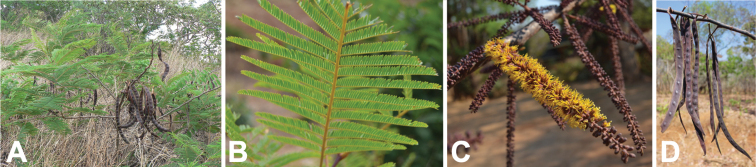
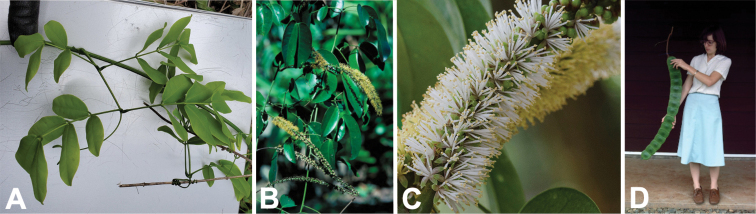
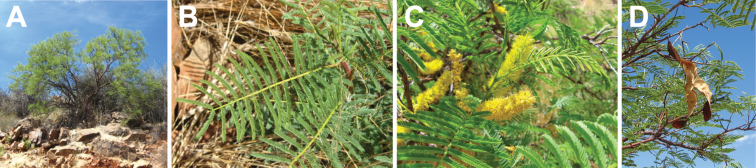
Recent phylogenomic analyses of 997 nuclear genes support the long-held view that the genus is congeneric with . is resolved as monophyletic only if the genus is subsumed within it. The two genera were distinguished solely by relatively minor differences in the mode of dehiscence of the fruits (a craspedium separating into one-seeded endocarp segments in versus a craspedium with the whole fruit valve breaking away from the persistent replum in ) and the craspedial fruit type itself provides a shared synapomorphy for the re-circumscribed . Here, we provide a synopsis of , including 11 new combinations in total, for the eight species, one subspecies and one variety previously placed in , as well as a new combination for a subspecies of Spreng. not previously dealt with when DC. was placed in synonymy. These new combinations are: (Benth.) S.A. O'Donnell & G.P. Lewis, ; (Burch.) S.A. O'Donnell & G.P. Lewis, ; (Harms) S.A. O'Donnell & G.P. Lewis, ; Entadagoetzeisubsp.lata (Brenan & Brummitt) S.A. O'Donnell & G.P. Lewis, ; (Burtt Davy) S.A. O'Donnell & G.P. Lewis, ; (J.H. Ross) S.A. O'Donnell & G.P. Lewis, ; (Harms) S.A. O'Donnell & G.P. Lewis, ; Entadarheedeisubsp.sinohimalensis (Grierson & D.G. Long) S.A. O'Donnell & G.P. Lewis, ; (Dinter) S.A. O'Donnell & G.P. Lewis, ; (E. Phillips) S.A. O'Donnell & G.P. Lewis, ; and Entadawoodiivar.pubescens (E. Phillips) S.A. O'Donnell & G.P. Lewis, We provide a revised circumscription of the genus which now comprises 40 species distributed pantropically, with the greatest diversity of species in tropical Africa. We present a complete taxonomic synopsis, including a map showing the global distribution of the genus and photographs showing variation amongst species in habit, foliage, flowers and fruits. A short discussion about extrafloral nectaries, mainly observed in the Madagascan species, is presented.

摘要

最近对997个核基因进行的系统基因组分析支持了长期以来的观点,即该属与另一属同属。只有当另一属归入该属时,该属才被解析为单系类群。这两个属仅通过果实开裂方式的相对微小差异来区分(一种是在某属中果盖分离成含单粒种子的内果皮节段,而在另一属中是整个果实瓣膜从宿存的胎座框上脱落),并且果盖果实类型本身为重新界定的该属提供了一个共同的共衍征。在此,我们提供了该属的概述,包括总共11个新组合,涉及先前置于另一属中的8个物种、1个亚种和1个变种,以及一个先前在某属被归为异名时未处理的某物种亚种的新组合。这些新组合如下:(原作者及学名)S.A. 奥唐奈和G.P. 刘易斯重新组合后的学名;(原作者及学名)S.A. 奥唐奈和G.P. 刘易斯重新组合后的学名;(原作者及学名)S.A. 奥唐奈和G.P. 刘易斯重新组合后的学名;Entadagoetzeisubsp.lata(原作者及学名)S.A. 奥唐奈和G.P. 刘易斯重新组合后的学名;(原作者及学名)S.A. 奥唐奈和G.P. 刘易斯重新组合后的学名;(原作者及学名)S.A. 奥唐奈和G.P. 刘易斯重新组合后的学名;(原作者及学名)S.A. 奥唐奈和G.P. 刘易斯重新组合后的学名;Entadarheedeisubsp.sinohimalensis(原作者及学名)S.A. 奥唐奈和G.P. 刘易斯重新组合后的学名;(原作者及学名)S.A. 奥唐奈和G.P. 刘易斯重新组合后的学名;(原作者及学名)S.A. 奥唐奈和G.P. 刘易斯重新组合后的学名;以及Entadawoodiivar.pubescens(原作者及学名)S.A. 奥唐奈和G.P. 刘易斯重新组合后的学名。我们提供了该属的修订界定,现在该属包括40个分布于泛热带地区的物种,其中热带非洲的物种多样性最高。我们给出了一个完整的分类概述,包括一幅显示该属全球分布的地图以及展示不同物种在习性、叶子、花朵和果实方面差异的照片。还对主要在马达加斯加物种中观察到的花外蜜腺进行了简短讨论。

https://cdn.ncbi.nlm.nih.gov/pmc/blobs/f6ec/9849012/b1eb7d1fd781/phytokeys-205-099_article-76790__-g024.jpg
https://cdn.ncbi.nlm.nih.gov/pmc/blobs/f6ec/9849012/82a6e32ec837/phytokeys-205-099_article-76790__-g001.jpg
https://cdn.ncbi.nlm.nih.gov/pmc/blobs/f6ec/9849012/971705d36be1/phytokeys-205-099_article-76790__-g002.jpg
https://cdn.ncbi.nlm.nih.gov/pmc/blobs/f6ec/9849012/3e1ff81c780f/phytokeys-205-099_article-76790__-g003.jpg
https://cdn.ncbi.nlm.nih.gov/pmc/blobs/f6ec/9849012/c446beaf814f/phytokeys-205-099_article-76790__-g004.jpg
https://cdn.ncbi.nlm.nih.gov/pmc/blobs/f6ec/9849012/863963f4b195/phytokeys-205-099_article-76790__-g005.jpg
https://cdn.ncbi.nlm.nih.gov/pmc/blobs/f6ec/9849012/3c9a173c4cf1/phytokeys-205-099_article-76790__-g006.jpg
https://cdn.ncbi.nlm.nih.gov/pmc/blobs/f6ec/9849012/793e73e4fc0c/phytokeys-205-099_article-76790__-g007.jpg
https://cdn.ncbi.nlm.nih.gov/pmc/blobs/f6ec/9849012/8e92b334fe87/phytokeys-205-099_article-76790__-g008.jpg
https://cdn.ncbi.nlm.nih.gov/pmc/blobs/f6ec/9849012/b07c65876018/phytokeys-205-099_article-76790__-g009.jpg
https://cdn.ncbi.nlm.nih.gov/pmc/blobs/f6ec/9849012/a9420d92f9e7/phytokeys-205-099_article-76790__-g010.jpg
https://cdn.ncbi.nlm.nih.gov/pmc/blobs/f6ec/9849012/d5c42c48edc4/phytokeys-205-099_article-76790__-g011.jpg
https://cdn.ncbi.nlm.nih.gov/pmc/blobs/f6ec/9849012/6aa37ba0cb4e/phytokeys-205-099_article-76790__-g012.jpg
https://cdn.ncbi.nlm.nih.gov/pmc/blobs/f6ec/9849012/e28c6548d237/phytokeys-205-099_article-76790__-g013.jpg
https://cdn.ncbi.nlm.nih.gov/pmc/blobs/f6ec/9849012/624810a20481/phytokeys-205-099_article-76790__-g014.jpg
https://cdn.ncbi.nlm.nih.gov/pmc/blobs/f6ec/9849012/bed378ba47eb/phytokeys-205-099_article-76790__-g015.jpg
https://cdn.ncbi.nlm.nih.gov/pmc/blobs/f6ec/9849012/188a03f15ba0/phytokeys-205-099_article-76790__-g016.jpg
https://cdn.ncbi.nlm.nih.gov/pmc/blobs/f6ec/9849012/7293ac717b40/phytokeys-205-099_article-76790__-g017.jpg
https://cdn.ncbi.nlm.nih.gov/pmc/blobs/f6ec/9849012/e2ff91670acb/phytokeys-205-099_article-76790__-g018.jpg
https://cdn.ncbi.nlm.nih.gov/pmc/blobs/f6ec/9849012/f85f3d16a584/phytokeys-205-099_article-76790__-g019.jpg
https://cdn.ncbi.nlm.nih.gov/pmc/blobs/f6ec/9849012/ff4656b11cda/phytokeys-205-099_article-76790__-g020.jpg
https://cdn.ncbi.nlm.nih.gov/pmc/blobs/f6ec/9849012/7dd0bb18b95d/phytokeys-205-099_article-76790__-g021.jpg
https://cdn.ncbi.nlm.nih.gov/pmc/blobs/f6ec/9849012/b2edf5fc55d2/phytokeys-205-099_article-76790__-g022.jpg
https://cdn.ncbi.nlm.nih.gov/pmc/blobs/f6ec/9849012/ed816818c442/phytokeys-205-099_article-76790__-g023.jpg
https://cdn.ncbi.nlm.nih.gov/pmc/blobs/f6ec/9849012/b1eb7d1fd781/phytokeys-205-099_article-76790__-g024.jpg
https://cdn.ncbi.nlm.nih.gov/pmc/blobs/f6ec/9849012/82a6e32ec837/phytokeys-205-099_article-76790__-g001.jpg
https://cdn.ncbi.nlm.nih.gov/pmc/blobs/f6ec/9849012/971705d36be1/phytokeys-205-099_article-76790__-g002.jpg
https://cdn.ncbi.nlm.nih.gov/pmc/blobs/f6ec/9849012/3e1ff81c780f/phytokeys-205-099_article-76790__-g003.jpg
https://cdn.ncbi.nlm.nih.gov/pmc/blobs/f6ec/9849012/c446beaf814f/phytokeys-205-099_article-76790__-g004.jpg
https://cdn.ncbi.nlm.nih.gov/pmc/blobs/f6ec/9849012/863963f4b195/phytokeys-205-099_article-76790__-g005.jpg
https://cdn.ncbi.nlm.nih.gov/pmc/blobs/f6ec/9849012/3c9a173c4cf1/phytokeys-205-099_article-76790__-g006.jpg
https://cdn.ncbi.nlm.nih.gov/pmc/blobs/f6ec/9849012/793e73e4fc0c/phytokeys-205-099_article-76790__-g007.jpg
https://cdn.ncbi.nlm.nih.gov/pmc/blobs/f6ec/9849012/8e92b334fe87/phytokeys-205-099_article-76790__-g008.jpg
https://cdn.ncbi.nlm.nih.gov/pmc/blobs/f6ec/9849012/b07c65876018/phytokeys-205-099_article-76790__-g009.jpg
https://cdn.ncbi.nlm.nih.gov/pmc/blobs/f6ec/9849012/a9420d92f9e7/phytokeys-205-099_article-76790__-g010.jpg
https://cdn.ncbi.nlm.nih.gov/pmc/blobs/f6ec/9849012/d5c42c48edc4/phytokeys-205-099_article-76790__-g011.jpg
https://cdn.ncbi.nlm.nih.gov/pmc/blobs/f6ec/9849012/6aa37ba0cb4e/phytokeys-205-099_article-76790__-g012.jpg
https://cdn.ncbi.nlm.nih.gov/pmc/blobs/f6ec/9849012/e28c6548d237/phytokeys-205-099_article-76790__-g013.jpg
https://cdn.ncbi.nlm.nih.gov/pmc/blobs/f6ec/9849012/624810a20481/phytokeys-205-099_article-76790__-g014.jpg
https://cdn.ncbi.nlm.nih.gov/pmc/blobs/f6ec/9849012/bed378ba47eb/phytokeys-205-099_article-76790__-g015.jpg
https://cdn.ncbi.nlm.nih.gov/pmc/blobs/f6ec/9849012/188a03f15ba0/phytokeys-205-099_article-76790__-g016.jpg
https://cdn.ncbi.nlm.nih.gov/pmc/blobs/f6ec/9849012/7293ac717b40/phytokeys-205-099_article-76790__-g017.jpg
https://cdn.ncbi.nlm.nih.gov/pmc/blobs/f6ec/9849012/e2ff91670acb/phytokeys-205-099_article-76790__-g018.jpg
https://cdn.ncbi.nlm.nih.gov/pmc/blobs/f6ec/9849012/f85f3d16a584/phytokeys-205-099_article-76790__-g019.jpg
https://cdn.ncbi.nlm.nih.gov/pmc/blobs/f6ec/9849012/ff4656b11cda/phytokeys-205-099_article-76790__-g020.jpg
https://cdn.ncbi.nlm.nih.gov/pmc/blobs/f6ec/9849012/7dd0bb18b95d/phytokeys-205-099_article-76790__-g021.jpg
https://cdn.ncbi.nlm.nih.gov/pmc/blobs/f6ec/9849012/b2edf5fc55d2/phytokeys-205-099_article-76790__-g022.jpg
https://cdn.ncbi.nlm.nih.gov/pmc/blobs/f6ec/9849012/ed816818c442/phytokeys-205-099_article-76790__-g023.jpg
https://cdn.ncbi.nlm.nih.gov/pmc/blobs/f6ec/9849012/b1eb7d1fd781/phytokeys-205-099_article-76790__-g024.jpg

相似文献

1
Re-circumscription of the mimosoid genus including new combinations for all species of the phylogenetically nested (Leguminosae, Caesalpinioideae, mimosoid clade).含羞草科属的重新界定,包括对系统发育嵌套的(豆科,苏木亚科,含羞草亚科分支)所有物种的新组合。
PhytoKeys. 2022 Aug 22;205:99-145. doi: 10.3897/phytokeys.205.76790. eCollection 2022.
2
Phylogeny and classification of the Australasian and Indomalayan mimosoid legumes and (Leguminosae, subfamily Caesalpinioideae, mimosoid clade).澳大拉西亚和东洋区含羞草亚科豆科植物(豆科,苏木亚科,含羞草分支)的系统发育与分类
PhytoKeys. 2022 Aug 22;205:299-333. doi: 10.3897/phytokeys.205.79381. eCollection 2022.
3
The Luciolinae of S. E. Asia and the Australopacific region: a revisionary checklist (Coleoptera: Lampyridae) including description of three new genera and 13 new species.东南亚及澳大拉西亚-太平洋地区的光萤亚科:一份修订名录(鞘翅目:萤科),包括三个新属及13个新种的描述
Zootaxa. 2019 Oct 18;4687(1):zootaxa.4687.1.1. doi: 10.11646/zootaxa.4687.1.1.
4
Phylogenomic analysis of 997 nuclear genes reveals the need for extensive generic re-delimitation in Caesalpinioideae (Leguminosae).对997个核基因的系统基因组分析表明,苏木亚科(豆科)需要进行广泛的属级重新界定。
PhytoKeys. 2022 Aug 22;205:3-58. doi: 10.3897/phytokeys.205.85866. eCollection 2022.
5
Dilemmas in generic delimitation of and allies (Caesalpinioideae, mimosoid clade): how to reconcile phylogenomic evidence with morphology and taxonomy?云实属及近缘类群(苏木亚科,含羞草类分支)的类属界定困境:如何使系统发育基因组学证据与形态学和分类学相协调?
PhytoKeys. 2022 Aug 22;205:261-278. doi: 10.3897/phytokeys.205.79378. eCollection 2022.
6
Advances in Legume Systematics 14. Classification of Caesalpinioideae. Part 2: Higher-level classification.豆科系统学进展14. 云实亚科的分类。第2部分:高级分类。
PhytoKeys. 2024 Apr 3;240:1-552. doi: 10.3897/phytokeys.240.101716. eCollection 2024.
7
 - a new segregate genus of mimosoid legume (Leguminosae, Caesalpinioideae, mimosoid clade) narrowly endemic to the Balsas Depression in Mexico.- 含羞草亚科豆科(豆科,苏木亚科,含羞草分支)的一个新分离属,仅在墨西哥巴尔萨斯凹陷地区狭域特有。
PhytoKeys. 2022 Aug 22;205:191-201. doi: 10.3897/phytokeys.205.78297. eCollection 2022.
8
Re-establishment of the genus (Leguminosae, Caesalpinioideae, mimosoid clade): the New World species formerly placed in .属(豆科,苏木亚科,含羞草类分支)的重新确立:以前归入的新世界物种。
PhytoKeys. 2022 Aug 22;205:371-400. doi: 10.3897/phytokeys.205.76821. eCollection 2022.
9
Misleading fruits: The non-monophyly of and supports generic re-circumscriptions and a new genus within mimosoid legumes.具误导性的果实:金合欢亚科和含羞草亚科的非单系性支持了分类的重新界定以及含羞草类豆科植物中的一个新属。
PhytoKeys. 2022 Aug 22;205:239-259. doi: 10.3897/phytokeys.205.82275. eCollection 2022.
10
A new generic circumscription of (Leguminosae, Caesalpinioideae, mimosoid clade) with an amphi-Atlantic distribution.一种具有跨大西洋分布的(豆科,苏木亚科,含羞草类分支)新的广义分类。
PhytoKeys. 2022 Aug 22;205:401-437. doi: 10.3897/phytokeys.205.82775. eCollection 2022.

引用本文的文献

1
Advances in Legume Systematics 14. Classification of Caesalpinioideae. Part 2: Higher-level classification.豆科系统学进展14. 云实亚科的分类。第2部分:高级分类。
PhytoKeys. 2024 Apr 3;240:1-552. doi: 10.3897/phytokeys.240.101716. eCollection 2024.
2
Precipitation is the main axis of tropical plant phylogenetic turnover across space and time.降水是热带植物系统发育随时间和空间转换的主要轴。
Sci Adv. 2023 Feb 17;9(7):eade4954. doi: 10.1126/sciadv.ade4954.
3
Phylogenomic analysis of 997 nuclear genes reveals the need for extensive generic re-delimitation in Caesalpinioideae (Leguminosae).

本文引用的文献

1
Phylogenomic analysis of 997 nuclear genes reveals the need for extensive generic re-delimitation in Caesalpinioideae (Leguminosae).对997个核基因的系统基因组分析表明,苏木亚科(豆科)需要进行广泛的属级重新界定。
PhytoKeys. 2022 Aug 22;205:3-58. doi: 10.3897/phytokeys.205.85866. eCollection 2022.
2
Hybrid capture of 964 nuclear genes resolves evolutionary relationships in the mimosoid legumes and reveals the polytomous origins of a large pantropical radiation.964 个核基因的混合捕获解决了含羞草类豆科植物的进化关系,并揭示了一个大型泛热带辐射的多系起源。
Am J Bot. 2020 Dec;107(12):1710-1735. doi: 10.1002/ajb2.1568. Epub 2020 Nov 30.
3
对997个核基因的系统基因组分析表明,苏木亚科(豆科)需要进行广泛的属级重新界定。
PhytoKeys. 2022 Aug 22;205:3-58. doi: 10.3897/phytokeys.205.85866. eCollection 2022.
Quartet-Based Computations of Internode Certainty Provide Robust Measures of Phylogenetic Incongruence.
基于四分体的节点可信度计算为系统发育分歧提供稳健的度量。
Syst Biol. 2020 Mar 1;69(2):308-324. doi: 10.1093/sysbio/syz058.
4
ASTRAL-III: polynomial time species tree reconstruction from partially resolved gene trees.ASTRAL-III:从部分解析的基因树重建多项式时间种系发生树。
BMC Bioinformatics. 2018 May 8;19(Suppl 6):153. doi: 10.1186/s12859-018-2129-y.
5
The remarkable congruence of New and Old World savanna origins.新旧世界稀树草原起源的显著一致性。
New Phytol. 2014 Oct;204(1):4-6. doi: 10.1111/nph.12996.
6
Savanna fire and the origins of the 'underground forests' of Africa.稀树草原火灾与非洲“地下森林”的起源
New Phytol. 2014 Oct;204(1):201-214. doi: 10.1111/nph.12936. Epub 2014 Jul 17.
7
Antidiabetic effect of total saponins from Entada phaseoloides (L.) Merr. in type 2 diabetic rats.含羞草科金合欢总皂苷对 2 型糖尿病大鼠的降血糖作用。
J Ethnopharmacol. 2012 Feb 15;139(3):814-21. doi: 10.1016/j.jep.2011.12.025. Epub 2011 Dec 28.
8
The evolutionary history of Mimosa (Leguminosae): toward a phylogeny of the sensitive plants.含羞草(豆科)的进化历史:走向敏感植物的系统发育。
Am J Bot. 2011 Jul;98(7):1201-21. doi: 10.3732/ajb.1000520.
9
Antiproliferative triterpene saponins from Entada africana.来自非洲榼藤子的抗增殖三萜皂苷
J Nat Prod. 2006 Sep;69(9):1323-9. doi: 10.1021/np060257w.
10
Antibacterial activity of East African medicinal plants.东非药用植物的抗菌活性。
J Ethnopharmacol. 1998 Feb;60(1):79-84. doi: 10.1016/s0378-8741(97)00128-1.