Weigel Angelika, Meinertz Dantoft Thomas, Jørgensen Torben, Carstensen Tina, Löwe Bernd, Weinman John, Frostholm Lisbeth
Department of Psychosomatic Medicine and Psychotherapy, University Medical Center Hamburg-Eppendorf, Hamburg, Germany.
The Research Clinic for Functional Disorders and Psychosomatics, Aarhus University Hospital, Aarhus, Denmark.
Clin Psychol Eur. 2022 Dec 22;4(4):e7739. doi: 10.32872/cpe.7739. eCollection 2022 Dec.
The present study investigated differences in symptom perceptions between individuals with functional disorders (FD), major health conditions, and FDs + major health conditions, respectively, and a group of healthy individuals. Furthermore, it investigated the relevance of FDs among other health-related and psychological correlates of symptom perceptions in the framework of the Common Sense Model of Self-Regulation (CMS).
This cross-sectional study used epidemiological data from the Danish Study of Functional Disorders part two (N = 7,459 participants, 54% female, 51.99 ± 13.4 years). Symptom perceptions were assessed using the Brief Illness Perception Questionnaire (B-IPQ) and compared between the four health condition groups. Multiple regression analyses were performed to examine associations between symptom perceptions, FDs, and other health-related and psychological correlates from the CMS framework.
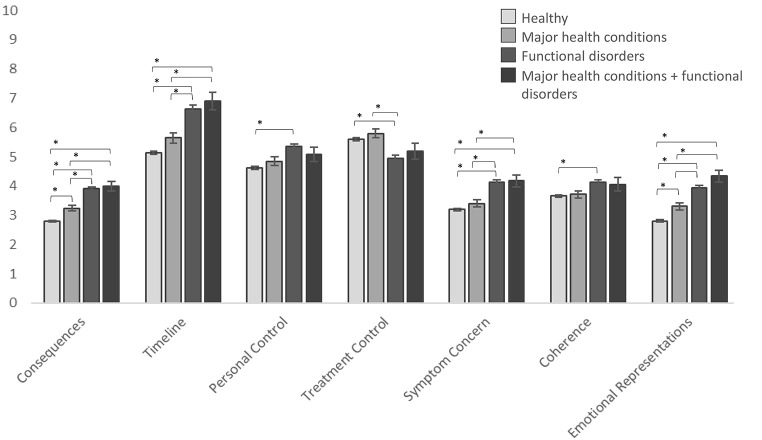
Individuals with FDs (n = 976) and those with FDs + major health conditions (n = 162) reported less favorable symptom perceptions compared to the other two groups, particularly regarding perceived consequences, timeline, and emotional representations (effect size range Cohen's d = 0.12-0.66). The presence of a FD was significantly associated with all B-IPQ items, even in the context of 16 other relevant health-related and psychological correlates from the CMS framework, whereas symptom presence last year or last week was not.
In the general population, symptom perceptions seem to play a more salient role in FD than in individuals with well-defined physical illness. Symptom perceptions should therefore be targeted in both primary and secondary interventions for FDs.
本研究分别调查了功能性障碍(FD)患者、患有主要健康问题的个体、同时患有FD和主要健康问题的个体以及一组健康个体在症状认知方面的差异。此外,在自我调节常识模型(CMS)的框架内,研究了FD在症状认知的其他健康相关和心理相关因素中的相关性。
这项横断面研究使用了丹麦功能性障碍研究第二部分的流行病学数据(N = 7459名参与者,54%为女性,年龄51.99±13.4岁)。使用简短疾病认知问卷(B-IPQ)评估症状认知,并在四个健康状况组之间进行比较。进行多元回归分析,以检验症状认知、FD与CMS框架中其他健康相关和心理相关因素之间的关联。
与其他两组相比,患有FD的个体(n = 976)和患有FD + 主要健康问题的个体(n = 162)报告的症状认知较差,特别是在感知后果、时间线和情绪表征方面(效应大小范围Cohen's d = 0.12 - 0.66)。即使在CMS框架中的其他16个相关健康相关和心理相关因素的背景下,FD的存在也与所有B-IPQ项目显著相关,而去年或上周的症状存在情况则不然。
在一般人群中,症状认知在FD中似乎比在明确的身体疾病个体中发挥更显著的作用。因此,在FD的一级和二级干预中都应针对症状认知。