• 文献检索
  • 文档翻译
  • 深度研究
  • 学术资讯
  • Suppr Zotero 插件Zotero 插件
  • 邀请有礼
  • 套餐&价格
  • 历史记录
应用&插件
Suppr Zotero 插件Zotero 插件浏览器插件Mac 客户端Windows 客户端微信小程序
定价
高级版会员购买积分包购买API积分包
服务
文献检索文档翻译深度研究API 文档MCP 服务
关于我们
关于 Suppr公司介绍联系我们用户协议隐私条款
关注我们

Suppr 超能文献

核心技术专利:CN118964589B侵权必究
粤ICP备2023148730 号-1Suppr @ 2026

文献检索

告别复杂PubMed语法,用中文像聊天一样搜索,搜遍4000万医学文献。AI智能推荐,让科研检索更轻松。

立即免费搜索

文件翻译

保留排版,准确专业,支持PDF/Word/PPT等文件格式,支持 12+语言互译。

免费翻译文档

深度研究

AI帮你快速写综述,25分钟生成高质量综述,智能提取关键信息,辅助科研写作。

立即免费体验

相似文献

1
Development and validation of a brief screener for posttraumatic stress disorder risk in emergency medical settings.在急诊环境中创伤后应激障碍风险的简短筛查器的制定和验证。
Gen Hosp Psychiatry. 2023 Mar-Apr;81:46-50. doi: 10.1016/j.genhosppsych.2023.01.012. Epub 2023 Jan 28.
2
Development and Validation of a Model to Predict Posttraumatic Stress Disorder and Major Depression After a Motor Vehicle Collision.机动车事故后创伤后应激障碍和重性抑郁障碍的预测模型的建立和验证。
JAMA Psychiatry. 2021 Nov 1;78(11):1228-1237. doi: 10.1001/jamapsychiatry.2021.2427.
3
Quantitative forecasting of PTSD from early trauma responses: a Machine Learning application.基于早期创伤反应的创伤后应激障碍定量预测:一项机器学习应用
J Psychiatr Res. 2014 Dec;59:68-76. doi: 10.1016/j.jpsychires.2014.08.017. Epub 2014 Sep 16.
4
A validated predictive algorithm of post-traumatic stress course following emergency department admission after a traumatic stressor.创伤后应激障碍患者在创伤性应激源后入住急诊科后,创伤后应激障碍病程的验证性预测算法。
Nat Med. 2020 Jul;26(7):1084-1088. doi: 10.1038/s41591-020-0951-z. Epub 2020 Jul 6.
5
Development and Validation of a Measure to Assess Patients' Threat Perceptions in the Emergency Department.评估患者在急诊科威胁感知的测量工具的开发和验证。
Acad Emerg Med. 2018 Oct;25(10):1098-1106. doi: 10.1111/acem.13513.
6
Validation of a brief mental health screener for Karen refugees in primary care.基层医疗中针对克伦族难民的简易心理健康筛查工具的验证
Fam Pract. 2016 Feb;33(1):107-11. doi: 10.1093/fampra/cmv093. Epub 2015 Nov 26.
7
Towards accurate screening and prevention for PTSD (2-ASAP): protocol of a longitudinal prospective cohort study.针对 PTSD(2-ASAP)的精准筛查和预防:一项纵向前瞻性队列研究方案。
BMC Psychiatry. 2024 Oct 15;24(1):688. doi: 10.1186/s12888-024-06110-6.
8
Posttraumatic stress disorder symptoms after respiratory and cardiovascular emergencies predict risk of hospital readmission: A prospective cohort study.创伤后应激障碍症状在呼吸和心血管急症后预测医院再入院风险:一项前瞻性队列研究。
Acad Emerg Med. 2022 May;29(5):598-605. doi: 10.1111/acem.14438. Epub 2022 Feb 10.
9
Machine learning prediction of posttraumatic stress disorder trajectories following traumatic injury: Identification and validation in two independent samples.机器学习预测创伤后应激障碍轨迹:两个独立样本的识别和验证。
J Trauma Stress. 2022 Dec;35(6):1656-1671. doi: 10.1002/jts.22868. Epub 2022 Aug 25.
10
Identification of biopSychoSocial factors predictive of post-traUmatic stress disorder in patients admitted to the Emergency department after a trauma (ISSUE): protocol for a multicenter prospective study.识别创伤后入住急诊科患者创伤后应激障碍的生物心理社会预测因素(ISSUE):一项多中心前瞻性研究方案
BMC Psychiatry. 2019 May 30;19(1):163. doi: 10.1186/s12888-019-2154-z.

引用本文的文献

1
Disentangling sex differences in PTSD risk factors.厘清创伤后应激障碍风险因素中的性别差异。
Nat Ment Health. 2024 May;2(5):605-615. doi: 10.1038/s44220-024-00236-y. Epub 2024 Apr 19.

本文引用的文献

1
Early Identification of Post-Traumatic Stress Disorder in Trauma Patients: Development of a Multivariable Risk Prediction Model.创伤患者创伤后应激障碍的早期识别:多变量风险预测模型的建立。
Am Surg. 2023 Nov;89(11):4542-4551. doi: 10.1177/00031348221121549. Epub 2022 Aug 18.
2
The Economic Burden of Posttraumatic Stress Disorder in the United States From a Societal Perspective.从社会视角看美国创伤后应激障碍的经济负担
J Clin Psychiatry. 2022 Apr 25;83(3):21m14116. doi: 10.4088/JCP.21m14116.
3
Nationwide Survey of Trauma Center Screening and Intervention Practices for Posttraumatic Stress Disorder, Firearm Violence, Mental Health, and Substance Use Disorders.全国范围内创伤中心创伤后应激障碍、枪支暴力、心理健康和物质使用障碍筛查和干预措施的调查。
J Am Coll Surg. 2022 Mar 1;234(3):274-287. doi: 10.1097/XCS.0000000000000064.
4
Sex Differences in Peritraumatic Inflammatory Cytokines and Steroid Hormones Contribute to Prospective Risk for Nonremitting Posttraumatic Stress Disorder.创伤周围炎症细胞因子和类固醇激素的性别差异导致创伤后应激障碍持续存在的前瞻性风险。
Chronic Stress (Thousand Oaks). 2021 Sep 23;5:24705470211032208. doi: 10.1177/24705470211032208. eCollection 2021 Jan-Dec.
5
Development and Validation of a Model to Predict Posttraumatic Stress Disorder and Major Depression After a Motor Vehicle Collision.机动车事故后创伤后应激障碍和重性抑郁障碍的预测模型的建立和验证。
JAMA Psychiatry. 2021 Nov 1;78(11):1228-1237. doi: 10.1001/jamapsychiatry.2021.2427.
6
Transcriptome-wide association study of post-trauma symptom trajectories identified GRIN3B as a potential biomarker for PTSD development.创伤后症状轨迹的转录组全基因组关联研究将 GRIN3B 鉴定为 PTSD 发展的潜在生物标志物。
Neuropsychopharmacology. 2021 Sep;46(10):1811-1820. doi: 10.1038/s41386-021-01073-8. Epub 2021 Jun 29.
7
Forecasting individual risk for long-term Posttraumatic Stress Disorder in emergency medical settings using biomedical data: A machine learning multicenter cohort study.利用生物医学数据预测急诊医疗环境中创伤后应激障碍的个体长期风险:一项机器学习多中心队列研究。
Neurobiol Stress. 2021 Jan 18;14:100297. doi: 10.1016/j.ynstr.2021.100297. eCollection 2021 May.
8
A validated predictive algorithm of post-traumatic stress course following emergency department admission after a traumatic stressor.创伤后应激障碍患者在创伤性应激源后入住急诊科后,创伤后应激障碍病程的验证性预测算法。
Nat Med. 2020 Jul;26(7):1084-1088. doi: 10.1038/s41591-020-0951-z. Epub 2020 Jul 6.
9
Investigation of optimal dose of early intervention to prevent posttraumatic stress disorder: A multiarm randomized trial of one and three sessions of modified prolonged exposure.早期干预预防创伤后应激障碍的最佳剂量研究:改良延长暴露法一次和三次治疗的多臂随机试验。
Depress Anxiety. 2020 May;37(5):429-437. doi: 10.1002/da.23015. Epub 2020 Apr 5.
10
Evaluating a screener to quantify PTSD risk using emergency care information: a proof of concept study.利用急诊信息评估 PTSD 风险筛查器:概念验证研究。
BMC Emerg Med. 2020 Mar 2;20(1):16. doi: 10.1186/s12873-020-00308-z.

在急诊环境中创伤后应激障碍风险的简短筛查器的制定和验证。

Development and validation of a brief screener for posttraumatic stress disorder risk in emergency medical settings.

机构信息

Department of Psychiatry, NYU Grossman School of Medicine, New York, USA; Department of Population Health, NYU Grossman School of Medicine, New York, USA.

Department of Psychiatry and Behavioral Sciences, Emory University School of Medicine, Atlanta, GA, USA; Center for Visual and Neurocognitive Rehabilitation, Atlanta Veterans' Affairs Health Care System, Atlanta, GA, USA.

出版信息

Gen Hosp Psychiatry. 2023 Mar-Apr;81:46-50. doi: 10.1016/j.genhosppsych.2023.01.012. Epub 2023 Jan 28.

DOI:10.1016/j.genhosppsych.2023.01.012
PMID:36764261
原文链接:https://pmc.ncbi.nlm.nih.gov/articles/PMC10866012/
Abstract

OBJECTIVE

Predicting risk of posttraumatic stress disorder (PTSD) in the acute care setting is challenging given the pace and acute care demands in the emergency department (ED) and the infeasibility of using time-consuming assessments. Currently, no accurate brief screening for long-term PTSD risk is routinely used in the ED. One instrument widely used in the ED is the 27-item Immediate Stress Reaction Checklist (ISRC). The aim of this study was to develop a short screener using a machine learning approach and to investigate whether accurate PTSD prediction in the ED can be achieved with substantially fewer items than the IRSC.

METHOD

This prospective longitudinal cohort study examined the development and validation of a brief screening instrument in two independent samples, a model development sample (N = 253) and an external validation sample (N = 93). We used a feature selection algorithm to identify a minimal subset of features of the ISRC and tested this subset in a predictive model to investigate if we can accurately predict long-term PTSD outcomes.

RESULTS

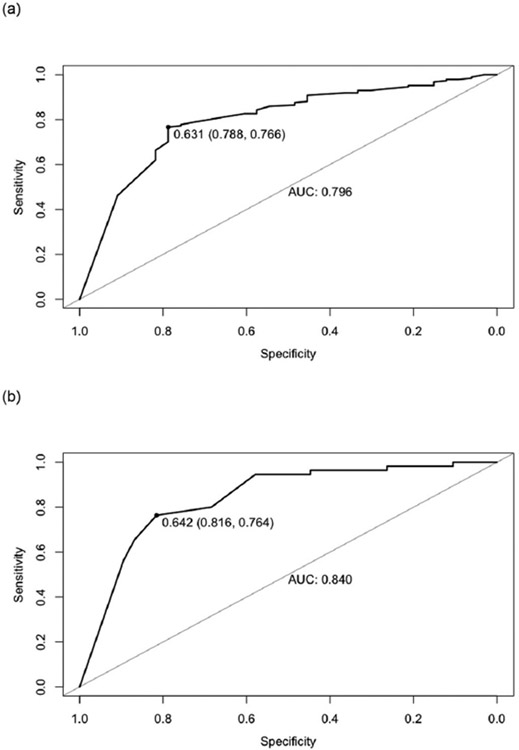
We were able to identify a reduced subset of 5 highly predictive features of the ISRC in the model development sample (AUC = 0.80), and we were able to validate those findings in the external validation sample (AUC = 0.84) to discriminate non-remitting vs. resilient trajectories.

CONCLUSION

This study developed and validated a brief 5-item screener in the ED setting, which may help to improve the diagnostic process of PTSD in the acute care setting and help ED clinicians plan follow-up care when patients are still in contact with the healthcare system. This could reduce the burden on patients and decrease the risk of chronic PTSD.

摘要

目的

鉴于急诊科(ED)的节奏和急性护理需求,以及使用耗时的评估方法不切实际,预测创伤后应激障碍(PTSD)的风险具有挑战性。目前,ED 中没有常规使用用于长期 PTSD 风险的准确简短筛查。ED 中广泛使用的一种工具是 27 项即时应激反应检查表(ISRC)。本研究旨在开发一种使用机器学习方法的简短筛查工具,并探讨是否可以使用比 ISRC 少得多的项目来实现 ED 中准确的 PTSD 预测。

方法

这项前瞻性纵向队列研究在两个独立样本中检验了一种简短筛查工具的开发和验证,一个是模型开发样本(N=253),另一个是外部验证样本(N=93)。我们使用特征选择算法来识别 ISRC 的最小特征子集,并在预测模型中测试该子集,以调查我们是否可以准确预测长期 PTSD 结局。

结果

我们能够在模型开发样本中确定 ISRC 的 5 个高度预测特征的减少子集(AUC=0.80),并能够在外部验证样本中验证这些发现(AUC=0.84),以区分非缓解与有弹性轨迹。

结论

本研究在 ED 环境中开发并验证了一种简短的 5 项筛查工具,这可能有助于改善急性护理环境中 PTSD 的诊断过程,并帮助 ED 临床医生在患者仍与医疗保健系统接触时计划后续护理。这可以减轻患者的负担,降低慢性 PTSD 的风险。
https://cdn.ncbi.nlm.nih.gov/pmc/blobs/29d3/10866012/3956563654dc/nihms-1963218-f0001.jpg