Tu Xiao, Li Chuncheng, Sun Wen, Tian Xi, Li Qiufu, Wang Shaoxin, Ding Xiaoling, Huang Zhen
Key Laboratory of Bio-Resource and Eco-Environment of Ministry of Education, College of Life Science, Sichuan University, Chengdu 610000, China.
State Key Laboratory of Southwestern Chinese Medicine Resources, Chengdu University of Traditional Chinese Medicine, Chengdu 610000, China.
Cancers (Basel). 2023 Feb 1;15(3):930. doi: 10.3390/cancers15030930.
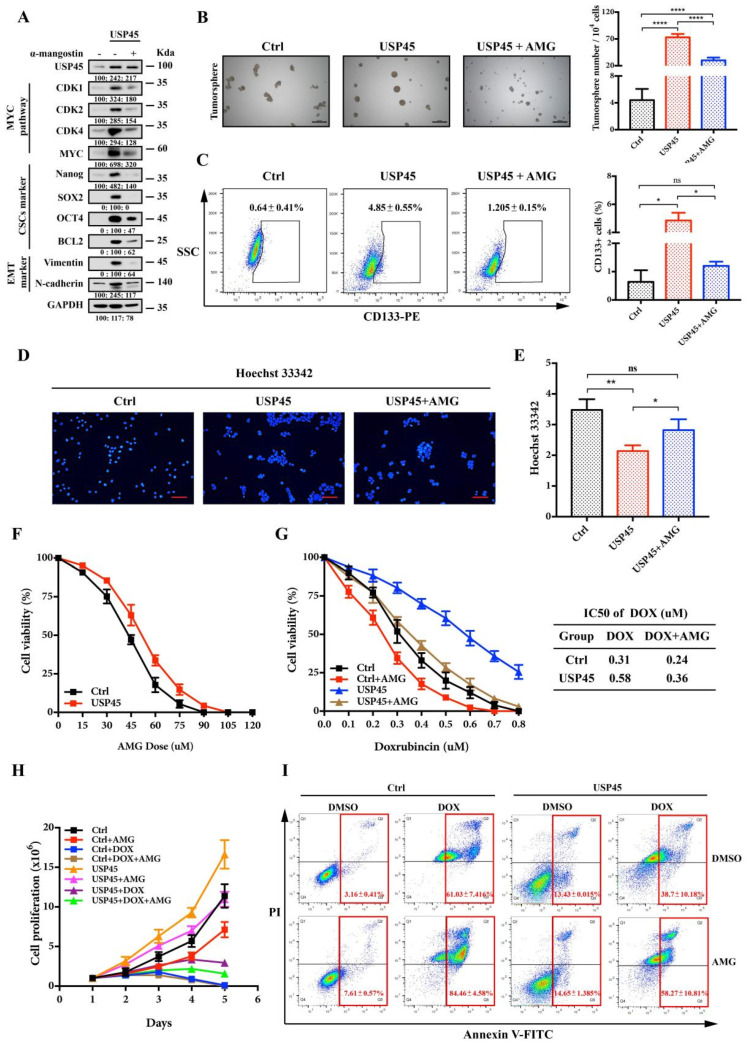
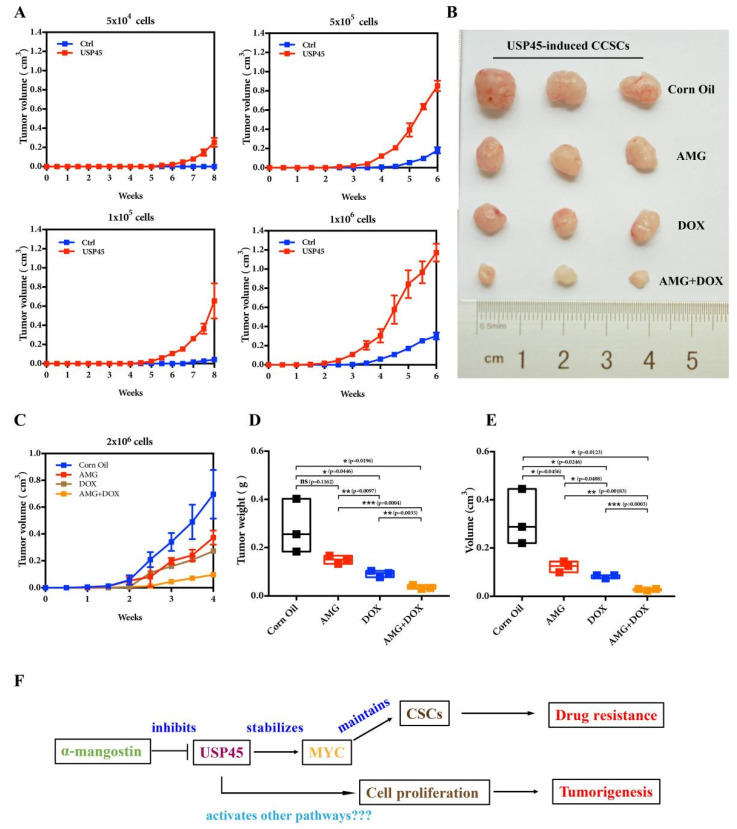
Cancer stem cells (CSCs) play significant roles in cancer development, drug resistance and cancer recurrence. In cancer treatments based on the CSC characteristics and inducing factors, MYC is a promising target for therapeutic molecules. Although it has been regarded as an undrugable target, its stability tightly regulated by the ubiquitin-proteasome system offers a new direction for molecule targeting and cancer treatment. Herein we report our discoveries in this research area, and we have found that deubiquitinase USP45 can directly bind with MYC, resulting in its deubiquitination and stabilization. Further, USP45 overexpressing can upregulate MYC, and this overexpressing can significantly enhance cancer development, cancer cell stemness and drug resistance. Interestingly, without enhancing cancer development, MYC silencing with shRNA can only suppress USP45-induced stemness and drug resistance. Moreover, we have identified that USP45 can be specifically bound and inhibited by a natural small molecule (α-mangostin), in turn significantly suppressing USP45-induced stemness and drug resistance. Since USP45 is significantly expressed in cervical tumors, we have discovered that the combination of α-mangostin and doxorubicin can significantly inhibit USP45-induced cervical tumorigenesis in an animal model. In general, on the basis of our USP45 discoveries on its MYC deubiquitination and α-mangostin inhibition, suppressing USP45 has opened a new window for suppressing cancer development, stemness and drug resistance.
癌症干细胞(CSCs)在癌症发展、耐药性和癌症复发中发挥着重要作用。在基于CSC特性和诱导因素的癌症治疗中,MYC是治疗分子的一个有前景的靶点。尽管它一直被认为是一个不可成药的靶点,但其稳定性受到泛素-蛋白酶体系统的严格调控,这为分子靶向和癌症治疗提供了一个新方向。在此,我们报告我们在该研究领域的发现,我们发现去泛素化酶USP45可以直接与MYC结合,导致其去泛素化和稳定化。此外,USP45过表达可以上调MYC,这种过表达可以显著促进癌症发展、癌细胞干性和耐药性。有趣的是,在不促进癌症发展的情况下,用shRNA沉默MYC只能抑制USP45诱导的干性和耐药性。此外,我们已经确定USP45可以被一种天然小分子(α-山竹素)特异性结合并抑制,进而显著抑制USP45诱导的干性和耐药性。由于USP45在宫颈肿瘤中显著表达,我们发现在动物模型中,α-山竹素和阿霉素联合使用可以显著抑制USP45诱导的宫颈肿瘤发生。总的来说,基于我们对USP45在MYC去泛素化和α-山竹素抑制方面的发现,抑制USP45为抑制癌症发展、干性和耐药性打开了一扇新窗口。