Healthy Working Lives Research Group, School of Public Health and Preventive Medicine, Monash University, Melbourne, VIC 3004, Australia.
Psychology and Counselling, Faculty of Health, Queensland University of Technology, Brisbane, QLD 4059, Australia.
Int J Environ Res Public Health. 2023 Feb 3;20(3):2732. doi: 10.3390/ijerph20032732.
Fatigued driving is one of the leading factors contributing to road crashes in the trucking industry. The nature of trucking, prolonged working time, and irregular sleep patterns can negatively impact drivers' health and wellbeing. However, there is limited research in Australia investigating the impact of demographic, occupational, or lifestyle factors on fatigue among truck drivers.
This cross-sectional study examines the role of demographic, occupational, lifestyle, and other health risk factors associated with fatigue among Australian truck drivers.
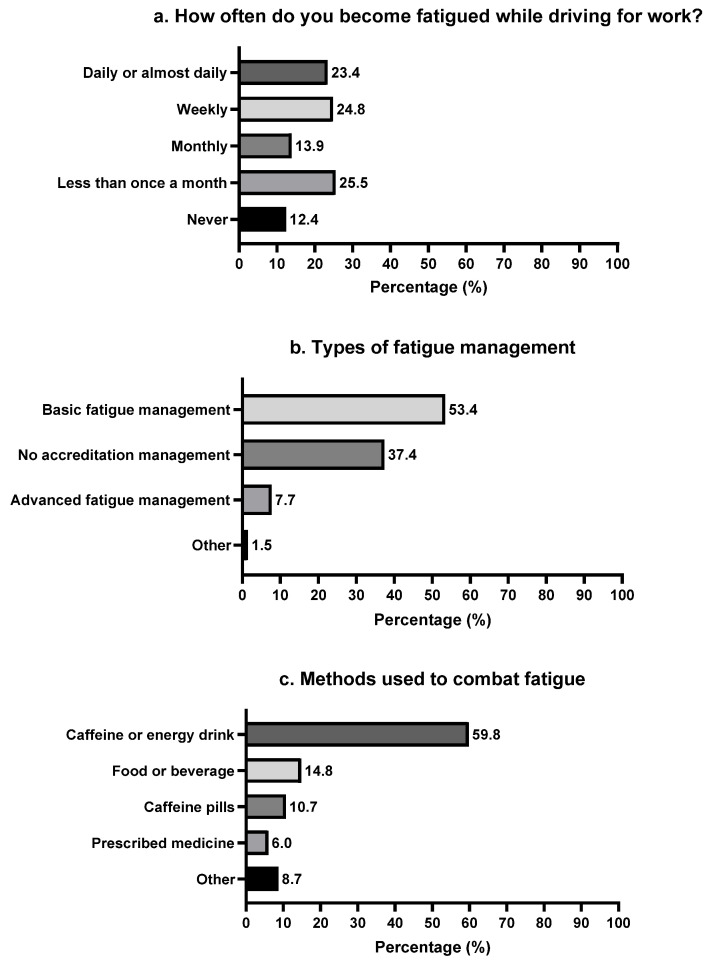
This study was part of a larger study that used a short online survey with a follow-up telephone survey to capture in-depth information on a wide range of determinants related to truck drivers' physical and mental health outcomes. Fatigue was measured by three questions, including the frequency of fatigue, fatigue management training, and strategies used to combat fatigue. Multivariate regression analysis was used to determine the specific impact of demographics, occupational factors, lifestyle factors, and other health risk factors on fatigue.
In total, 332 drivers completed both the online and telephone surveys; 97% were male, representing drivers from broad age groups and professional experience. The odds of being in the high-risk fatigue group were nearly three times higher in drivers who worked 40-60 h compared to those who worked < 40 h. Poor sleep increased the odds of high-risk fatigue by seventimes (95% CI: 2.26-21.67, = 0.001). Drivers who reported experiencing loneliness also had double the odds of being at high risk of fatigued driving.
The increased risk of fatigue in truck drivers is associated with prolonged working hours, poor sleep, and social aspects such as loneliness. Further interventions seeking to reduce driver fatigue should consider the impact of work schedules, the availability of quality sleeping spaces, and the level of social connections.
疲劳驾驶是导致卡车运输行业道路事故的主要因素之一。卡车运输的性质、工作时间延长和不规律的睡眠模式会对驾驶员的健康和福祉产生负面影响。然而,澳大利亚对人口统计学、职业和生活方式因素对卡车司机疲劳的影响的研究有限。
本横断面研究调查了人口统计学、职业、生活方式和其他健康风险因素与澳大利亚卡车司机疲劳的关系。
本研究是一项更大研究的一部分,该研究使用简短的在线调查和后续电话调查,以获取与卡车司机身心健康结果相关的广泛决定因素的详细信息。疲劳通过三个问题来衡量,包括疲劳频率、疲劳管理培训以及用于对抗疲劳的策略。使用多元回归分析来确定人口统计学、职业因素、生活方式因素和其他健康风险因素对疲劳的具体影响。
共有 332 名司机完成了在线和电话调查;97%为男性,代表了来自广泛年龄组和专业经验的司机。与工作<40 小时的司机相比,工作 40-60 小时的司机处于高风险疲劳组的几率几乎高出三倍。睡眠质量差使高风险疲劳的几率增加了七倍(95%CI:2.26-21.67, = 0.001)。报告感到孤独的司机疲劳驾驶的高风险几率也增加了一倍。
卡车司机疲劳风险增加与工作时间延长、睡眠质量差以及孤独等社会因素有关。进一步旨在减少驾驶员疲劳的干预措施应考虑工作时间表的影响、高质量睡眠空间的可用性以及社会联系的水平。