Capozzi Antonella, Manganelli Valeria, Riitano Gloria, Caissutti Daniela, Longo Agostina, Garofalo Tina, Sorice Maurizio, Misasi Roberta
Department of Experimental Medicine, "Sapienza" University of Rome, 00161 Rome, Italy.
J Clin Med. 2023 Jan 23;12(3):891. doi: 10.3390/jcm12030891.
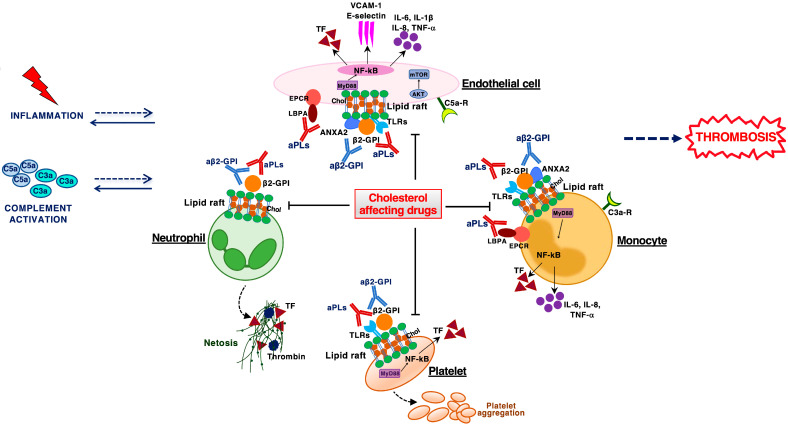
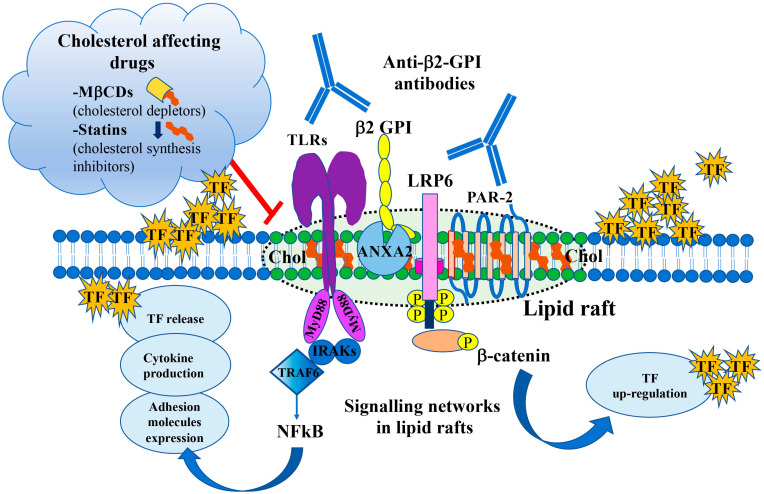
The pathological features of antiphospholipid syndrome (APS) are related to the activity of circulating antiphospholipid antibodies (aPLs) associated with vascular thrombosis and obstetric complications. Indeed, aPLs are not only disease markers, but also play a determining pathogenetic role in APS and exert their effects through the activation of cells and coagulation factors and inflammatory mediators for the materialization of the thromboinflammatory pathogenetic mechanism. Cellular activation in APS necessarily involves the interaction of aPLs with target receptors on the cell membrane, capable of triggering the signal transduction pathway(s). This interaction occurs at specific microdomains of the cell plasma membrane called lipid rafts. In this review, we focus on the key role of lipid rafts as signaling platforms in the pathogenesis of APS, and propose this pathogenetic step as a strategic target of new therapies in order to improve classical anti-thrombotic approaches with "new" immunomodulatory drugs.
抗磷脂综合征(APS)的病理特征与循环抗磷脂抗体(aPLs)的活性有关,这些抗体与血管血栓形成和产科并发症相关。事实上,aPLs不仅是疾病标志物,而且在APS中发挥决定性的致病作用,并通过激活细胞、凝血因子和炎症介质来发挥其作用,以实现血栓炎症致病机制。APS中的细胞激活必然涉及aPLs与细胞膜上靶受体的相互作用,从而能够触发信号转导途径。这种相互作用发生在细胞质膜的特定微结构域,即脂筏。在本综述中,我们重点关注脂筏作为APS发病机制中信号平台的关键作用,并提出这一致病步骤作为新疗法的战略靶点,以便用“新型”免疫调节药物改进经典的抗血栓方法。