Ferreira-Souza Luiz Felipe, Julianelli-Peçanha Marize, Coelho-Oliveira Ana Carolina, da Silva Bahia Christianne Martins Corrêa, Paineiras-Domingos Laisa Liane, Reis-Silva Aline, Moura-Fernandes Márcia Cristina, Trindade-Gusmão Luiza Carla, Taiar Redha, da Cunha Sá-Caputo Danubia, Rapin Amandine, Bernardo-Filho Mario
Laboratório de Vibrações Mecânicas e Práticas Integrativas-LAVIMPI, Departamento de Biofísica e Biometria, Instituto de Biologia Roberto Alcântara Gomes and Policlínica Piquet Carneiro, Universidade do Estado do Rio de Janeiro, Rio de Janeiro 20950-003, RJ, Brazil.
Programa de Pós-Graduação em Saúde, Medicina Laboratorial e Tecnologia Forense, Universidade do Estado do Rio de Janeiro, Rio de Janeiro 20950-003, RJ, Brazil.
J Clin Med. 2023 Feb 2;12(3):1182. doi: 10.3390/jcm12031182.
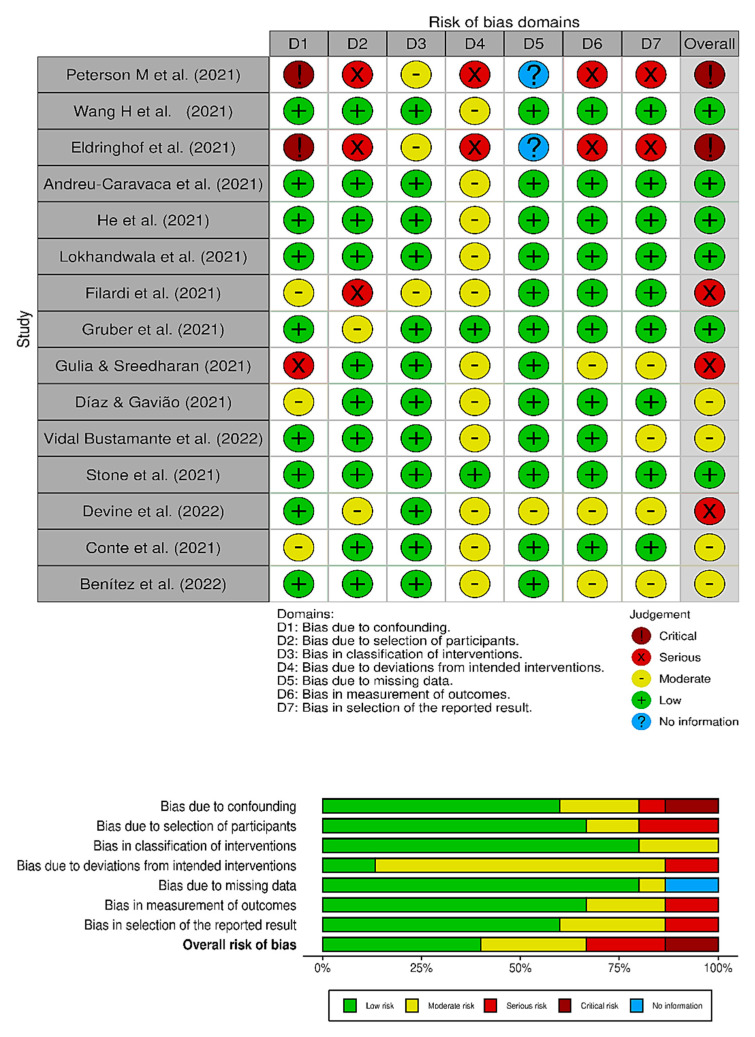
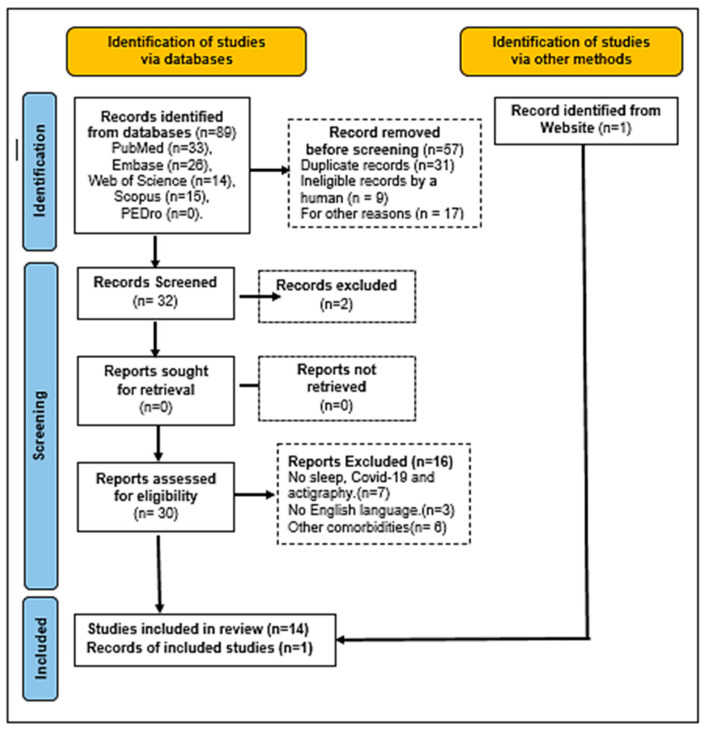
COVID-19 has probably contributed as a risk factor for sleep disturbance. Actigraphy has been used to evaluate sleep complaints in self-isolated populations and frontline doctors during the COVID-19 pandemic. This systematic review aims to summarize the impact of the COVID-19 pandemic on sleep through wrist actigraphy, estimating sleep latency, total sleep time, awakening-after-sleep onset, and sleep efficiency. Searches were conducted of observational studies on the PubMed, Embase, Scopus, Web of Science, and PEDro databases from 1 December 2019 to 31 December 2022. Ninety articles were found, and given the eligibility criteria, fifteen were selected. Six studies were classified by the National Health and Medical Research Council as evidence level IV, two studies as level III-3, and seven studies as level III-2. According to the ACROBAT-NRSI instrument, three studies were classified as having a "serious" risk of bias, two as having "critical" risk, four as having "moderate" risk, and six as having "low" risk. In the selected publications, various populations were evaluated via actigraphy during the COVID-19 pandemic, with reports of "poor" sleep quality. Actigraphy may be a relevant tool to assess individual day-night rhythms and provide recommendations under enduring pandemic conditions. Moreover, as actigraphy presents objective data for sleep evaluations, it is suggested that this method be used in similar pandemics and that actigraphy be included as part of the sleep hygiene strategy.
2019冠状病毒病可能是导致睡眠障碍的一个风险因素。在2019冠状病毒病大流行期间,活动记录仪已被用于评估自我隔离人群和一线医生的睡眠问题。本系统评价旨在通过手腕活动记录仪总结2019冠状病毒病大流行对睡眠的影响,评估睡眠潜伏期、总睡眠时间、睡眠后觉醒时间和睡眠效率。检索了2019年12月1日至2022年12月31日期间在PubMed、Embase、Scopus、Web of Science和PEDro数据库上发表的观察性研究。共找到90篇文章,根据纳入标准,筛选出15篇。六项研究被澳大利亚国家卫生与医学研究委员会列为证据等级IV,两项研究列为III-3级,七项研究列为III-2级。根据ACROBAT-NRSI工具,三项研究被归类为存在“严重”偏倚风险,两项研究为“关键”风险,四项研究为“中度”风险,六项研究为“低”风险。在所选出版物中,在2019冠状病毒病大流行期间通过活动记录仪对不同人群进行了评估,报告显示睡眠质量“较差”。活动记录仪可能是评估个体昼夜节律并在持续的大流行条件下提供建议的相关工具。此外,由于活动记录仪为睡眠评估提供客观数据,建议在类似的大流行中使用这种方法,并将活动记录仪纳入睡眠卫生策略的一部分。