Delgado Lilian Pérez, Franco-Bacca Adriana Paola, Cervantes-Alvarez Fernando, Ortiz-Vazquez Elizabeth, Ramon-Sierra Jesús Manuel, Rejon Victor, Aguirre-Macedo María Leopoldina, Alvarado-Gil Juan José, Rodríguez-Gattorno Geonel
Merida Unit, Functional Materials Laboratory, Applied Physics Department, Center for Research and Advanced Studies (CINVESTAV), Merida C.P. 97310, Mexico.
Merida Unit, Laboratory of Applied and Molecular Microbiology, National Technological Institute of Mexico, Merida C.P. 97118, Mexico.
Nanomaterials (Basel). 2023 Jan 23;13(3):463. doi: 10.3390/nano13030463.
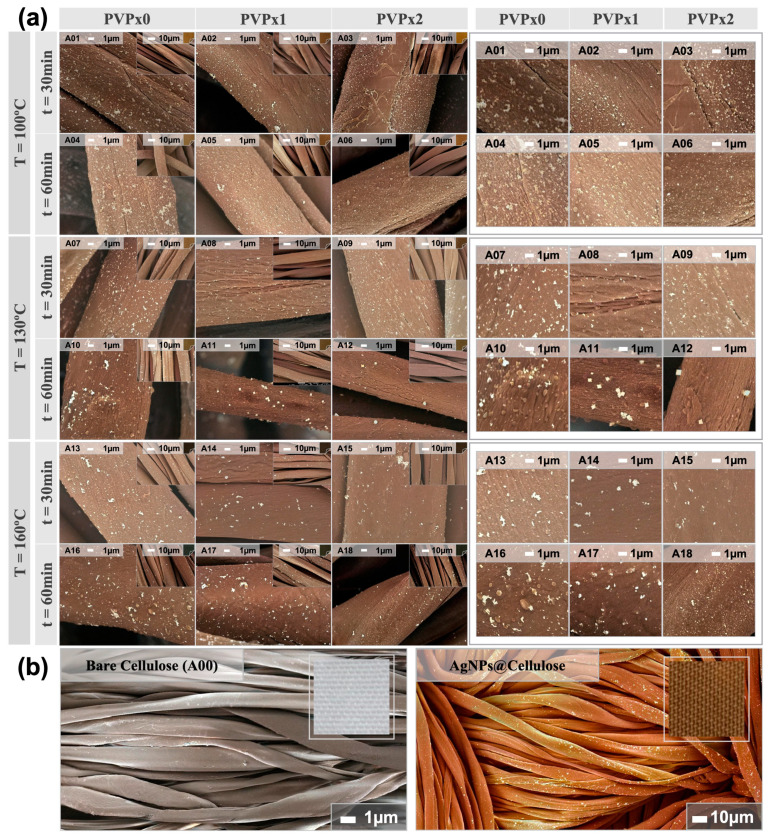
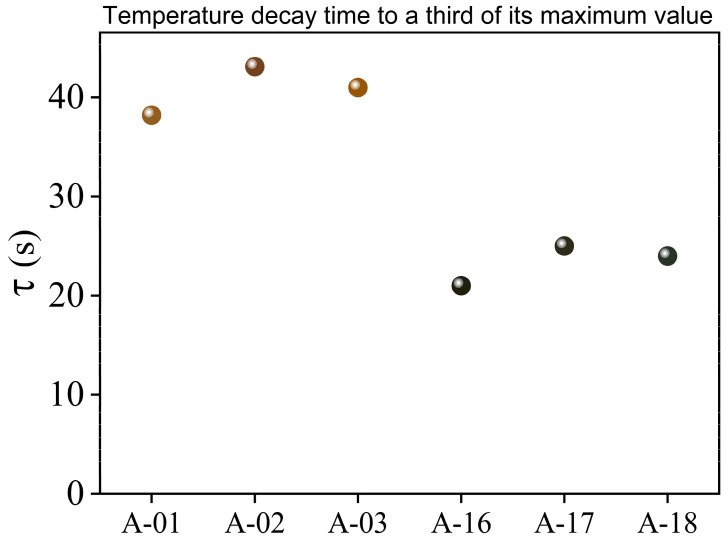
Through the execution of scientific innovations, "smart materials" are shaping the future of technology by interacting and responding to changes in our environment. To make this a successful reality, proper component selection, synthesis procedures, and functional active agents must converge in practical and resource-efficient procedures to lay the foundations for a profitable and sustainable industry. Here we show how the reaction time, temperature, and surface stabilizer concentration impact the most promising functional properties in a cotton-based fabric coated with silver nanoparticles (AgNPs@cotton), i.e., the thermal and bactericidal response. The coating quality was characterized and linked to the selected synthesis parameters and correlated by a parallel description of "proof of concept" experiments for the differential heat transfer (conversion and dissipation properties) and the bactericidal response tested against reference bacteria and natural bacterial populations (from a beach, cenote, and swamp of the Yucatan Peninsula). The quantification of functional responses allowed us to establish the relationship between (i) the size and shape of the AgNPs, (ii) the collective response of their agglomerates, and (iii) the thermal barrier role of a surface modifier as PVP. The procedures and evaluations in this work enable a spectrum of synthesis coordinates that facilitate the formulation of application-modulated fabrics, with grounded examples reflected in "smart packaging", "smart clothing", and "smart dressing".
通过科学创新的实施,“智能材料”正在通过与我们环境中的变化相互作用并做出响应来塑造技术的未来。为了使这成为成功的现实,合适的组件选择、合成程序和功能活性剂必须在实际且资源高效的程序中汇聚,为盈利且可持续的产业奠定基础。在此,我们展示了反应时间、温度和表面稳定剂浓度如何影响涂有银纳米颗粒的棉织物(AgNPs@棉)中最具前景的功能特性,即热响应和杀菌响应。对涂层质量进行了表征,并将其与所选的合成参数相关联,同时通过对“概念验证”实验的平行描述进行关联,这些实验涉及差分热传递(转换和耗散特性)以及针对参考细菌和天然细菌群体(来自尤卡坦半岛的海滩、天然井和沼泽)测试的杀菌响应。功能响应的量化使我们能够确定(i)银纳米颗粒的尺寸和形状、(ii)其团聚体的集体响应以及(iii)作为聚乙烯吡咯烷酮(PVP)的表面改性剂的热障作用之间的关系。这项工作中的程序和评估实现了一系列合成坐标,有助于制定应用调制织物,“智能包装”“智能服装”和“智能敷料”中都有实际例子体现。