Laboratory of Food Microbiology and Hygiene, Department of Food Science and Nutrition, School of the Environment, University of the Aegean, 81400 Myrina, Lemnos, Greece.
Aegean Organics, Organic Herbs and Essential Oils, 81400 Agios Dimitrios, Lemnos, Greece.
Molecules. 2023 Jan 24;28(3):1154. doi: 10.3390/molecules28031154.
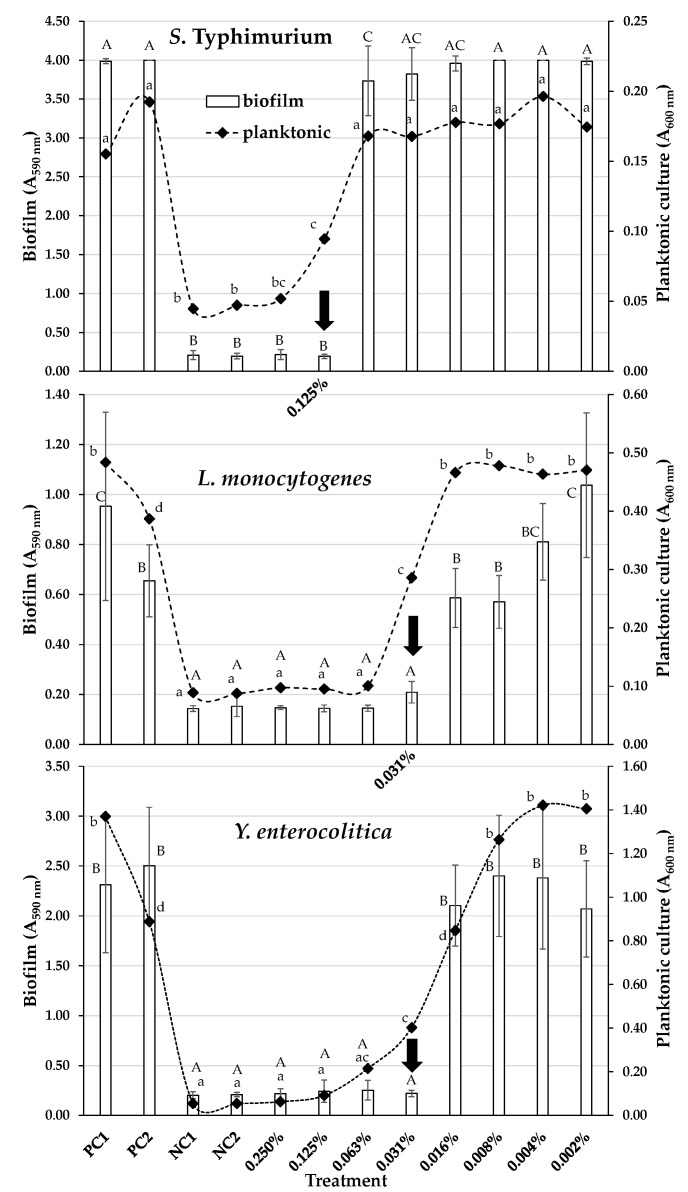
Essential oils (EOs) are mixtures of volatile plant secondary metabolites and have been exploited by humans for thousands of years for various purposes because of their many bioactivities. In this study, the EO from , a thyme species organically cultured on the Greek Island of Lemnos, was analyzed for its chemical composition (through GC-FID and GC-MS), antioxidant activity (AA), and total phenolic content (TPC), as well as its antimicrobial and antibiofilm actions against three important foodborne bacterial pathogens ( ser. Typhimurium, , and ). For the latter investigations, the minimum inhibitory concentrations (MICs) and minimum biofilm inhibitory concentrations (MBICs) of the EO against the planktonic and biofilm growth of each pathogen were determined, together with the minimum biofilm eradication concentrations (MBECs). Results revealed that EO was rich in thymol, -cymene, and carvacrol, presenting high AA and TPC (144.66 μmol Trolox equivalents and 231.32 mg gallic acid equivalents per g of EO, respectively), while its MICs and MBICs ranged from 0.03% to 0.06% / and 0.03% to 0.13% /, respectively, depending on the target pathogen. The EO was able to fully destroy preformed (mature) biofilms of all three pathogenic species upon application for 15 min, with MBECs ranging from 2.00 to 6.25% /. Overall, the results demonstrate that the EO of organically cultured presents strong antioxidant, antibacterial, and antibiofilm properties and could, therefore, be further exploited as a functional and antimicrobial natural formulation for food and health applications.
精油(EOs)是挥发性植物次生代谢物的混合物,由于其多种生物活性,人类数千年来一直将其用于各种用途。在这项研究中,分析了在希腊 Lemnos 岛上有机种植的百里香属植物的精油的化学成分(通过 GC-FID 和 GC-MS)、抗氧化活性(AA)和总酚含量(TPC),以及其对三种重要食源性病原体(血清。肠炎、 和 )的抗菌和抗生物膜作用。对于后者的研究,确定了精油对每种病原体浮游生物和生物膜生长的最小抑制浓度(MIC)和最小生物膜抑制浓度(MBIC),以及最小生物膜消除浓度(MBEC)。结果表明, 精油富含百里香酚、-柠檬烯和香芹酚,具有高 AA 和 TPC(分别为 144.66 μmol Trolox 当量和 231.32 mg 没食子酸当量/克精油),而其 MIC 和 MBIC 范围为 0.03%至 0.06%/和 0.03%至 0.13%/,具体取决于目标病原体。精油在应用 15 分钟后能够完全破坏所有三种致病性生物膜的成熟生物膜,MBEC 范围为 2.00 至 6.25%/。总体而言,这些结果表明,有机培养的 精油具有很强的抗氧化、抗菌和抗生物膜特性,因此可以进一步开发为用于食品和健康应用的功能性和抗菌天然配方。