Department of Electrical Engineering, National Taiwan Ocean University, Keelung 20224, Taiwan.
Sensors (Basel). 2023 Jan 17;23(3):1078. doi: 10.3390/s23031078.
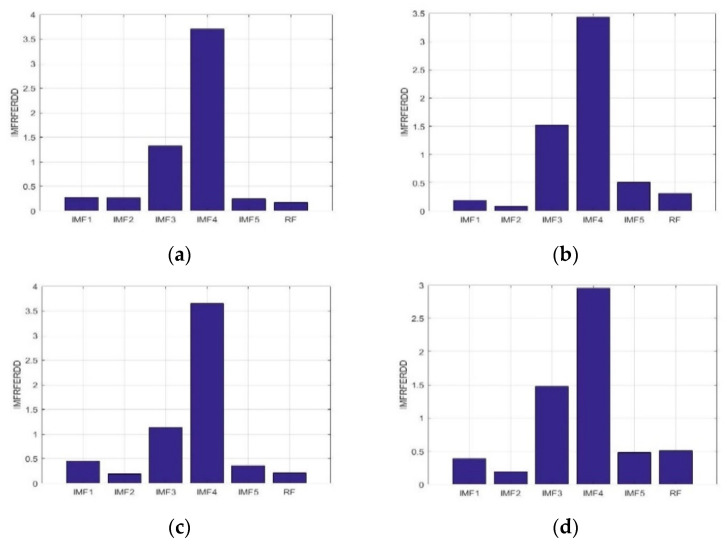
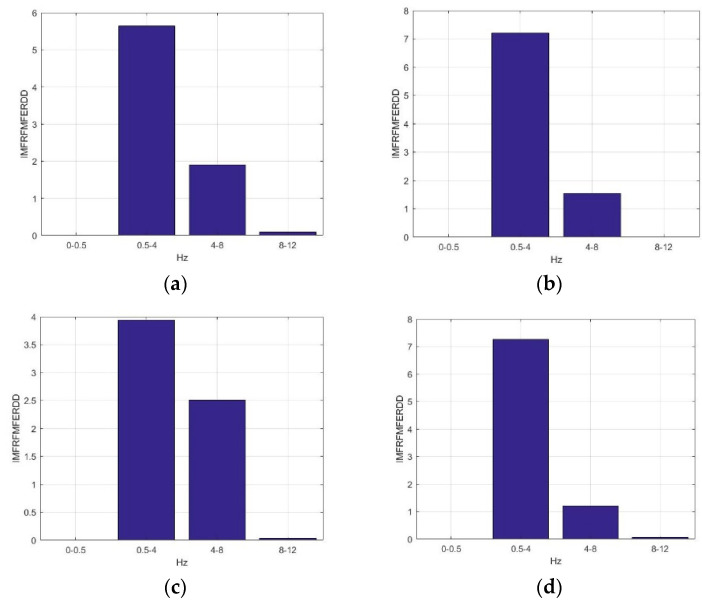
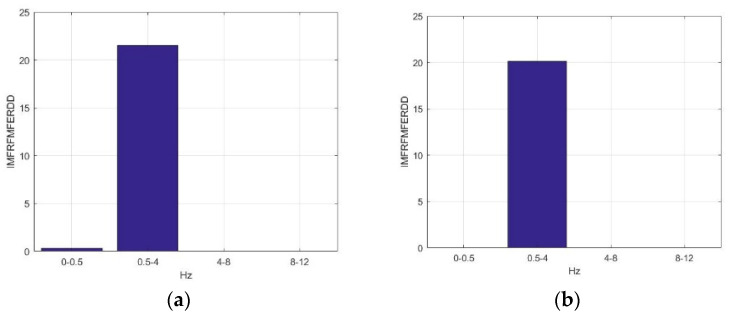
This study aims to extract the energy feature distributions in the form of marginal frequency (MF) and Hilbert spectrum (HS) in the intrinsic mode functions (IMF) domain for actual movement (AM)-based and motor imagery (MI)-based electroencephalogram (EEG) signals using the Hilbert-Huang transformation (HHT) time frequency (TF) analysis method. Accordingly, F5 and F6 EEG signal TF energy feature distributions in delta (0.5-4 Hz) rhythm are explored. We propose IMF-based and residue function (RF)-based MF and HS feature information extraction methods with (IMFRF energy refereed distribution density), (IMFRF MF energy refereed distribution density), and (IMFRF HS energy refereed distribution density) parameters using HHT with application to AM, MI EEG F5, and F6 signals in delta rhythm. The AM and MI tasks involve simultaneously opening fists and feet, as well as simultaneously closing fists and feet. Eight samples (32 in total) with a time duration of 1000 ms are extracted for analyzing F5AM, F5MI, F6AM, and F6MI EEG signals, which are decomposed into five IMFs and one RF. The maximum average values of IMF4 are 3.70, 3.43, 3.65, and 3.69 for F5AM, F5MI, F6 AM, and F6MI, respectively. The maximum average values of IMF4 in the delta rhythm are 21.50, 20.15, 21.02, and 17.30, for F5AM, F5MI, F6AM, and F6MI, respectively. Additionally, the maximum average values of IMF4 in delta rhythm are 39,21, 39.14, 36.29, and 33.06 with time intervals of 500-600, 800-900, 800-900, and 500-600 ms, for F5AM, F5MI, F6AM, and F6MI, respectively. The results of this study, advance our understanding of meaningful feature information of F5MM, F5MI, F6MM, and F6MI, enabling the design of MI-based brain-computer interface assistive devices for disabled persons.
本研究旨在使用希尔伯特-黄变换(HHT)时频(TF)分析方法,从实际运动(AM)和运动想象(MI)脑电(EEG)信号的固有模态函数(IMF)域中提取边际频率(MF)和希尔伯特谱(HS)的能量特征分布。因此,我们探索了 F5 和 F6 EEG 信号中 delta(0.5-4 Hz)节律的 TF 能量特征分布。我们提出了基于 IMF 和剩余函数(RF)的 MF 和 HS 特征信息提取方法,使用 HHT 得到(IMFRF 能量参考分布密度)、(IMFRF MF 能量参考分布密度)和(IMFRF HS 能量参考分布密度)参数,应用于 delta 节律中的 AM、MI F5 和 F6 信号。AM 和 MI 任务包括同时张开拳头和脚,以及同时握拳和脚。提取了 8 个样本(共 32 个),每个样本持续时间为 1000ms,用于分析 F5AM、F5MI、F6AM 和 F6MI EEG 信号,这些信号被分解为 5 个 IMF 和一个 RF。F5AM、F5MI、F6AM 和 F6MI 的 IMF4 的最大平均 值分别为 3.70、3.43、3.65 和 3.69。F5AM、F5MI、F6AM 和 F6MI 的 delta 节律中 IMF4 的最大平均 值分别为 21.50、20.15、21.02 和 17.30。此外,F5AM、F5MI、F6AM 和 F6MI 的 delta 节律中 IMF4 的最大平均 值分别为 39、21、39.14、36.29 和 33.06,时间间隔分别为 500-600ms、800-900ms、800-900ms 和 500-600ms。本研究的结果,推进了我们对 F5MM、F5MI、F6MM 和 F6MI 有意义特征信息的理解,为设计基于 MI 的残疾人脑机接口辅助设备提供了帮助。