Centers of Cardiovascular Research, Temple University Lewis Katz School of Medicine, Philadelphia, PA, United States.
Department of Pathology and Laboratory Medicine, Temple University Lewis Katz School of Medicine, Philadelphia, PA, United States.
Front Immunol. 2023 Jan 26;14:1113883. doi: 10.3389/fimmu.2023.1113883. eCollection 2023.
Non-alcoholic fatty liver disease (NAFLD) has a global prevalence of 25% of the population and is a leading cause of cirrhosis and hepatocellular carcinoma. NAFLD ranges from simple steatosis (non-alcoholic fatty liver) to non-alcoholic steatohepatitis (NASH). Hepatic macrophages, specifically Kupffer cells (KCs) and monocyte-derived macrophages, act as key players in the progression of NAFLD. Caspases are a family of endoproteases that provide critical connections to cell regulatory networks that sense disease risk factors, control inflammation, and mediate inflammatory cell death (pyroptosis). Caspase-11 can cleave gasdermin D (GSDMD) to induce pyroptosis and specifically defends against bacterial pathogens that invade the cytosol. However, it's still unknown whether high fat diet (HFD)-facilitated gut microbiota-generated cytoplasmic lipopolysaccharides (LPS) activate caspase-11 and promote NAFLD.
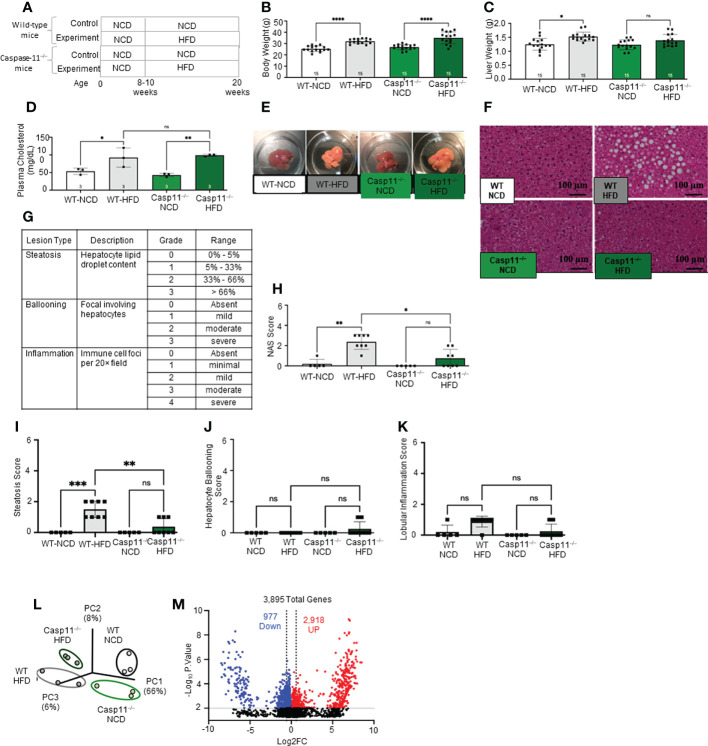
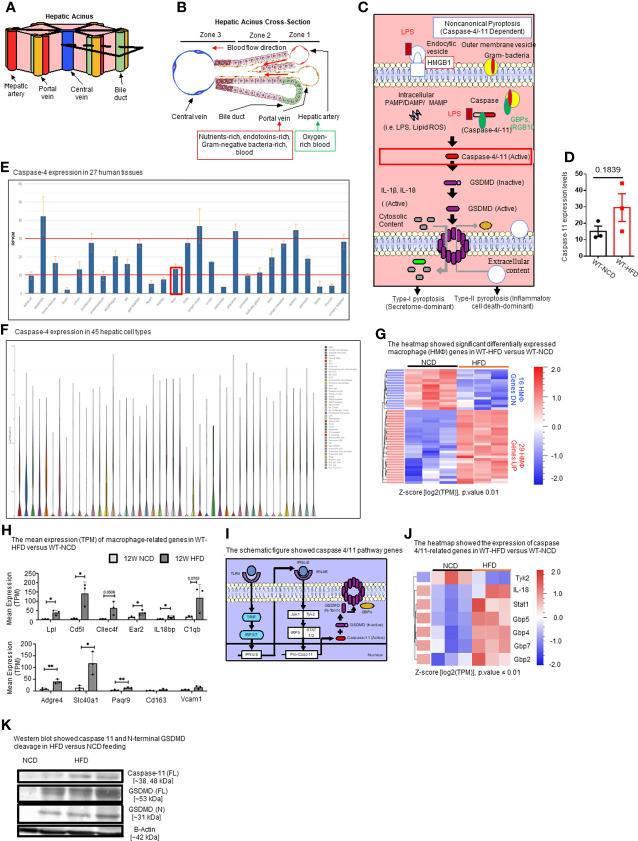
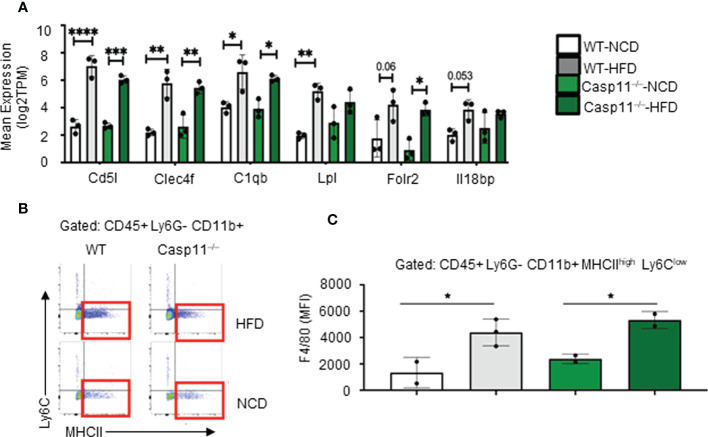
To examine this hypothesis, we performed liver pathological analysis, RNA-seq, FACS, Western blots, Seahorse mitochondrial stress analyses of macrophages and bone marrow transplantation on HFD-induced NAFLD in WT and Casp11-/- mice.
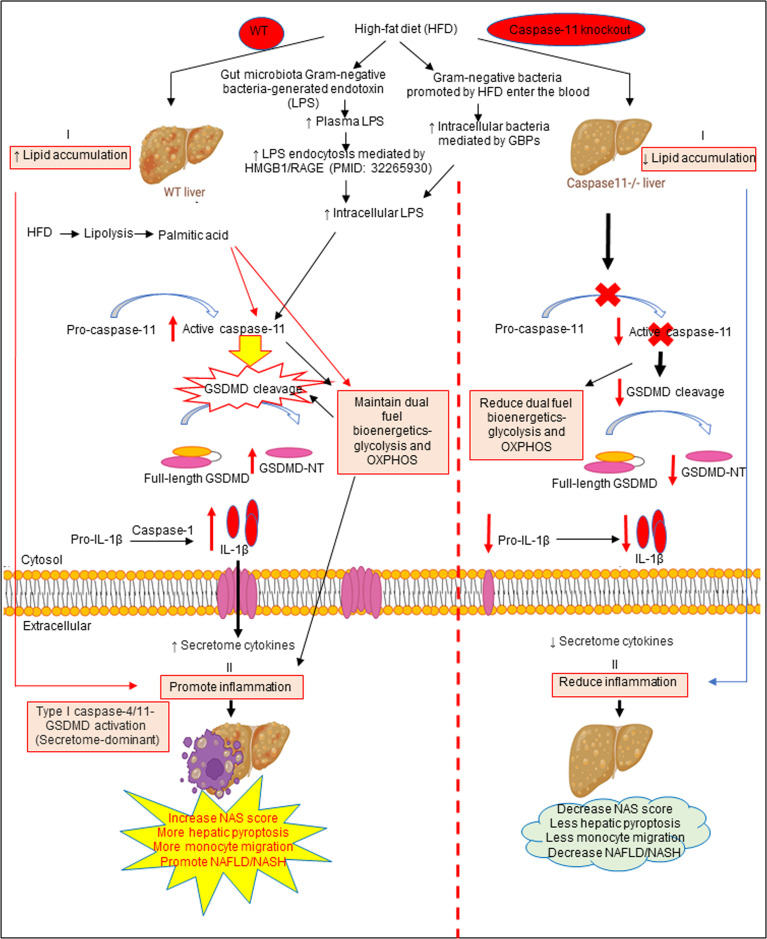
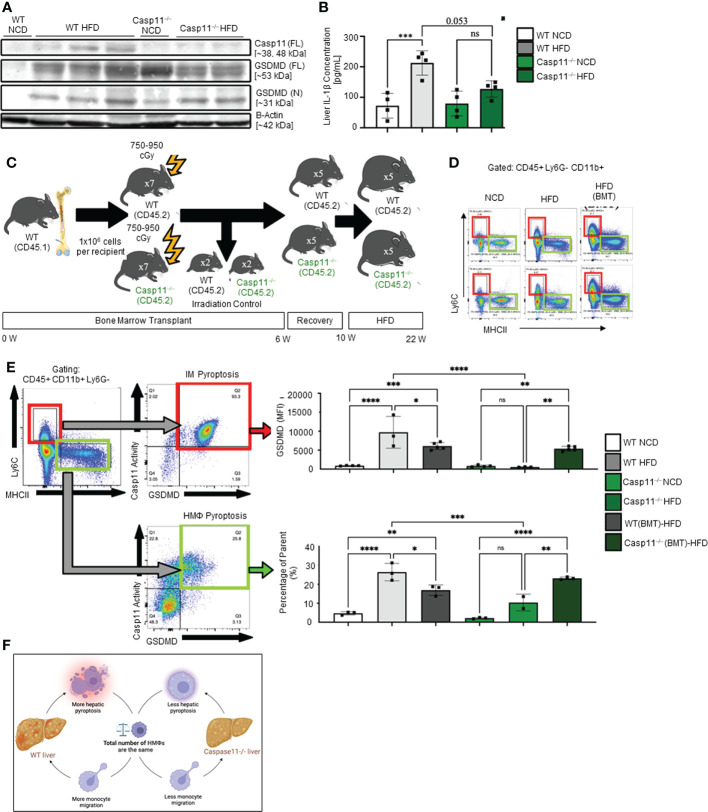
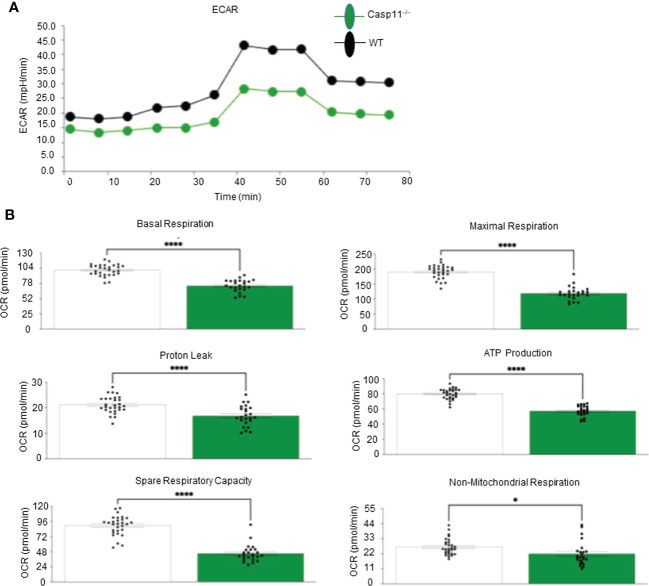
Our results showed that 1) HFD increases body wight, liver wight, plasma cholesterol levels, liver fat deposition, and NAFLD activity score (NAS score) in wild-type (WT) mice; 2) HFD increases the expression of caspase-11, GSDMD, interleukin-1β, and guanylate-binding proteins in WT mice; 3) Caspase-11 deficiency decreases fat liver deposition and NAS score; 4) Caspase-11 deficiency decreases bone marrow monocyte-derived macrophage (MDM) pyroptosis (inflammatory cell death) and inflammatory monocyte (IM) surface GSDMD expression; 5) Caspase-11 deficiency re-programs liver transcriptomes and reduces HFD-induced NAFLD; 6) Caspase-11 deficiency decreases extracellular acidification rates (glycolysis) and oxidative phosphorylation (OXPHOS) in inflammatory fatty acid palmitic acid-stimulated macrophages, indicating that caspase-11 significantly contributes to maintain dual fuel bioenergetics-glycolysis and OXPHOS for promoting pyroptosis in macrophages. These results provide novel insights on the roles of the caspase-11-GSDMD pathway in promoting hepatic macrophage inflammation and pyroptosis and novel targets for future therapeutic interventions involving the transition of NAFLD to NASH, hyperlipidemia, type II diabetes, metabolic syndrome, metabolically healthy obesity, atherosclerotic cardiovascular diseases, autoimmune diseases, liver transplantation, and hepatic cancers.
非酒精性脂肪性肝病 (NAFLD) 的全球患病率为 25%,是肝硬化和肝细胞癌的主要病因。NAFLD 从单纯性脂肪变性(非酒精性脂肪肝)到非酒精性脂肪性肝炎(NASH)不等。肝巨噬细胞,特别是库普弗细胞 (KC) 和单核细胞衍生的巨噬细胞,作为 NAFLD 进展的关键参与者。半胱天冬酶是一组内肽酶,为感知疾病风险因素、控制炎症和介导炎症细胞死亡(细胞焦亡)的细胞调控网络提供重要连接。半胱天冬酶-11 可切割 Gasdermin D (GSDMD) 以诱导细胞焦亡,并特异性防御细胞质中入侵的细菌病原体。然而,高脂肪饮食 (HFD) 促进的肠道微生物群产生的细胞质脂多糖 (LPS) 是否激活半胱天冬酶-11 并促进 NAFLD 仍不清楚。
为了检验这一假设,我们对 HFD 诱导的 WT 和 Casp11-/- 小鼠 NAFLD 进行了肝脏病理分析、RNA-seq、FACS、Western blot、Seahorse 线粒体应激分析和骨髓移植。
我们的结果表明:1)HFD 增加 WT 小鼠的体重、肝脏重量、血浆胆固醇水平、肝脏脂肪沉积和 NAFLD 活性评分(NAS 评分);2)HFD 增加 WT 小鼠中半胱天冬酶-11、GSDMD、白细胞介素-1β 和鸟苷酸结合蛋白的表达;3)Caspase-11 缺陷可减少脂肪性肝沉积和 NAS 评分;4)Caspase-11 缺陷可减少骨髓单核细胞衍生巨噬细胞 (MDM) 细胞焦亡(炎症细胞死亡)和炎症单核细胞 (IM) 表面 GSDMD 表达;5)Caspase-11 缺陷可重新编程肝转录组并减少 HFD 诱导的 NAFLD;6)Caspase-11 缺陷可降低炎症性脂肪酸棕榈酸刺激的巨噬细胞中的细胞外酸化率(糖酵解)和氧化磷酸化 (OXPHOS),表明半胱天冬酶-11 显著有助于维持双重燃料生物能学-糖酵解和 OXPHOS,以促进巨噬细胞中的细胞焦亡。这些结果为半胱天冬酶-11-GSDMD 途径在促进肝巨噬细胞炎症和细胞焦亡中的作用提供了新的见解,并为涉及从 NAFLD 向 NASH、高脂血症、II 型糖尿病、代谢综合征、代谢健康肥胖、动脉粥样硬化性心血管疾病、自身免疫性疾病、肝移植和肝细胞癌的过渡的未来治疗干预提供了新的靶点。