Wolock Timothy M, Flaxman Seth, Chimpandule Tiwonge, Mbiriyawanda Stone, Jahn Andreas, Nyirenda Rose, Eaton Jeffrey W
MRC Centre for Global Infectious Disease Analysis, School of Public Health, Imperial College London, London, UK.
Department of Mathematics, Imperial College London, London, UK.
medRxiv. 2023 Feb 4:2023.02.02.23285334. doi: 10.1101/2023.02.02.23285334.
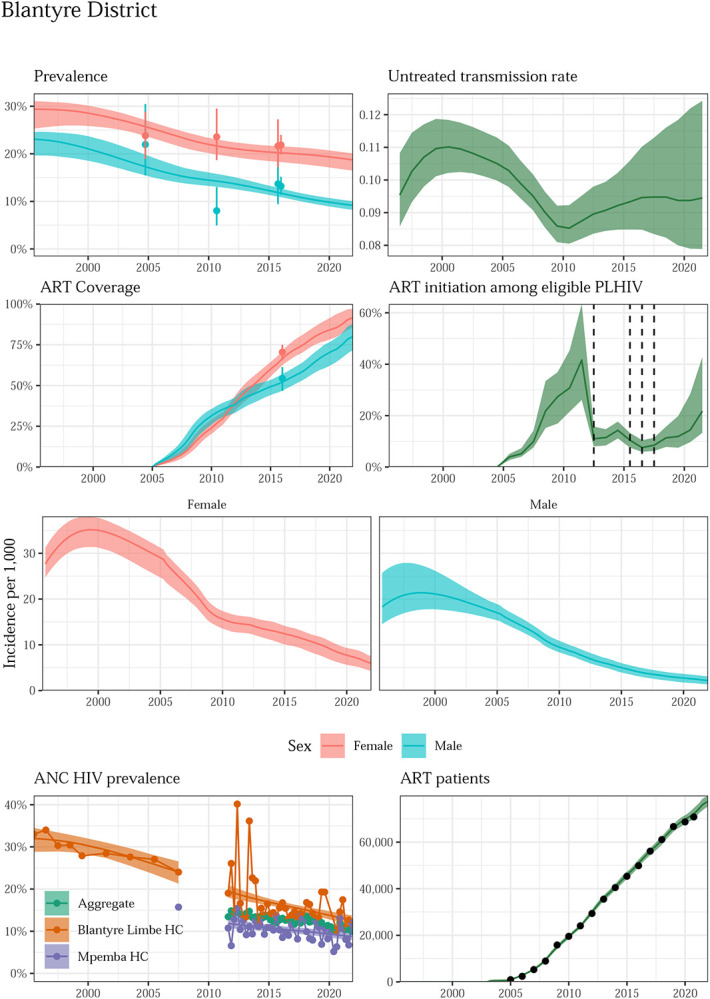
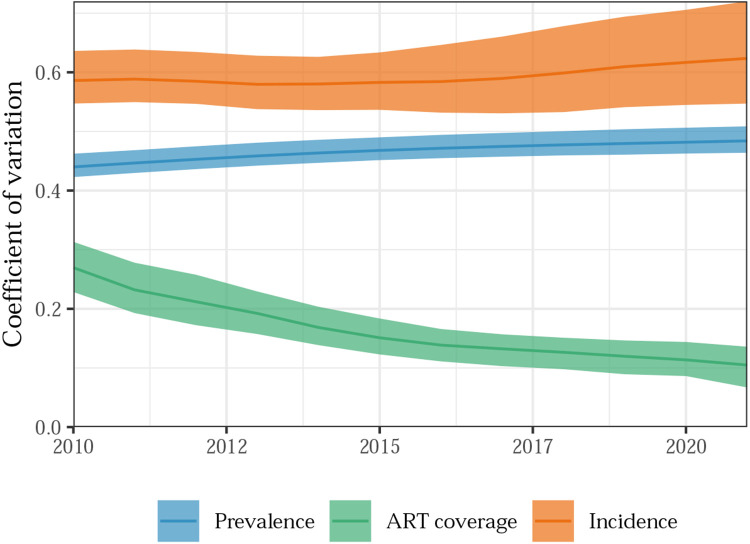
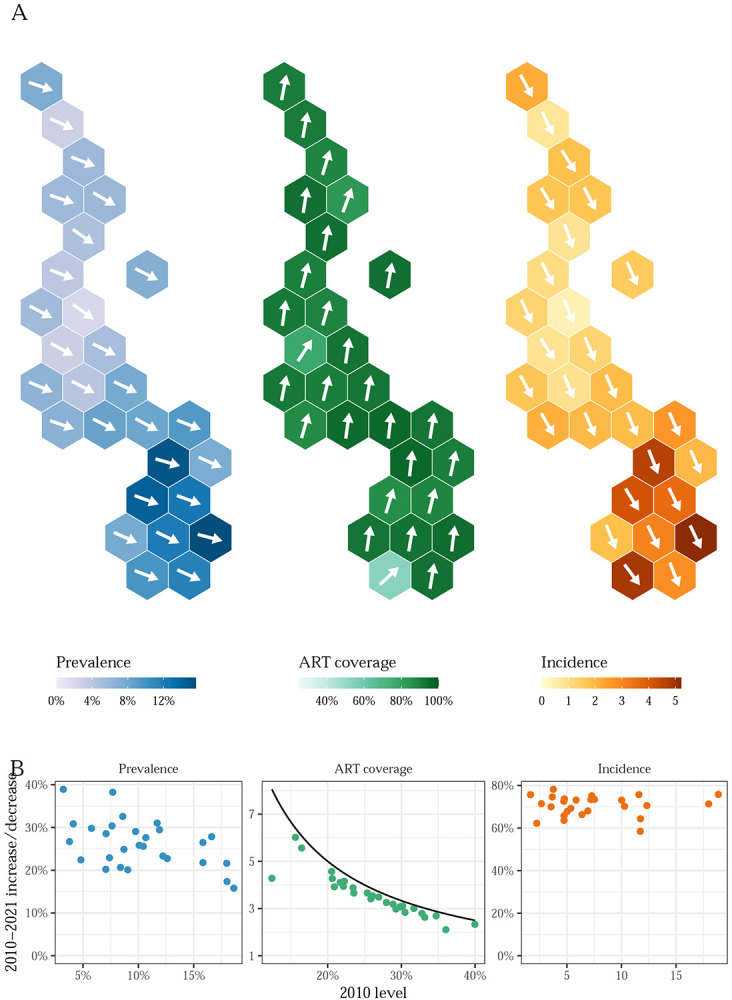
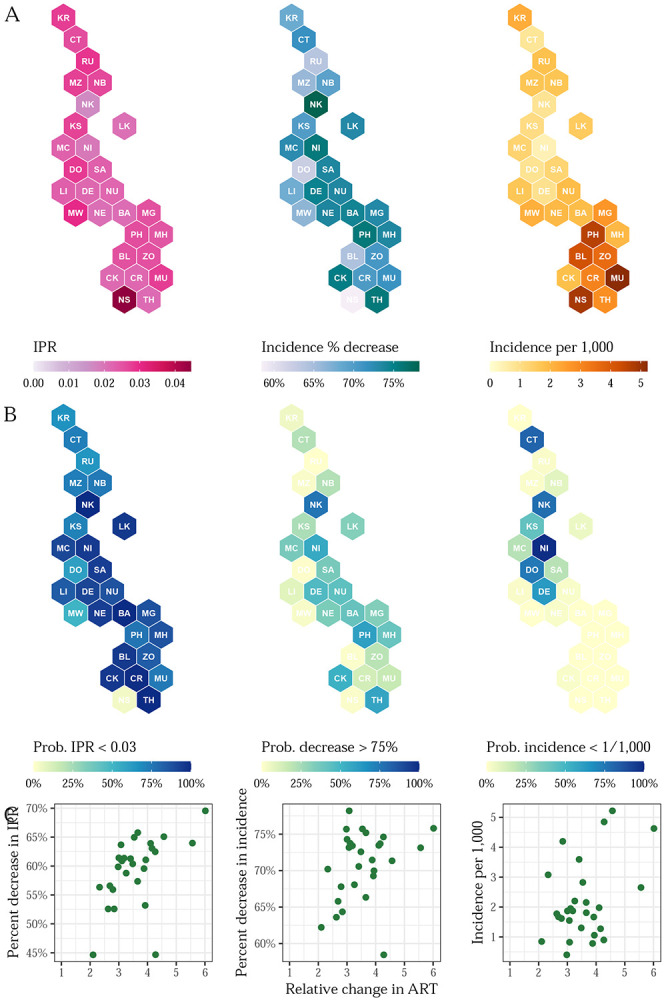
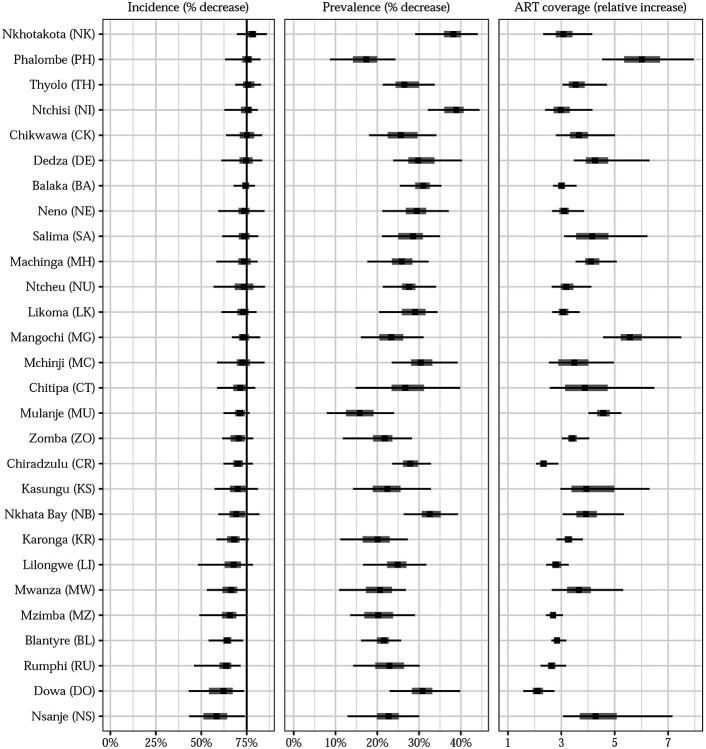
The rate of new HIV infections globally has decreased substantially from its peak in the late 1990s, but the epidemic persists and remains highest in many countries in eastern and southern Africa. Previous research hypothesised that, as the epidemic recedes, it will become increasingly concentrated among sub-populations and geographic areas where transmission is the highest and that are least effectively reached by treatment and prevention services. However, empirical data on subnational HIV incidence trends is sparse, and the local transmission rates in the context of effective treatment scale-up are unknown. In this work, we developed a novel Bayesian spatio-temporal epidemic model to estimate adult HIV prevalence, incidence and treatment coverage at the district level in Malawi from 2010 through the end of 2021. We found that HIV incidence decreased in every district of Malawi between 2010 and 2021 but the rate of decline varied by area. National-level treatment coverage more than tripled between 2010 and 2021 and more than doubled in every district. Large increases in treatment coverage were associated with declines in HIV transmission, with 12 districts having incidence-prevalence ratios of 0.03 or less (a previously suggested threshold for epidemic control). Across districts, incidence varied more than HIV prevalence and ART coverage, suggesting that the epidemic is becoming increasingly spatially concentrated. Our results highlight the success of the Malawi HIV treatment programme over the past decade, with large improvements in treatment coverage leading to commensurate declines in incidence. More broadly, we demonstrate the utility of spatially resolved HIV modelling in generalized epidemic settings. By estimating temporal changes in key epidemic indicators at a relatively fine spatial resolution, we were able to directly assess, for the first time, whether the ART scaleup in Malawi resulted in spatial gaps or hotspots. Regular use of this type of analysis will allow HIV program managers to monitor the equity of their treatment and prevention programmes and their subnational progress towards epidemic control.
全球新增艾滋病毒感染率已从20世纪90年代末的峰值大幅下降,但疫情仍在持续,在东非和南部非洲的许多国家仍然最高。先前的研究假设,随着疫情消退,它将越来越集中在传播率最高且治疗和预防服务覆盖效果最差的亚人群和地理区域。然而,关于国家以下层面艾滋病毒发病率趋势的实证数据稀少,在有效扩大治疗规模背景下的当地传播率也未知。在这项工作中,我们开发了一种新颖的贝叶斯时空流行模型,以估计2010年至2021年底马拉维各地区的成人艾滋病毒流行率、发病率和治疗覆盖率。我们发现,2010年至2021年期间,马拉维每个地区的艾滋病毒发病率都有所下降,但下降速度因地区而异。2010年至2021年期间,国家层面的治疗覆盖率增长了两倍多,每个地区都增长了一倍多。治疗覆盖率的大幅提高与艾滋病毒传播的下降相关,有12个地区的发病率与流行率之比为0.03或更低(这是先前建议的疫情控制阈值)。在各地区之间,发病率的差异大于艾滋病毒流行率和抗逆转录病毒疗法覆盖率,这表明疫情在空间上越来越集中。我们的结果突出了马拉维艾滋病毒治疗项目在过去十年中的成功,治疗覆盖率的大幅提高导致发病率相应下降。更广泛地说,我们展示了空间分辨艾滋病毒建模在普遍流行环境中的效用。通过以相对精细的空间分辨率估计关键流行指标的时间变化,我们首次能够直接评估马拉维扩大抗逆转录病毒疗法规模是否导致了空间差距或热点地区。定期使用这种类型的分析将使艾滋病毒项目管理人员能够监测其治疗和预防项目的公平性以及在国家以下层面实现疫情控制的进展。