Howes Adam, Risher Kathryn A, Nguyen Van Kính, Stevens Oliver, Jia Katherine M, Wolock Timothy M, Esra Rachel T, Zembe Lycias, Wanyeki Ian, Mahy Mary, Benedikt Clemens, Flaxman Seth R, Eaton Jeffrey W
Department of Mathematics, Imperial College London, London, United Kingdom.
MRC Centre for Global Infectious Disease Analysis, School of Public Health, Imperial College London, London, United Kingdom.
PLOS Glob Public Health. 2023 Apr 19;3(4):e0001731. doi: 10.1371/journal.pgph.0001731. eCollection 2023.
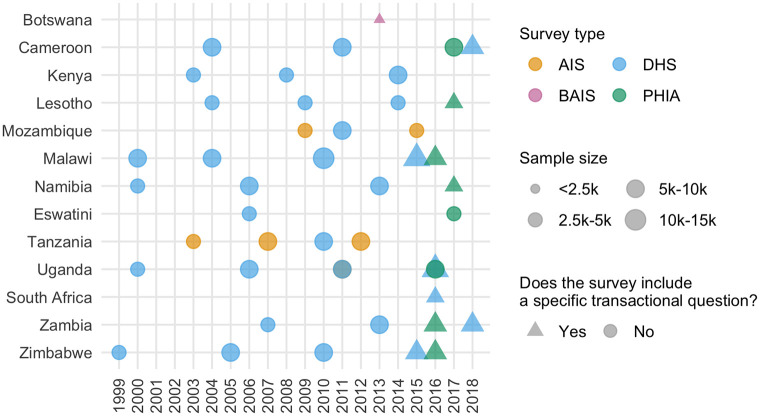
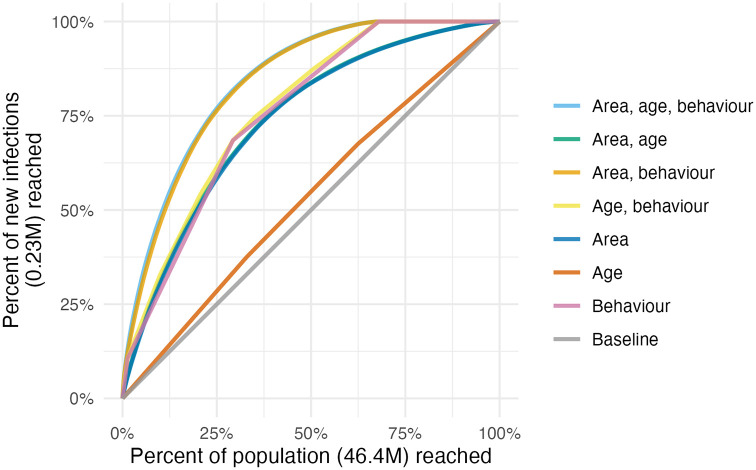
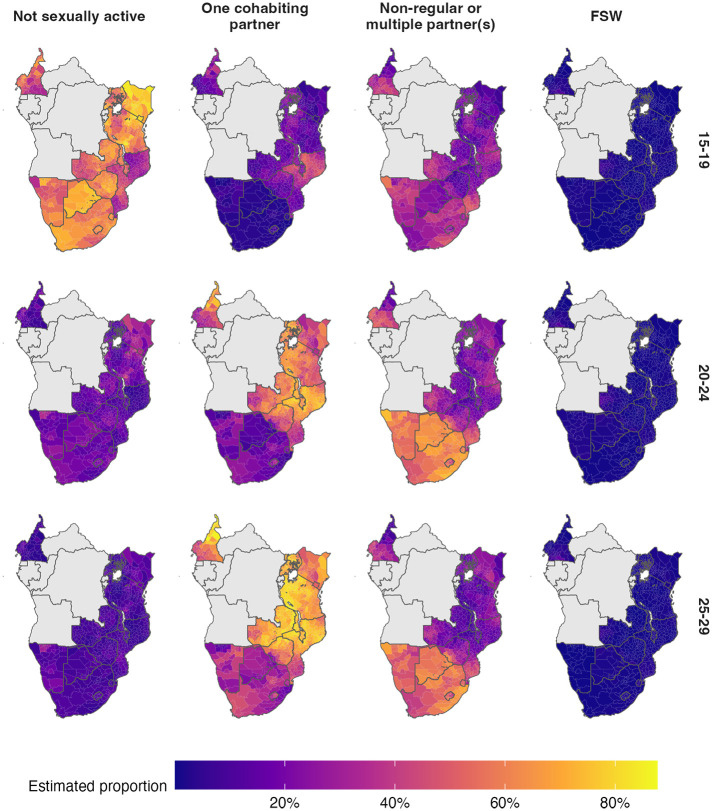
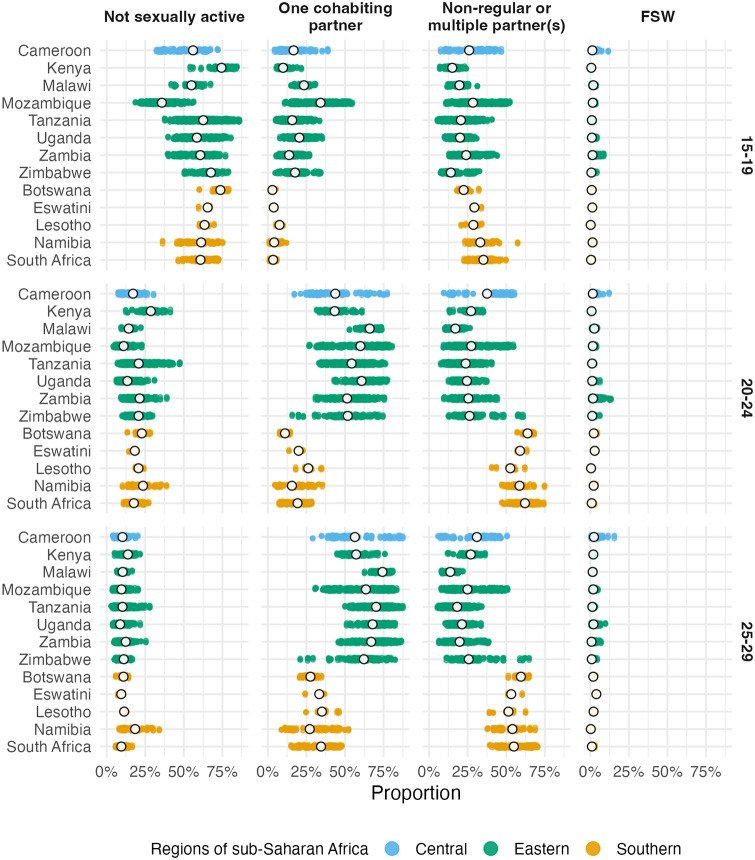
The Global AIDS Strategy 2021-2026 identifies adolescent girls and young women (AGYW) as a priority population for HIV prevention, and recommends differentiating intervention portfolios geographically based on local HIV incidence and individual risk behaviours. We estimated prevalence of HIV risk behaviours and associated HIV incidence at health district level among AGYW living in 13 countries in sub-Saharan Africa. We analysed 46 geospatially-referenced national household surveys conducted between 1999-2018 across 13 high HIV burden countries in sub-Saharan Africa. Female survey respondents aged 15-29 years were classified into four risk groups (not sexually active, cohabiting, non-regular or multiple partner[s] and female sex workers [FSW]) based on reported sexual behaviour. We used a Bayesian spatio-temporal multinomial regression model to estimate the proportion of AGYW in each risk group stratified by district, year, and five-year age group. Using subnational estimates of HIV prevalence and incidence produced by countries with support from UNAIDS, we estimated new HIV infections in each risk group by district and age group. We then assessed the efficiency of prioritising interventions according to risk group. Data consisted of 274,970 female survey respondents aged 15-29. Among women aged 20-29, cohabiting (63.1%) was more common in eastern Africa than non-regular or multiple partner(s) (21.3%), while in southern countries non-regular or multiple partner(s) (58.9%) were more common than cohabiting (23.4%). Risk group proportions varied substantially across age groups (65.9% of total variation explained), countries (20.9%), and between districts within each country (11.3%), but changed little over time (0.9%). Prioritisation based on behavioural risk, in combination with location- and age-based prioritisation, reduced the proportion of population required to be reached in order to find half of all expected new infections from 19.4% to 10.6%. FSW were 1.3% of the population but 10.6% of all expected new infections. Our risk group estimates provide data for HIV programmes to set targets and implement differentiated prevention strategies outlined in the Global AIDS Strategy. Successfully implementing this approach would result in more efficiently reaching substantially more of those at risk for infections.
《2021-2026年全球艾滋病战略》将青春期女孩和年轻女性确定为艾滋病毒预防的重点人群,并建议根据当地艾滋病毒发病率和个人风险行为在地理上区分干预措施组合。我们估计了撒哈拉以南非洲13个国家中青春期女孩和年轻女性在卫生区层面的艾滋病毒风险行为流行率及相关艾滋病毒发病率。我们分析了1999年至2018年间在撒哈拉以南非洲13个艾滋病毒高负担国家进行的46次地理空间参考的全国家庭调查。根据报告的性行为,将15至29岁的女性调查受访者分为四个风险组(无性活动、同居、非固定或多个性伴侣以及女性性工作者)。我们使用贝叶斯时空多项回归模型来估计按地区、年份和五岁年龄组分层的每个风险组中青春期女孩和年轻女性的比例。利用在联合国艾滋病规划署支持下各国提供的国家以下层面的艾滋病毒流行率和发病率估计数,我们按地区和年龄组估计了每个风险组中的新增艾滋病毒感染病例。然后,我们评估了根据风险组确定干预重点的效率。数据包括274970名15至29岁的女性调查受访者。在20至29岁的女性中,同居(63.1%)在东非比非固定或多个性伴侣(21.3%)更为常见,而在南部国家,非固定或多个性伴侣(58.9%)比同居(23.4%)更为常见。风险组比例在不同年龄组(解释了总变异的65.9%)、国家(20.9%)以及每个国家内的不同地区之间(11.3%)差异很大,但随时间变化很小(0.9%)。基于行为风险的优先排序,结合基于地点和年龄的优先排序,将为发现所有预期新增感染病例的一半所需覆盖的人口比例从19.4%降至10.6%。女性性工作者占人口的1.3%,但占所有预期新增感染病例的10.6%。我们对风险组的估计为艾滋病毒项目提供了数据,以便设定目标并实施《全球艾滋病战略》中概述的差异化预防策略。成功实施这一方法将更有效地覆盖更多有感染风险的人群。