• 文献检索
  • 文档翻译
  • 深度研究
  • 学术资讯
  • Suppr Zotero 插件Zotero 插件
  • 邀请有礼
  • 套餐&价格
  • 历史记录
应用&插件
Suppr Zotero 插件Zotero 插件浏览器插件Mac 客户端Windows 客户端微信小程序
定价
高级版会员购买积分包购买API积分包
服务
文献检索文档翻译深度研究API 文档MCP 服务
关于我们
关于 Suppr公司介绍联系我们用户协议隐私条款
关注我们

Suppr 超能文献

核心技术专利:CN118964589B侵权必究
粤ICP备2023148730 号-1Suppr @ 2026

文献检索

告别复杂PubMed语法,用中文像聊天一样搜索,搜遍4000万医学文献。AI智能推荐,让科研检索更轻松。

立即免费搜索

文件翻译

保留排版,准确专业,支持PDF/Word/PPT等文件格式,支持 12+语言互译。

免费翻译文档

深度研究

AI帮你快速写综述,25分钟生成高质量综述,智能提取关键信息,辅助科研写作。

立即免费体验

闭环导航中的因果推理:自我运动与物体运动的解析

Causal inference during closed-loop navigation: parsing of self- and object-motion.

作者信息

Noel Jean-Paul, Bill Johannes, Ding Haoran, Vastola John, DeAngelis Gregory C, Angelaki Dora E, Drugowitsch Jan

机构信息

Center for Neural Science, New York University, New York City, NY, United States.

Department of Neurobiology, Harvard Medical School, Boston, MA, United States.

出版信息

bioRxiv. 2023 Jan 30:2023.01.27.525974. doi: 10.1101/2023.01.27.525974.

DOI:10.1101/2023.01.27.525974
PMID:36778376
原文链接:https://pmc.ncbi.nlm.nih.gov/articles/PMC9915492/
Abstract

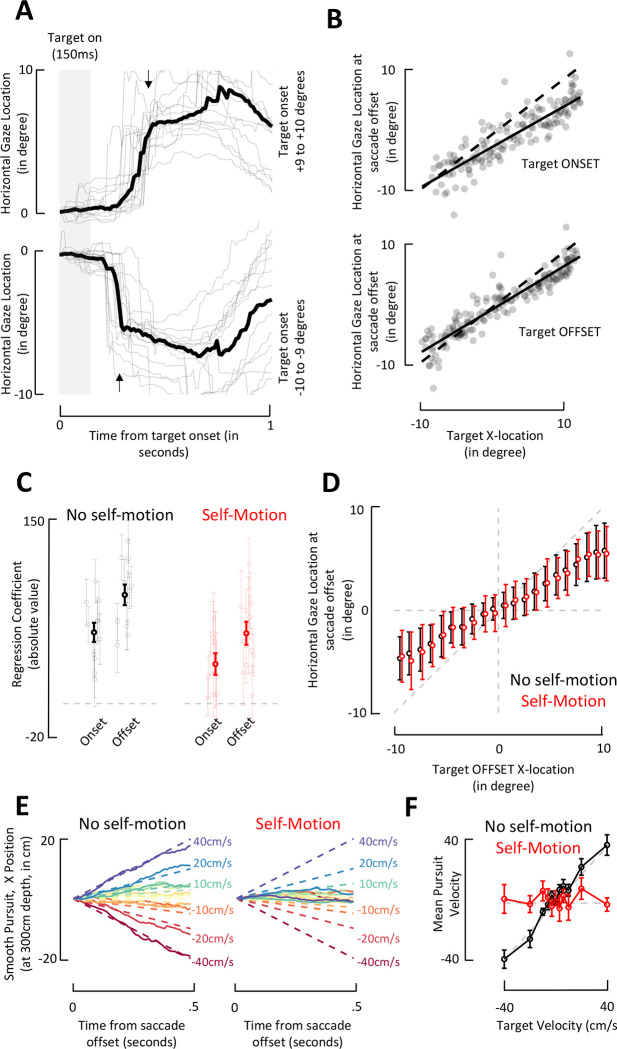
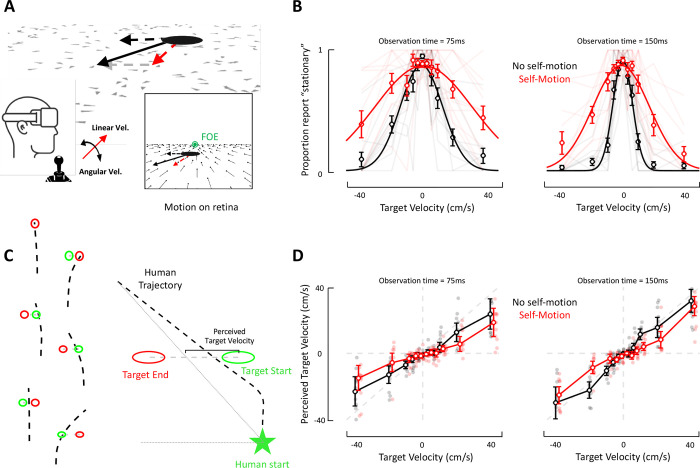
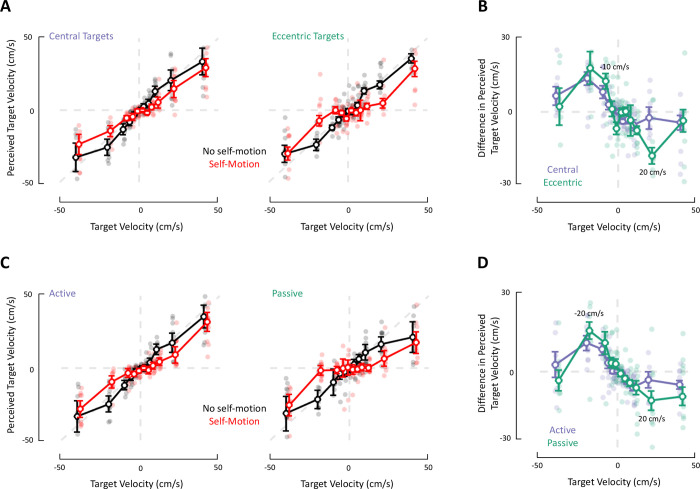
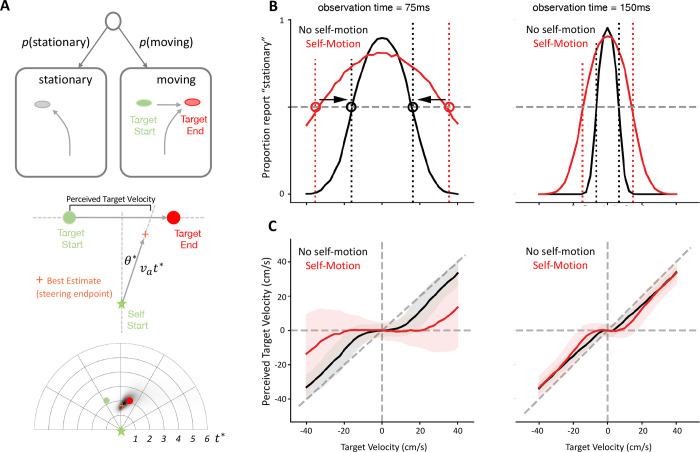
A key computation in building adaptive internal models of the external world is to ascribe sensory signals to their likely cause(s), a process of Bayesian Causal Inference (CI). CI is well studied within the framework of two-alternative forced-choice tasks, but less well understood within the cadre of naturalistic action-perception loops. Here, we examine the process of disambiguating retinal motion caused by self- and/or object-motion during closed-loop navigation. First, we derive a normative account specifying how observers ought to intercept hidden and moving targets given their belief over (i) whether retinal motion was caused by the target moving, and (ii) if so, with what velocity. Next, in line with the modeling results, we show that humans report targets as stationary and steer toward their initial rather than final position more often when they are themselves moving, suggesting a misattribution of object-motion to the self. Further, we predict that observers should misattribute retinal motion more often: (i) during passive rather than active self-motion (given the lack of an efference copy informing self-motion estimates in the former), and (ii) when targets are presented eccentrically rather than centrally (given that lateral self-motion flow vectors are larger at eccentric locations during forward self-motion). Results confirm both of these predictions. Lastly, analysis of eye-movements show that, while initial saccades toward targets are largely accurate regardless of the self-motion condition, subsequent gaze pursuit was modulated by target velocity during object-only motion, but not during concurrent object- and self-motion. These results demonstrate CI within action-perception loops, and suggest a protracted temporal unfolding of the computations characterizing CI.

摘要

构建外部世界适应性内部模型的一个关键计算是将感官信号归因于其可能的原因,这是一个贝叶斯因果推理(CI)过程。CI在二选一强制选择任务的框架内得到了充分研究,但在自然主义的动作-感知循环中却了解较少。在这里,我们研究了在闭环导航过程中区分由自我运动和/或物体运动引起的视网膜运动的过程。首先,我们得出一个规范性解释,规定了观察者在对以下两点有信念的情况下应该如何拦截隐藏的移动目标:(i)视网膜运动是否由目标移动引起;(ii)如果是,目标以何种速度移动。接下来,根据建模结果,我们表明,当人类自己移动时,他们更常将目标报告为静止,并朝着目标的初始位置而非最终位置转向,这表明物体运动被错误归因于自我。此外,我们预测观察者应该更频繁地错误归因视网膜运动:(i)在被动而非主动自我运动期间(因为前者缺乏用于自我运动估计的传出副本);(ii)当目标偏心呈现而非中心呈现时(因为在向前自我运动期间,偏心位置的横向自我运动流向量更大)。结果证实了这两个预测。最后,对眼动的分析表明,虽然无论自我运动条件如何,最初朝向目标的扫视在很大程度上都是准确的,但在仅物体运动期间,后续的注视追踪会受到目标速度的调节,而在物体和自我同时运动期间则不会。这些结果证明了动作-感知循环中的CI,并表明CI计算具有长期的时间展开过程。
https://cdn.ncbi.nlm.nih.gov/pmc/blobs/13b0/9915492/858a9e9a212c/nihpp-2023.01.27.525974v1-f0004.jpg
https://cdn.ncbi.nlm.nih.gov/pmc/blobs/13b0/9915492/a97f93207269/nihpp-2023.01.27.525974v1-f0001.jpg
https://cdn.ncbi.nlm.nih.gov/pmc/blobs/13b0/9915492/f382b837109e/nihpp-2023.01.27.525974v1-f0002.jpg
https://cdn.ncbi.nlm.nih.gov/pmc/blobs/13b0/9915492/5fd6902fe5cc/nihpp-2023.01.27.525974v1-f0003.jpg
https://cdn.ncbi.nlm.nih.gov/pmc/blobs/13b0/9915492/858a9e9a212c/nihpp-2023.01.27.525974v1-f0004.jpg
https://cdn.ncbi.nlm.nih.gov/pmc/blobs/13b0/9915492/a97f93207269/nihpp-2023.01.27.525974v1-f0001.jpg
https://cdn.ncbi.nlm.nih.gov/pmc/blobs/13b0/9915492/f382b837109e/nihpp-2023.01.27.525974v1-f0002.jpg
https://cdn.ncbi.nlm.nih.gov/pmc/blobs/13b0/9915492/5fd6902fe5cc/nihpp-2023.01.27.525974v1-f0003.jpg
https://cdn.ncbi.nlm.nih.gov/pmc/blobs/13b0/9915492/858a9e9a212c/nihpp-2023.01.27.525974v1-f0004.jpg

相似文献

1
Causal inference during closed-loop navigation: parsing of self- and object-motion.闭环导航中的因果推理:自我运动与物体运动的解析
bioRxiv. 2023 Jan 30:2023.01.27.525974. doi: 10.1101/2023.01.27.525974.
2
Causal inference during closed-loop navigation: parsing of self- and object-motion.闭环导航中的因果推理:自身和物体运动的解析。
Philos Trans R Soc Lond B Biol Sci. 2023 Sep 25;378(1886):20220344. doi: 10.1098/rstb.2022.0344. Epub 2023 Aug 7.
3
Object motion perception is shaped by the motor control mechanism of ocular pursuit.物体运动感知受眼球追踪的运动控制机制影响。
Exp Brain Res. 2003 Feb;148(3):350-65. doi: 10.1007/s00221-002-1306-3. Epub 2002 Nov 20.
4
Saccades to remembered targets: the effects of smooth pursuit and illusory stimulus motion.对记忆目标的扫视:平稳跟踪和虚幻刺激运动的影响。
J Neurophysiol. 1996 Dec;76(6):3617-32. doi: 10.1152/jn.1996.76.6.3617.
5
The influence of retinal and extra-retinal motion cues on perceived object motion during self-motion.视网膜和视网膜外运动线索对自我运动过程中感知物体运动的影响。
J Vis. 2008 Oct 23;8(14):5.1-10. doi: 10.1167/8.14.5.
6
Causal inference accounts for heading perception in the presence of object motion.因果推断解释了在物体运动存在的情况下的头部感知。
Proc Natl Acad Sci U S A. 2019 Apr 30;116(18):9060-9065. doi: 10.1073/pnas.1820373116. Epub 2019 Apr 17.
7
The impact of visually simulated self-motion on predicting object motion.视觉模拟自身运动对预测物体运动的影响。
PLoS One. 2024 Mar 14;19(3):e0295110. doi: 10.1371/journal.pone.0295110. eCollection 2024.
8
A Neural Model of MST and MT Explains Perceived Object Motion during Self-Motion.MST和MT的神经模型解释了自我运动过程中感知到的物体运动。
J Neurosci. 2016 Aug 3;36(31):8093-102. doi: 10.1523/JNEUROSCI.4593-15.2016.
9
Multisensory Integration of Visual and Vestibular Signals Improves Heading Discrimination in the Presence of a Moving Object.视觉与前庭信号的多感官整合在存在移动物体的情况下改善航向辨别能力。
J Neurosci. 2015 Oct 7;35(40):13599-607. doi: 10.1523/JNEUROSCI.2267-15.2015.
10
The accuracy of object motion perception during locomotion.运动过程中物体运动感知的准确性。
Front Psychol. 2023 Jan 12;13:1068454. doi: 10.3389/fpsyg.2022.1068454. eCollection 2022.

本文引用的文献

1
Visual motion perception as online hierarchical inference.视觉运动知觉作为在线分层推理。
Nat Commun. 2022 Dec 1;13(1):7403. doi: 10.1038/s41467-022-34805-5.
2
Coding of latent variables in sensory, parietal, and frontal cortices during closed-loop virtual navigation.感觉皮层、顶叶皮层和前额叶皮层在闭环虚拟导航过程中潜在变量的编码。
Elife. 2022 Oct 25;11:e80280. doi: 10.7554/eLife.80280.
3
Neural dynamics of causal inference in the macaque frontoparietal circuit.猕猴额顶叶回路中因果推理的神经动力学。
Elife. 2022 Oct 24;11:e76145. doi: 10.7554/eLife.76145.
4
Sensory Evidence Accumulation Using Optic Flow in a Naturalistic Navigation Task.利用自然导航任务中的光流进行感觉证据积累。
J Neurosci. 2022 Jul 6;42(27):5451-5462. doi: 10.1523/JNEUROSCI.2203-21.2022. Epub 2022 May 31.
5
Aberrant causal inference and presence of a compensatory mechanism in autism spectrum disorder.自闭症谱系障碍中的异常因果推理及代偿机制的存在
Elife. 2022 May 17;11:e71866. doi: 10.7554/eLife.71866.
6
Bayesian causal inference: A unifying neuroscience theory.贝叶斯因果推断:统一的神经科学理论。
Neurosci Biobehav Rev. 2022 Jun;137:104619. doi: 10.1016/j.neubiorev.2022.104619. Epub 2022 Mar 21.
7
Inverse Rational Control with Partially Observable Continuous Nonlinear Dynamics.具有部分可观测连续非线性动力学的逆有理控制
Adv Neural Inf Process Syst. 2020 Dec;33:7898-7909.
8
How multisensory neurons solve causal inference.多感觉神经元如何解决因果推断问题。
Proc Natl Acad Sci U S A. 2021 Aug 10;118(32). doi: 10.1073/pnas.2106235118.
9
Perceptual Inference, Learning, and Attention in a Multisensory World.感知推断、学习和多感官世界中的注意
Annu Rev Neurosci. 2021 Jul 8;44:449-473. doi: 10.1146/annurev-neuro-100120-085519. Epub 2021 Apr 21.
10
Human visual motion perception shows hallmarks of Bayesian structural inference.人类视觉运动知觉具有贝叶斯结构推理的特征。
Sci Rep. 2021 Feb 12;11(1):3714. doi: 10.1038/s41598-021-82175-7.