Department of Biomedical Engineering, New Jersey Institute of Technology, Newark, NJ 07102, USA.
Center for the Developing Brain, Child Mind Institute, New York, NY 10022, USA.
bioRxiv. 2023 Jun 14:2023.01.30.526311. doi: 10.1101/2023.01.30.526311.
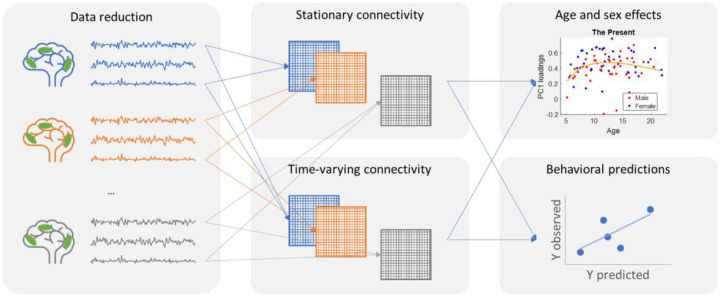
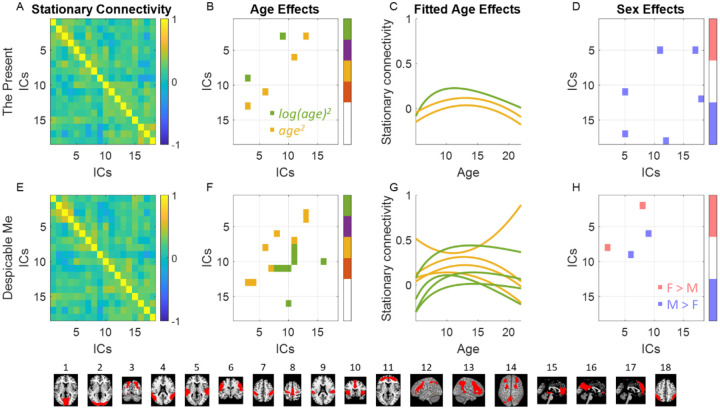
Spatially remote brain regions exhibit dynamic functional interactions across various task conditions. While time-varying functional connectivity during movie watching shows sensitivity to movie content, stationary functional connectivity remains relatively stable across videos. These findings suggest that dynamic and stationary functional interactions may represent different aspects of brain function. However, the relationship between individual differences in time-varying and stationary connectivity and behavioral phenotypes remains elusive. To address this gap, we analyzed an open-access functional MRI dataset comprising participants aged 5 to 22 years, who watched two cartoon movie clips. We calculated regional brain activity, time-varying connectivity, and stationary connectivity, examining associations with age, sex, and behavioral assessments. Model comparison revealed that time-varying connectivity was more sensitive to age and sex effects compared with stationary connectivity. The preferred age models exhibited quadratic log age or quadratic age effects, indicative of inverted-U shaped developmental patterns. In addition, females showed higher consistency in regional brain activity and time-varying connectivity than males. However, in terms of behavioral predictions, only stationary connectivity demonstrated the ability to predict full-scale intelligence quotient. These findings suggest that individual differences in time-varying and stationary connectivity may capture distinct aspects of behavioral phenotypes.
空间上遥远的大脑区域在各种任务条件下表现出动态的功能相互作用。虽然在观看电影时的时变功能连接对电影内容敏感,但在不同视频之间的静息功能连接仍然相对稳定。这些发现表明,动态和静息功能相互作用可能代表了大脑功能的不同方面。然而,个体在时变和静息连接上的差异与行为表型之间的关系仍然难以捉摸。为了解决这一差距,我们分析了一个包含 5 至 22 岁参与者的开放获取功能磁共振成像数据集,他们观看了两个卡通电影片段。我们计算了区域脑活动、时变连接和静息连接,并检查了与年龄、性别和行为评估的关联。模型比较表明,与静息连接相比,时变连接对年龄和性别效应更为敏感。首选的年龄模型表现出二次对数年龄或二次年龄效应,表明了倒 U 形的发展模式。此外,女性在区域脑活动和时变连接方面的一致性高于男性。然而,就行为预测而言,只有静息连接具有预测全量表智商的能力。这些发现表明,个体在时变和静息连接上的差异可能捕捉到了行为表型的不同方面。