Klein Brennan, Zenteno Ana C, Joseph Daisha, Zahedi Mohammadmehdi, Hu Michael, Copenhaver Martin S, Kraemer Moritz U G, Chinazzi Matteo, Klompas Michael, Vespignani Alessandro, Scarpino Samuel V, Salmasian Hojjat
Network Science Institute, Northeastern University, Boston, MA, USA.
Laboratory for the Modeling of Biological and Socio-Technical Systems, Northeastern University, Boston, MA, USA.
Commun Med (Lond). 2023 Feb 14;3(1):25. doi: 10.1038/s43856-023-00253-5.
For each of the COVID-19 pandemic waves, hospitals have had to plan for deploying surge capacity and resources to manage large but transient increases in COVID-19 admissions. While a lot of effort has gone into predicting regional trends in COVID-19 cases and hospitalizations, there are far fewer successful tools for creating accurate hospital-level forecasts.
Large-scale, anonymized mobile phone data has been shown to correlate with regional case counts during the first two waves of the pandemic (spring 2020, and fall/winter 2021). Building off this success, we developed a multi-step, recursive forecasting model to predict individual hospital admissions; this model incorporates the following data: (i) hospital-level COVID-19 admissions, (ii) statewide test positivity data, and (iii) aggregate measures of large-scale human mobility, contact patterns, and commuting volume.
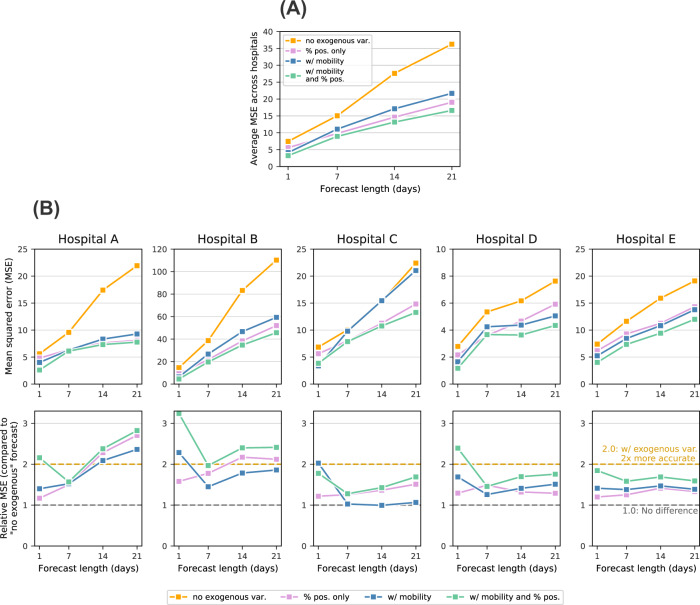
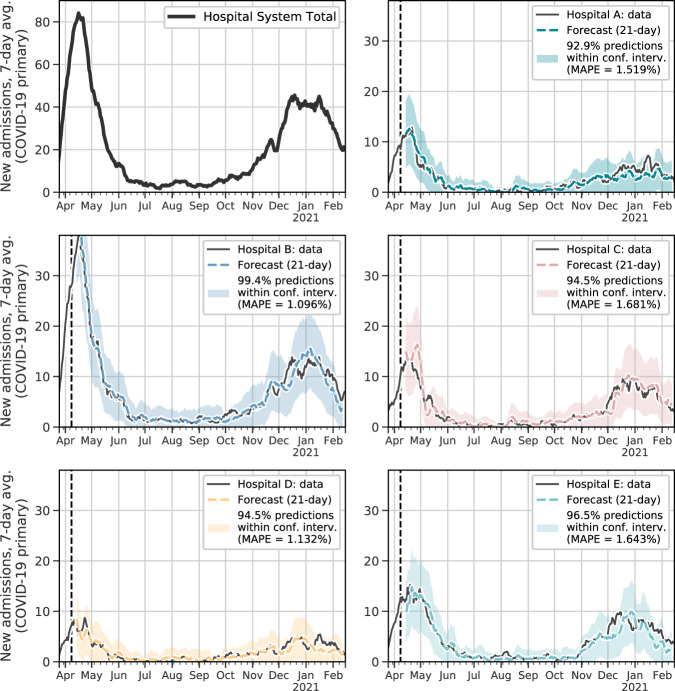
Incorporating large-scale, aggregate mobility data as exogenous variables in prediction models allows us to make hospital-specific COVID-19 admission forecasts 21 days ahead. We show this through highly accurate predictions of hospital admissions for five hospitals in Massachusetts during the first year of the COVID-19 pandemic.
The high predictive capability of the model was achieved by combining anonymized, aggregated mobile device data about users' contact patterns, commuting volume, and mobility range with COVID hospitalizations and test-positivity data. Mobility-informed forecasting models can increase the lead-time of accurate predictions for individual hospitals, giving managers valuable time to strategize how best to allocate resources to manage forthcoming surges.
在新冠疫情的每一波流行期间,医院都必须规划如何调配应急能力和资源,以应对新冠病毒感染患者入院人数大幅但短暂的增加。尽管在预测新冠病例和住院人数的区域趋势方面投入了大量精力,但用于生成准确的医院层面预测的成功工具却少得多。
大规模匿名手机数据已被证明在疫情的前两波(2020年春季和2021年秋冬)与区域病例数相关。基于这一成功经验,我们开发了一种多步骤递归预测模型来预测各个医院的入院人数;该模型纳入了以下数据:(i)医院层面的新冠病毒感染患者入院人数,(ii)全州检测阳性数据,以及(iii)大规模人员流动、接触模式和通勤量的汇总指标。
在预测模型中纳入大规模汇总流动数据作为外生变量,使我们能够提前21天对特定医院的新冠病毒感染患者入院人数进行预测。我们通过对新冠疫情第一年马萨诸塞州五家医院入院人数的高度准确预测来证明这一点。
该模型的高预测能力是通过将关于用户接触模式、通勤量和流动范围的匿名汇总移动设备数据与新冠住院人数和检测阳性数据相结合而实现的。基于流动信息的预测模型可以增加对各个医院准确预测的提前时间,为管理人员提供宝贵的时间来制定策略,以最佳方式分配资源来应对即将到来的激增情况。