Data Science Institute (DSI), I-BioStat, Universiteit Hasselt, BE-3500 Hasselt, Belgium.
Global Health Institute (GHI), University of Antwerp, BE-2000 Antwerp, Belgium.
Int J Environ Res Public Health. 2020 Oct 17;17(20):7560. doi: 10.3390/ijerph17207560.
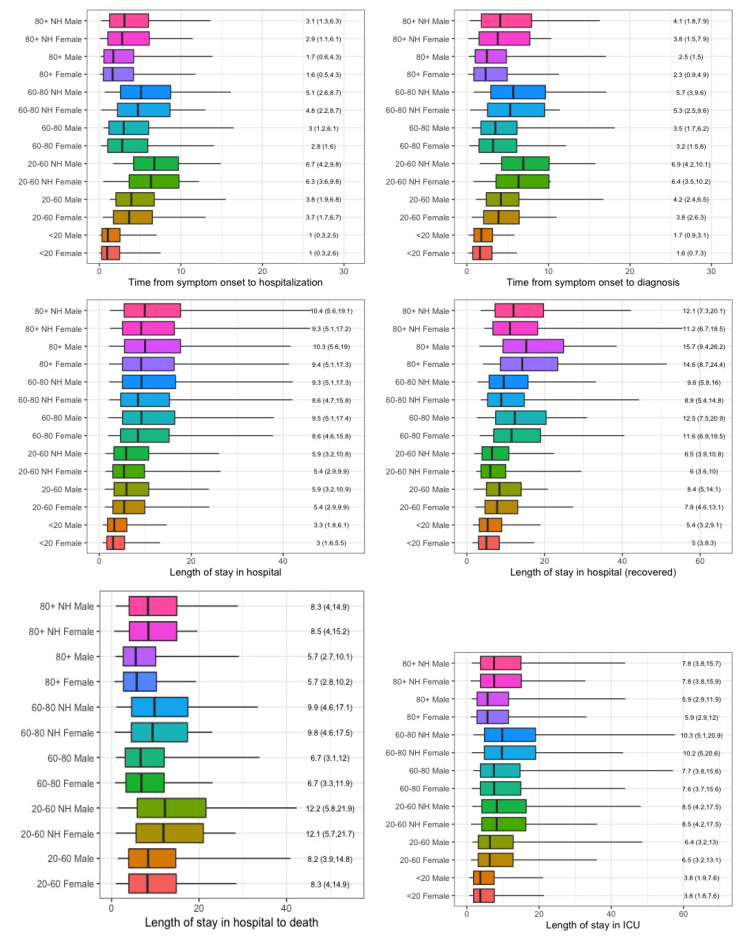
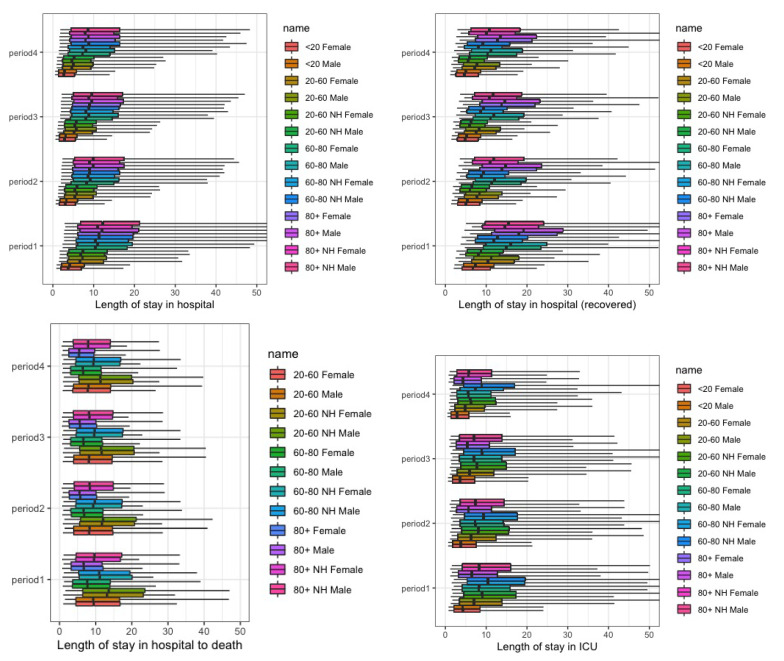
There are different patterns in the COVID-19 outbreak in the general population and amongst nursing home patients. We investigate the time from symptom onset to diagnosis and hospitalization or the length of stay (LoS) in the hospital, and whether there are differences in the population. Sciensano collected information on 14,618 hospitalized patients with COVID-19 admissions from 114 Belgian hospitals between 14 March and 12 June 2020. The distributions of different event times for different patient groups are estimated accounting for interval censoring and right truncation of the time intervals. The time between symptom onset and hospitalization or diagnosis are similar, with median length between symptom onset and hospitalization ranging between 3 and 10.4 days, depending on the age of the patient (longest delay in age group 20-60 years) and whether or not the patient lives in a nursing home (additional 2 days for patients from nursing home). The median LoS in hospital varies between 3 and 10.4 days, with the LoS increasing with age. The hospital LoS for patients that recover is shorter for patients living in a nursing home, but the time to death is longer for these patients. Over the course of the first wave, the LoS has decreased.
普通人群和养老院患者的 COVID-19 爆发模式不同。我们调查了从症状出现到诊断和住院或住院时间(LoS)的时间,以及人群中是否存在差异。Sciensano 收集了 2020 年 3 月 14 日至 6 月 12 日期间来自 114 家比利时医院的 14618 名 COVID-19 住院患者的信息。对于不同的患者群体,不同事件时间的分布是根据时间间隔的区间 censoring 和右截断来估计的。症状出现和住院或诊断之间的时间相似,症状出现和住院之间的中位时间范围在 3 到 10.4 天之间,具体取决于患者的年龄(20-60 岁年龄组的延迟最长)以及患者是否居住在养老院(来自养老院的患者增加 2 天)。住院期间的中位 LoS 为 3 至 10.4 天,LoS 随年龄增长而增加。对于居住在养老院的患者,康复患者的住院 LoS 较短,但这些患者的死亡时间较长。在第一波疫情期间,LoS 有所下降。