Bole Raevti, Lundy Scott D, Pei Evonne, Bajic Petar, Parekh Neel, Vij Sarah C
Department of Urology, Glickman Urological and Kidney Institute, Cleveland Clinic Foundation, Cleveland, OH, USA.
Case Western School of Medicine, Cleveland, OH, USA.
Int J Impot Res. 2024 May;36(3):265-268. doi: 10.1038/s41443-023-00672-x. Epub 2023 Feb 14.
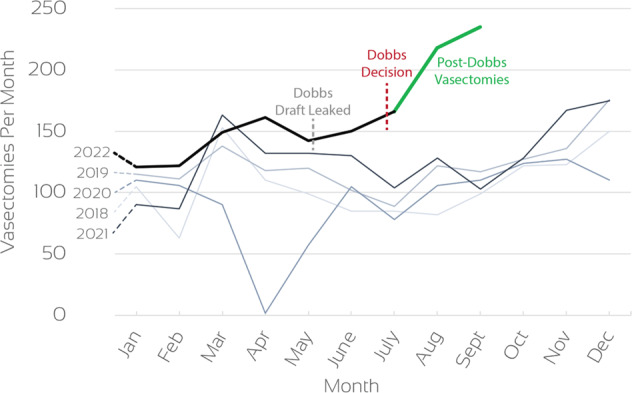
In June 2022 the United States Supreme Court issued a ruling in the case Dobbs v. Jackson that overturned Roe v. Wade, the 1973 ruling establishing a federally protected right to abortion in the United States. Anecdotal reports suggested increased vasectomy volume following this event; however, no published data exist. We sought to describe trends in vasectomy consultation before and after the Dobbs v. Jackson ruling (referred to as pre- and post-Dobbs herein). Following IRB approval, we reviewed charts of all adults seeking vasectomy consultation in July-August 2021 and July-August 2022 at a large healthcare organization. We then aggregated vasectomy procedural billing data from 2018 to present. The primary outcome was volume of vasectomy consultation appointments and the secondary outcome was number of vasectomies performed. In July-August 2021 (Pre-Dobbs), 116 men attended vasectomy consultation versus 142 men in July-August 2022 (Post-Dobbs). Median age Post-Dobbs was significantly younger than Pre-Dobbs (35 vs 38 years, respectively, p = 0.01) with a significant increase in Post-Dobbs men under 30 seeking vasectomy (p = 0.005). A total of 16.9% (24/142) of Post-Dobbs men were childless, compared to 8.6% (10/116) of Pre-Dobbs men (p = 0.05). Of those with children, median number of offspring was unchanged at 2. Billing data showed a significant increase in vasectomy procedural volumes Post-Dobbs. While overturning Roe v Wade directly impacted female reproductive rights, number of vasectomy consultations and procedures increased significantly following this decision. Younger men, especially those under 30, as well as childless men were significantly more likely to seek consultation Post-Dobbs compared to the prior reproductive legal climate. While longer-term data are needed, findings indicate that men are invested in maintaining reproductive autonomy for themselves and their partners.
2022年6月,美国最高法院对多布斯诉杰克逊案作出裁决,推翻了1973年确立美国联邦保护堕胎权的罗诉韦德案裁决。轶事报道表明,这一事件后输精管切除术数量有所增加;然而,尚无公开数据。我们试图描述多布斯诉杰克逊案裁决前后(本文中称为裁决前和裁决后)输精管切除术咨询的趋势。经机构审查委员会批准后,我们查阅了2021年7月至8月以及2022年7月至8月期间在一家大型医疗保健机构寻求输精管切除术咨询的所有成年人的病历。然后,我们汇总了2018年至今的输精管切除手术计费数据。主要结果是输精管切除术咨询预约数量,次要结果是输精管切除手术数量。2021年7月至8月(裁决前),有116名男性参加了输精管切除术咨询,而2022年7月至8月(裁决后)有142名男性。裁决后男性的中位年龄明显低于裁决前(分别为35岁和38岁,p = 0.01),30岁以下寻求输精管切除术的裁决后男性显著增加(p = 0.005)。裁决后,共有16.9%(24/142)的男性没有子女,而裁决前这一比例为8.6%(10/116)(p = 0.05)。在有子女的男性中,子女数量中位数保持不变,为2个。计费数据显示,裁决后输精管切除手术量显著增加。虽然推翻罗诉韦德案直接影响了女性生殖权利,但这一决定后,输精管切除术咨询和手术数量显著增加。与之前的生殖法律环境相比,年轻男性,尤其是30岁以下的男性以及无子女男性在裁决后寻求咨询的可能性显著更高。虽然需要长期数据,但研究结果表明,男性致力于维护自己和伴侣的生殖自主权。