Department of Public Health, Faculty of Medicine, University of Toyama, 2630 Sugitani Toyama 930-0194, Toyama, Japan.
Toyama Regional Center for Japan Environment and Children's Study, University of Toyama, Toyama, Japan.
BMC Pediatr. 2023 Feb 15;23(1):78. doi: 10.1186/s12887-023-03878-6.
Atopic dermatitis (AD) is reported to be more prevalent in children who were born in autumn than in spring. Here, we investigated how early the association between season of birth and eczema or AD can be observed in the postnatal period. We also examined whether specific prevalence outcomes for infant eczema and AD differed according to sex and maternal history of allergic disease in a large Japanese cohort.
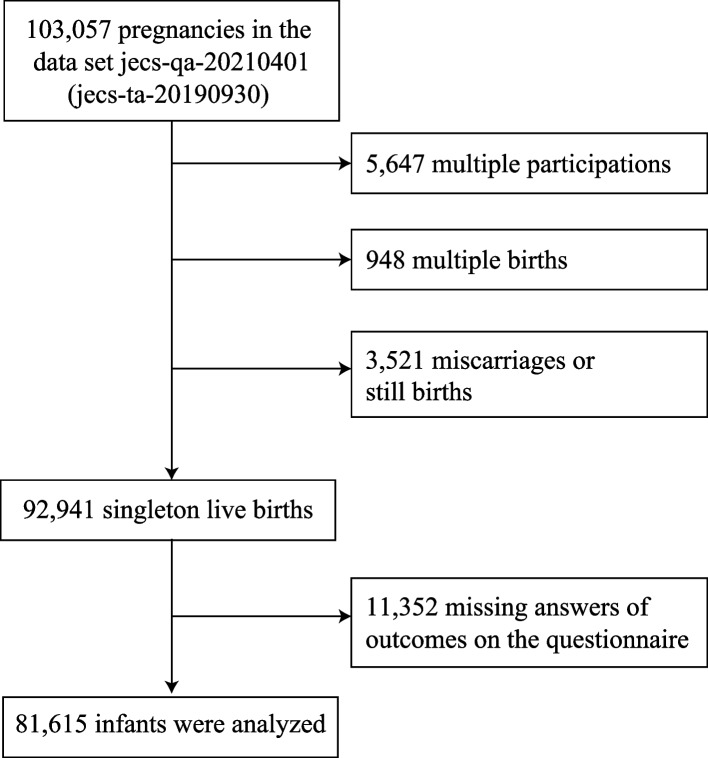
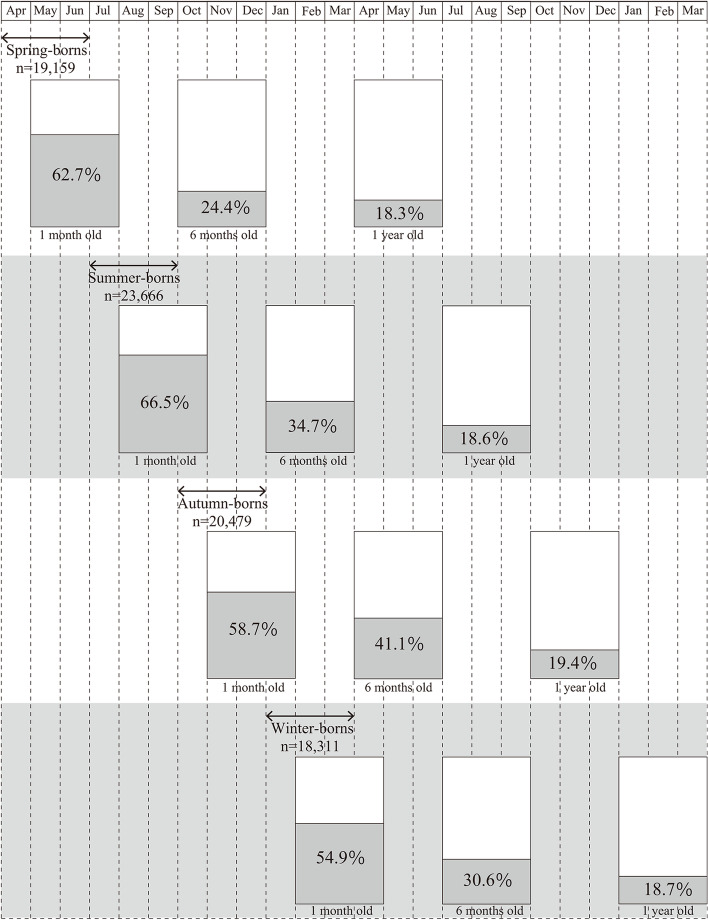
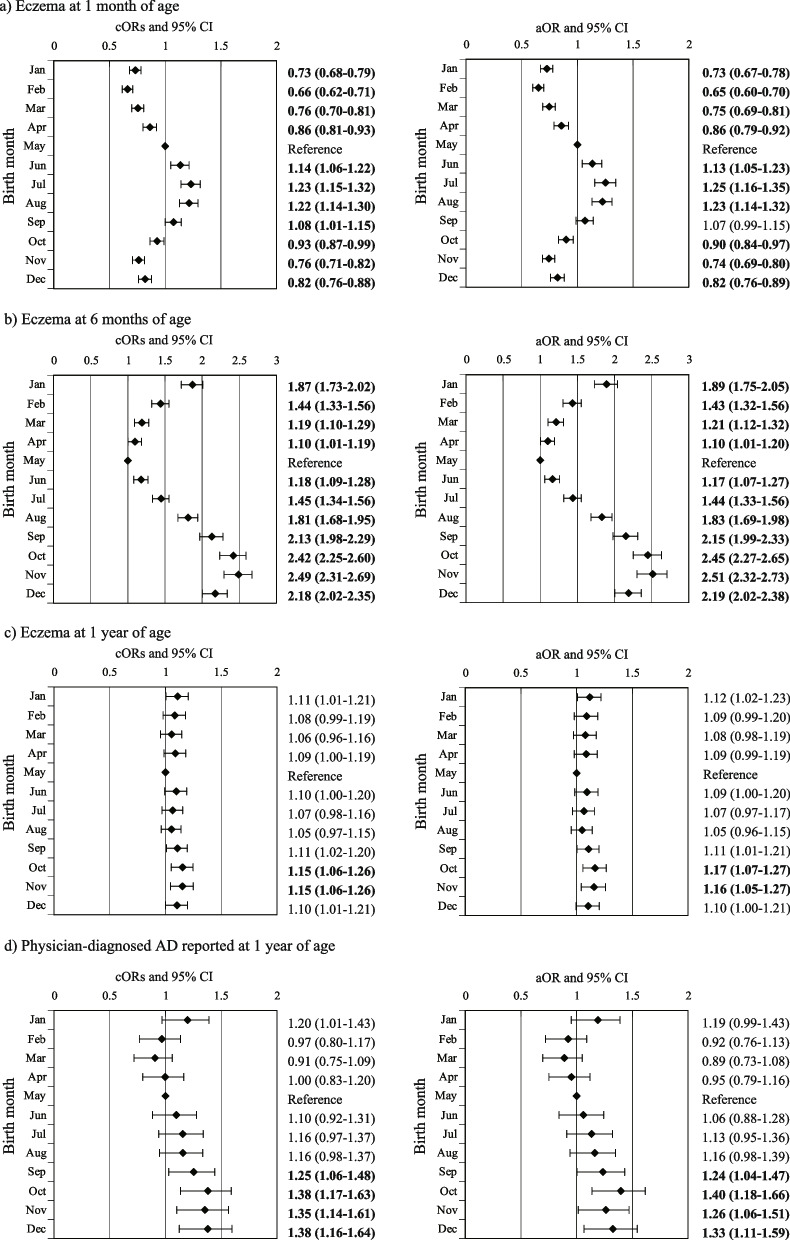
Using data of 81,615 infants from the Japan Environment and Children's Study, we examined the associations of birth month or season with four different outcomes-eczema at 1 month, 6 months, and 1 year of age and physician-diagnosed AD up to 1 year of age-using multiple logistic regression analysis. We also analyzed the effect of maternal history of allergic disease on these outcomes stratified by infant sex.
The risk of eczema at 1 month was highest in infants born in July. In contrast, infants born in autumn had higher risks of eczema at 6 months (adjusted odds ratio [aOR], 2.19; 95% confidence interval [CI], 2.10-2.30) and at 1 year (aOR, 1.08; 95% CI, 1.02-1.14) and of physician-diagnosed AD up to 1 year of age (aOR, 1.33; 95% CI, 1.20-1.47) compared with infants born in spring. Eczema and AD were more prevalent in infants with a maternal history of allergic disease, particularly boys.
Our findings suggest that the prevalence of AD is associated with the season of observation. Eczema is prevalent in infants born in autumn, and this phenomenon was observed in infants as young as 6 months old. The risk associated with being born in autumn was particularly clear in boys with a maternal history of allergic disease.
UMIN000030786.
据报道,秋季出生的特应性皮炎(AD)患儿比春季出生的患儿更为常见。在此,我们研究了在产后期间可以多早观察到出生季节与湿疹或 AD 之间的关联。我们还在一个大型日本队列中,检查了婴儿湿疹和 AD 的特定流行结果是否因性别和母亲过敏疾病史而异。
使用来自日本环境与儿童研究的 81615 名婴儿的数据,我们使用多变量逻辑回归分析,检查了出生月份或季节与四个不同结局(1 个月、6 个月和 1 岁时的湿疹以及 1 岁时的医生诊断的 AD)之间的关联。我们还根据婴儿性别,分析了母亲过敏疾病史对这些结局的影响。
1 个月时湿疹的风险在 7 月出生的婴儿中最高。相比之下,秋季出生的婴儿在 6 个月(调整后的优势比[aOR],2.19;95%置信区间[CI],2.10-2.30)和 1 岁(aOR,1.08;95%CI,1.02-1.14)时患有湿疹和 1 岁时患有医生诊断的 AD(aOR,1.33;95%CI,1.20-1.47)的风险更高,与春季出生的婴儿相比。有母亲过敏疾病史的婴儿中,湿疹和 AD 的发病率更高,尤其是男孩。
我们的研究结果表明,AD 的流行与观察季节有关。秋季出生的婴儿中湿疹更为常见,这种现象在 6 个月大的婴儿中就已经出现。有母亲过敏疾病史的秋季出生的男孩患病风险特别明显。
UMIN000030786。