Department of Psychology, University of Sheffield, Sheffield, UK.
UK Dementia Research Institute at University College London, University College London, London, UK.
Commun Biol. 2023 Feb 17;6(1):185. doi: 10.1038/s42003-023-04542-6.
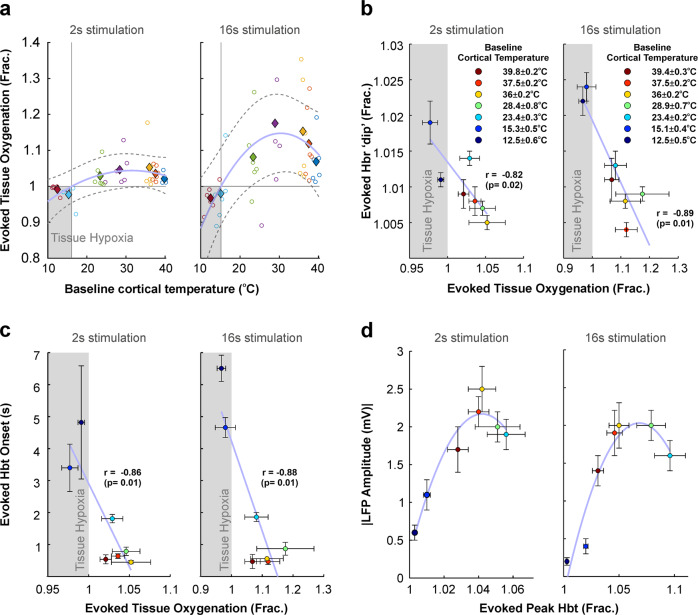
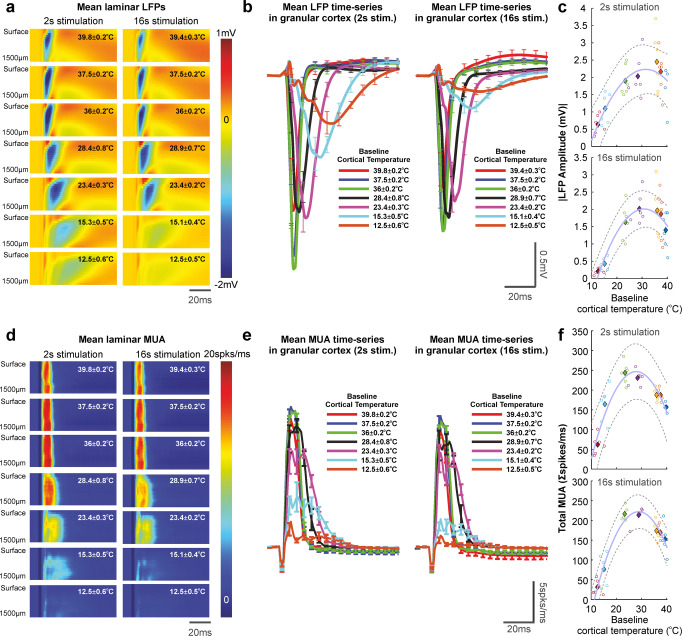
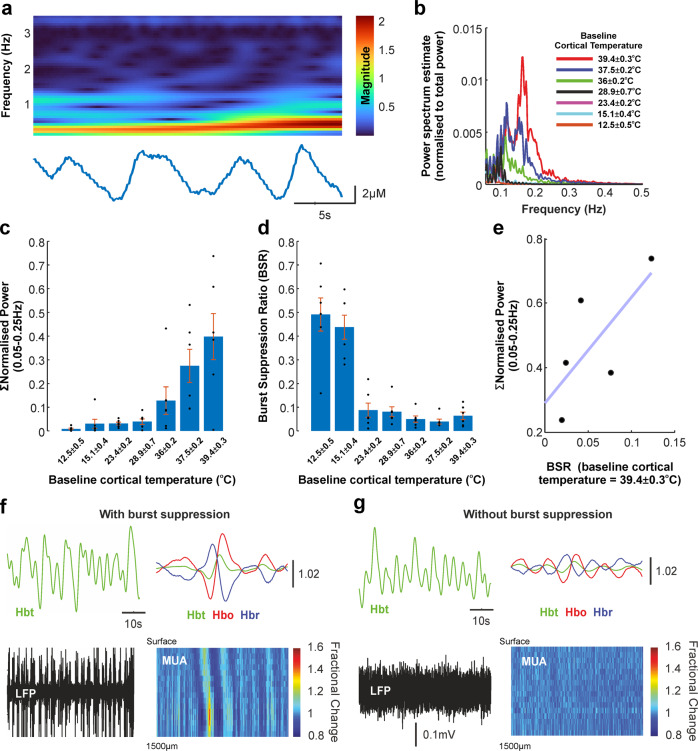
Neurovascular coupling (NVC) is a mechanism that, amongst other known and latent critical functions, ensures activated brain regions are adequately supplied with oxygen and glucose. This biological phenomenon underpins non-invasive perfusion-related neuroimaging techniques and recent reports have implicated NVC impairment in several neurodegenerative disorders. Yet, much remains unknown regarding NVC in health and disease, and only recently has there been burgeoning recognition of a close interplay with brain thermodynamics. Accordingly, we developed a novel multi-modal approach to systematically modulate cortical temperature and interrogate the spatiotemporal dynamics of sensory-evoked NVC. We show that changes in cortical temperature profoundly and intricately modulate NVC, with low temperatures associated with diminished oxygen delivery, and high temperatures inducing a distinct vascular oscillation. These observations provide novel insights into the relationship between NVC and brain thermodynamics, with important implications for brain-temperature related therapies, functional biomarkers of elevated brain temperature, and in-vivo methods to study neurovascular coupling.
神经血管耦合(NVC)是一种机制,它在其他已知和潜在的关键功能中,确保激活的大脑区域得到足够的氧气和葡萄糖供应。这种生物学现象是基于非侵入性的灌注相关神经影像学技术的,最近的报告表明,NVC 功能障碍与几种神经退行性疾病有关。然而,关于健康和疾病中的 NVC 仍有许多未知之处,并且直到最近才开始认识到它与大脑热力学之间存在密切的相互作用。因此,我们开发了一种新的多模态方法来系统地调节皮质温度,并探究感觉诱发的 NVC 的时空动力学。我们表明,皮质温度的变化深刻而复杂地调节了 NVC,低温与氧输送减少有关,而高温则诱导出一种独特的血管波动。这些观察结果为 NVC 与大脑热力学之间的关系提供了新的见解,对与大脑温度相关的治疗、大脑温度升高的功能生物标志物以及研究神经血管耦合的体内方法具有重要意义。