Neuroendocrine Unit, Department of Medicine, Massachusetts General Hospital and Harvard Medical School, Boston, MA, United States.
Eating Disorders Clinical and Research Program, Department of Psychiatry, Massachusetts General Hospital and Harvard Medical School, Boston, MA, United States.
Front Endocrinol (Lausanne). 2023 Jan 31;13:1049541. doi: 10.3389/fendo.2022.1049541. eCollection 2022.
Anorexia nervosa (AN) is commonly associated with depression, anxiety, and deficits in socioemotional functioning. Basal levels of oxytocin, a neurohormone with antidepressant, anxiolytic, and prosocial properties, are low in women with AN. However, the relationship between oxytocin and psychopathology of AN/atypical AN has not been examined in individuals with primarily food restriction (AN/AtypAN-R) or those with restriction plus binge/purge behaviors (AN/AtypAN-BP) alone, which is important to further elucidate the neurobiology of different AN presentations. We investigated whether oxytocin levels are related to eating, affective, and socioemotional psychopathology in women with AN/AtypAN-R and separately AN/AtypAN-BP.
In a cross-sectional study of 53 women with low-weight AN or atypical AN based on DSM-5 (AN/AtypAN-R: n=21, AN/AtypAN-BP: n=32), we obtained fasting serum oxytocin levels and self-report measures of psychopathology, including the Eating Disorder Examination-Questionnaire (EDE-Q), Beck Depression Inventory-IA (BDI), State-Trait Anxiety Inventory (STAI), and Toronto Alexithymia Scale (TAS-20).
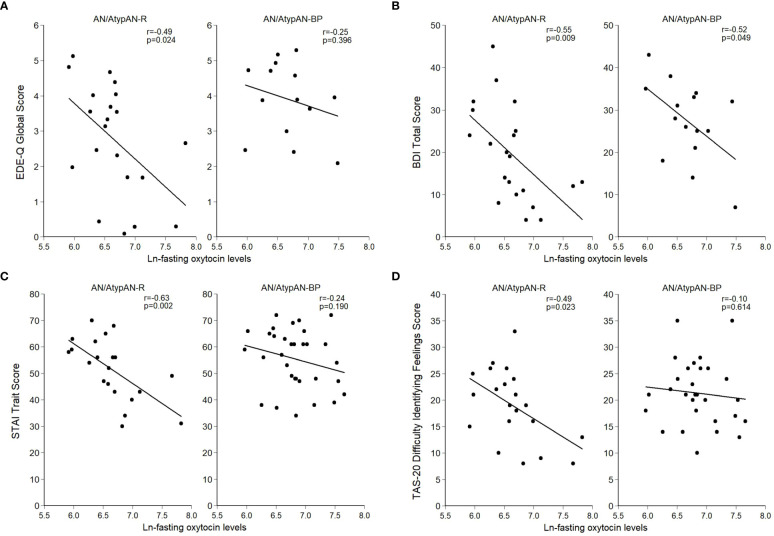
In individuals with AN/AtypAN-R, oxytocin levels were negatively associated with eating psychopathology (EDE-Q Global Score: r=-0.49, p=0.024), depressive and anxiety symptoms (BDI Total Score: r=-0.55, p=0.009; STAI Trait Score: r=-0.63, p=0.002), and socioemotional symptoms (TAS-20 Difficulty Identifying Feelings Score: r=-0.49, p=0.023). In contrast, in those with AN/AtypAN-BP oxytocin levels were negatively associated with depressive symptoms only (BDI Total Score: r=-0.52, p=0.049).
These findings support the notion that AN/AtypAN-R and AN/AtypAN-BP might have divergent underlying neurobiology. Understanding these differences is crucial to develop targeted treatments for a population with high levels of chronicity, for which no specific pharmacological treatments are currently available.
https://clinicaltrials.gov, identifier: NCT01121211.
神经性厌食症(AN)常与抑郁、焦虑和社会情感功能障碍有关。神经激素催产素的基础水平在患有 AN 的女性中较低,催产素有抗抑郁、抗焦虑和促进亲社会的特性。然而,在主要限制饮食的个体(AN/AtypAN-R)或仅限制加暴食/清除行为的个体(AN/AtypAN-BP)中,催产素与 AN/非典型 AN 的精神病理学之间的关系尚未得到检查,这对于进一步阐明不同 AN 表现的神经生物学很重要。我们研究了在 AN/AtypAN-R 和单独 AN/AtypAN-BP 的女性中,催产素水平是否与饮食、情感和社会情感精神病理学有关。
在一项基于 DSM-5 的低体重 AN 或非典型 AN 的 53 名女性的横断面研究中(AN/AtypAN-R:n=21,AN/AtypAN-BP:n=32),我们获得了空腹血清催产素水平和自我报告的精神病理学测量,包括饮食障碍检查问卷(EDE-Q)、贝克抑郁量表-IA(BDI)、状态-特质焦虑量表(STAI)和多伦多述情障碍量表(TAS-20)。
在 AN/AtypAN-R 个体中,催产素水平与饮食精神病理学(EDE-Q 总分:r=-0.49,p=0.024)、抑郁和焦虑症状(BDI 总分:r=-0.55,p=0.009;STAI 特质评分:r=-0.63,p=0.002)和社会情感症状(TAS-20 难以识别感受评分:r=-0.49,p=0.023)呈负相关。相比之下,在 AN/AtypAN-BP 个体中,催产素水平仅与抑郁症状呈负相关(BDI 总分:r=-0.52,p=0.049)。
这些发现支持 AN/AtypAN-R 和 AN/AtypAN-BP 可能具有不同的潜在神经生物学的观点。了解这些差异对于为一群慢性程度高的人群开发针对性治疗至关重要,目前尚无针对该人群的特定药物治疗方法。