Department of Occupational and Environmental Health Sciences, School of Public Health, Peking University, Beijing 100191, China.
Department of Occupational and Environmental Health Sciences, School of Public Health, Peking University, Beijing 100191, China.
J Sport Health Sci. 2024 Jan;13(1):72-80. doi: 10.1016/j.jshs.2023.02.002. Epub 2023 Feb 18.
Irritable bowel syndrome (IBS) substantially affects quality of life and requires early prevention. This study aimed to elucidate the relationships between IBS and daily behaviors, including sedentary behavior (SB), physical activity (PA), and sleep. In particular, it seeks to identify healthy behaviors to reduce IBS risk, which previous studies have rarely addressed.
Daily behaviors were retrieved from self-reported data of 362,193 eligible UK Biobank participants. Incident cases were determined by self-report or health care data according to Rome IV criteria.
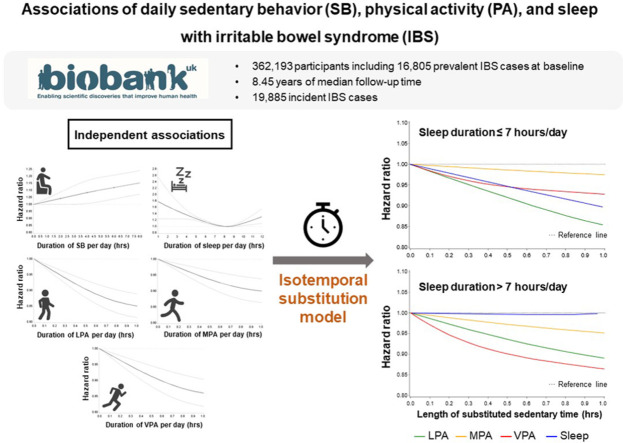
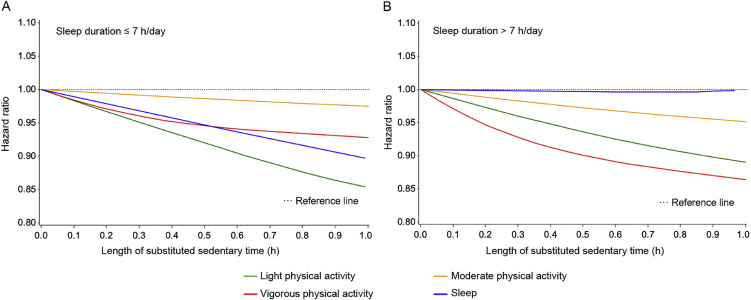
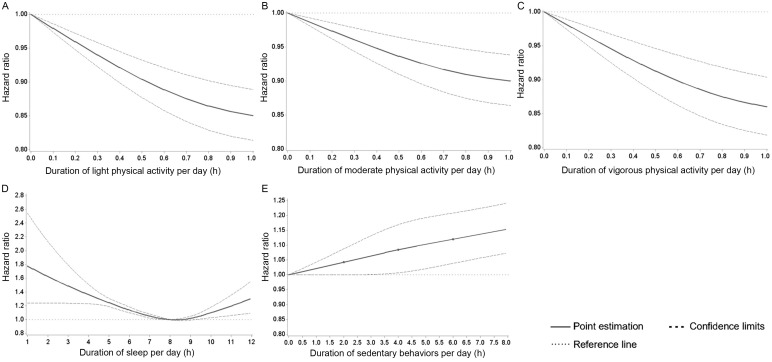
A total of 345,388 participants were IBS-free at baseline, during a median follow-up of 8.45 years, 19,885 incident IBS cases were recorded. When examined individually, SB and shorter (≤7 h/day) or longer (>7 h/day) sleep duration were each positively associated with increased IBS risk, and PA was associated with lower IBS risk. The isotemporal substitution model suggested that replacing SB with other activities could provide further protective effects against IBS risk. Among people sleeping ≤7 h/day, replacing 1 h of SB with equivalent light PA, vigorous PA, or sleep was associated with 8.1% (95% confidence interval (95%CI): 0.901-0.937), 5.8% (95%CI: 0.896-0.991), and 9.2% (95%CI: 0.885-0.932) reduced IBS risk, respectively. For people sleeping >7 h/day, light and vigorous PA were associated with a 4.8% (95%CI: 0.926-0.978) and a 12.0% (95%CI: 0.815-0.949) lower IBS risk, respectively. These benefits were mostly independent of genetic risk for IBS.
SB and unhealthy sleep duration are risk factors for IBS. A promising way to mitigate IBS risk for individuals sleeping ≤7 h/day and for those sleeping >7 h/day appears to be by replacing SB with adequate sleep or vigorous PA, respectively, regardless of the genetic predisposition of IBS.
肠易激综合征(IBS)严重影响生活质量,需要早期预防。本研究旨在阐明 IBS 与日常行为之间的关系,包括久坐行为(SB)、体力活动(PA)和睡眠。特别是,它旨在确定降低 IBS 风险的健康行为,这是以前的研究很少涉及的。
日常行为从符合条件的 362193 名英国生物银行参与者的自我报告数据中检索。根据罗马 IV 标准,通过自我报告或医疗保健数据确定病例。
共有 345388 名参与者在基线时无 IBS,中位随访 8.45 年后记录了 19885 例 IBS 事件。单独检查时,SB 以及较短(≤7 小时/天)或较长(>7 小时/天)的睡眠时间均与 IBS 风险增加相关,而 PA 与较低的 IBS 风险相关。等时替代模型表明,用其他活动替代 SB 可能会对 IBS 风险提供进一步的保护作用。对于睡眠时间≤7 小时/天的人,用等量的轻度 PA、剧烈 PA 或睡眠替代 1 小时的 SB,与 IBS 风险降低 8.1%(95%可信区间(95%CI):0.901-0.937)、5.8%(95%CI:0.896-0.991)和 9.2%(95%CI:0.885-0.932)相关。对于睡眠时间>7 小时/天的人,轻度和剧烈 PA 与 IBS 风险降低 4.8%(95%CI:0.926-0.978)和 12.0%(95%CI:0.815-0.949)相关。这些益处主要与 IBS 的遗传风险无关。
SB 和不健康的睡眠时间是 IBS 的危险因素。对于睡眠时间≤7 小时/天的个体和睡眠时间>7 小时/天的个体,通过用充足的睡眠或剧烈的 PA 替代 SB,似乎是减轻 IBS 风险的一种有希望的方法,而与 IBS 的遗传易感性无关。