Institute of Ecology and Evolution, School of Biological Sciences, University of Edinburgh, Edinburgh, EH9 3FL, UK.
GenPhySE, Université de Toulouse, INRAE, ENVT, 31326, Castanet-Tolosan, France.
Heredity (Edinb). 2023 Apr;130(4):242-250. doi: 10.1038/s41437-023-00602-z. Epub 2023 Feb 17.
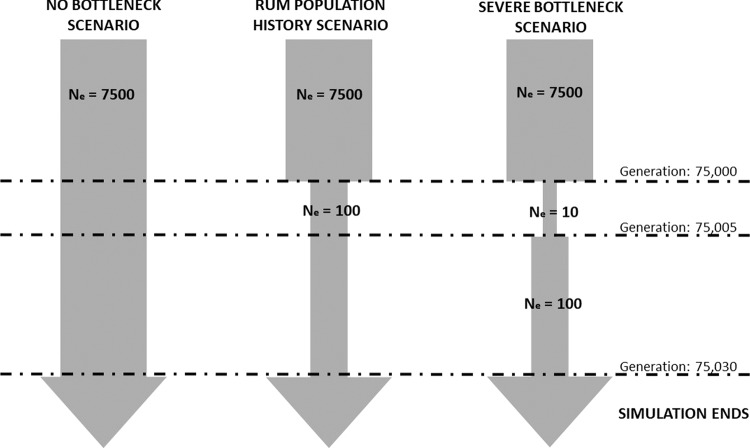
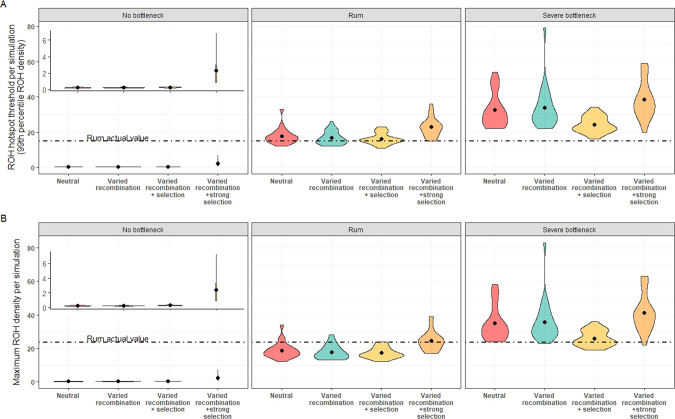
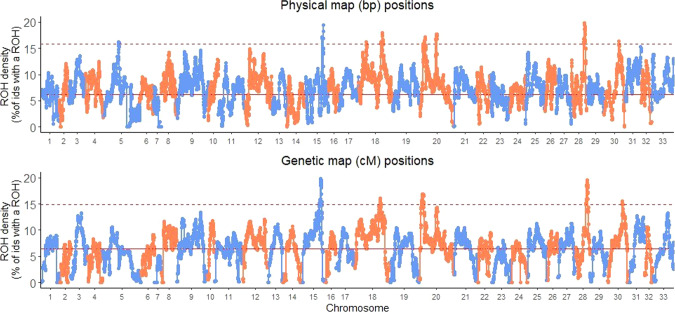
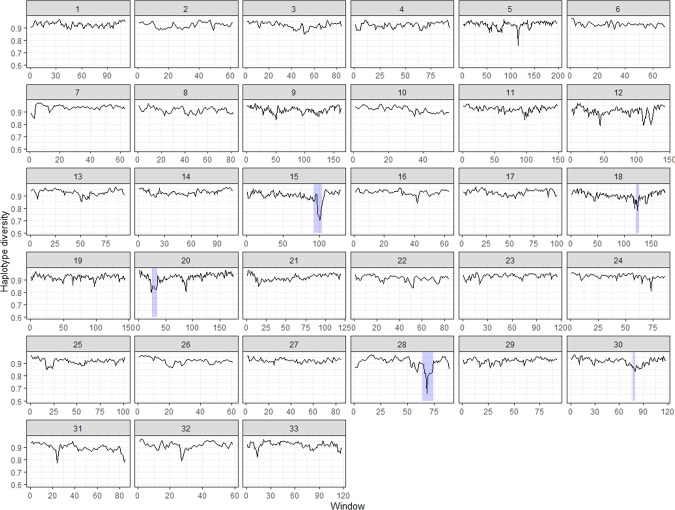
The distribution of runs of homozygosity (ROH) may be shaped by a number of interacting processes such as selection, recombination and population history, but little is known about the importance of these mechanisms in shaping ROH in wild populations. We combined an empirical dataset of >3000 red deer genotyped at >35,000 genome-wide autosomal SNPs and evolutionary simulations to investigate the influence of each of these factors on ROH. We assessed ROH in a focal and comparison population to investigate the effect of population history. We investigated the role of recombination using both a physical map and a genetic linkage map to search for ROH. We found differences in ROH distribution between both populations and map types indicating that population history and local recombination rate have an effect on ROH. Finally, we ran forward genetic simulations with varying population histories, recombination rates and levels of selection, allowing us to further interpret our empirical data. These simulations showed that population history has a greater effect on ROH distribution than either recombination or selection. We further show that selection can cause genomic regions where ROH is common, only when the effective population size (N) is large or selection is particularly strong. In populations having undergone a population bottleneck genetic drift can outweigh the effect of selection. Overall, we conclude that in this population, genetic drift resulting from a historical population bottleneck is most likely to have resulted in the observed ROH distribution, with selection possibly playing a minor role.
杂合子连续缺失(ROH)的分布可能受到多种相互作用的过程的影响,如选择、重组和种群历史,但对于这些机制在塑造野生种群中的 ROH 中的重要性知之甚少。我们结合了超过 3000 只红鹿的经验数据集,这些鹿在超过 35000 个全基因组常染色体 SNP 上进行了基因分型,并进行了进化模拟,以研究这些因素对 ROH 的影响。我们评估了焦点和比较种群中的 ROH,以研究种群历史的影响。我们使用物理图谱和遗传连锁图谱来研究重组的作用,以搜索 ROH。我们发现了两个种群和两种图谱类型之间的 ROH 分布差异,表明种群历史和局部重组率对 ROH 有影响。最后,我们使用不同的种群历史、重组率和选择水平进行了正向遗传模拟,使我们能够进一步解释我们的经验数据。这些模拟表明,种群历史对 ROH 分布的影响大于重组或选择。我们进一步表明,只有当有效种群大小(N)较大或选择特别强时,选择才能导致 ROH 常见的基因组区域。在经历种群瓶颈的种群中,遗传漂变的影响可能超过选择的影响。总的来说,我们得出的结论是,在这个种群中,历史上种群瓶颈导致的遗传漂变最有可能导致观察到的 ROH 分布,选择可能只起次要作用。