Department of Medicine, Seoul National University College of Medicine, Seoul, Republic of Korea.
Department of Family Medicine, Seoul National University Health Service Center, Seoul, Republic of Korea.
BMC Med. 2023 Feb 20;21(1):64. doi: 10.1186/s12916-023-02757-2.
To assess the association between the reproductive factors of age at menarche, age at menopause, and reproductive span and the incidence of myocardial infarction (MI) and ischemic stroke (IS).
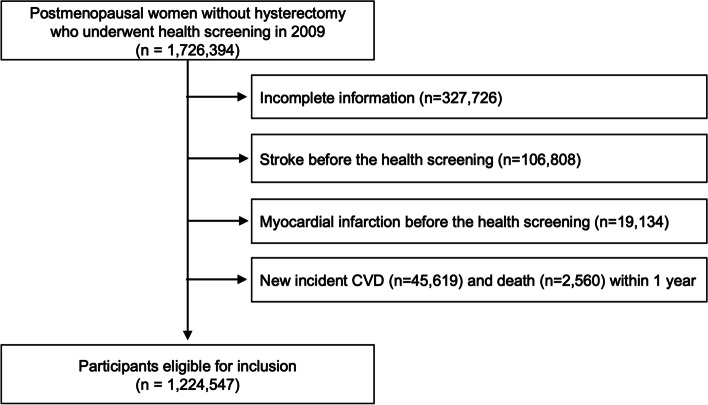
We used a population-based retrospective cohort study from the National Health Insurance Service database of Korea including a total of 1,224,547 postmenopausal women. Associations between age at menarche (≤ 12, 13-14 [reference], 15, 16, and ≥ 17 years), age at menopause (< 40, 40-45, 46-50, 51-54 [reference], and ≥ 55 years), and reproductive span (< 30, 30-33, 34-36, 37-40 [reference], and ≥ 41 years) and the incidence of MI and IS were assessed by Cox proportional hazard models with adjustment for traditional cardiovascular risk factors and various reproductive factors.
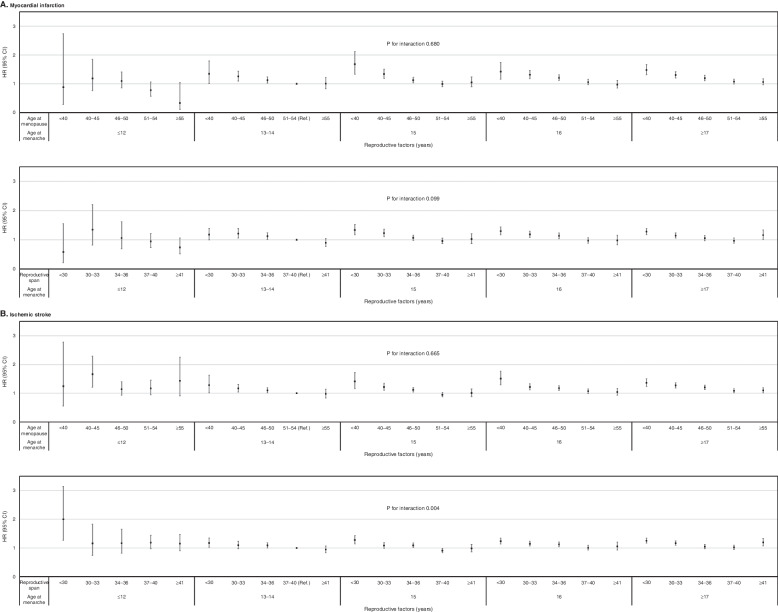
During a median follow-up of 8.4 years, 25,181 MI and 38,996 IS cases were identified. Late menarche (≥ 16 years), early menopause (≤ 50 years), and short reproductive span (≤ 36 years) were linearly associated with a 6%, 12-40%, and 12-32% higher risk of MI, respectively. Meanwhile, a U-shaped association between age at menarche and risk of IS was found, with a 16% higher risk in early menarche (≤ 12 years) and a 7-9% higher risk in late menarche (≥ 16 years). Short reproductive span was linearly associated with an increased risk of MI, whereas both shorter and longer reproductive spans were associated with an increased risk of IS.
This study demonstrated different patterns of association between age at menarche and incidence of MI and IS: a linear association for MI versus a U-shaped association for IS. Female reproductive factors in addition to traditional cardiovascular risk factors should be considered when assessing overall cardiovascular risk in postmenopausal women.
评估初潮年龄、绝经年龄和生殖期与心肌梗死(MI)和缺血性中风(IS)发生率之间的关联。
我们使用了来自韩国国家健康保险服务数据库的基于人群的回顾性队列研究,其中包括总共 1,224,547 名绝经后妇女。通过 Cox 比例风险模型评估初潮年龄(≤ 12、13-14[参考]、15、16 和≥17 岁)、绝经年龄(<40、40-45、46-50、51-54[参考]和≥55 岁)和生殖期(<30、30-33、34-36、37-40[参考]和≥41 岁)与 MI 和 IS 发生率之间的关联,并对传统心血管危险因素和各种生殖因素进行了调整。
在中位随访 8.4 年期间,确定了 25,181 例 MI 和 38,996 例 IS 病例。晚初潮(≥ 16 岁)、早绝经(≤ 50 岁)和短生殖期(≤ 36 岁)与 MI 风险分别增加 6%、12-40%和 12-32%线性相关。同时,初潮年龄与 IS 风险之间存在 U 形关联,初潮早(≤ 12 岁)风险增加 16%,晚初潮(≥ 16 岁)风险增加 7-9%。短生殖期与 MI 风险增加呈线性相关,而较短和较长的生殖期均与 IS 风险增加相关。
本研究表明初潮年龄与 MI 和 IS 发生率之间存在不同的关联模式:MI 呈线性关联,IS 呈 U 形关联。在评估绝经后女性的整体心血管风险时,除了传统心血管危险因素外,还应考虑女性生殖因素。