Department of Dermatology, Hanyang University College of Medicine, 222 Wangsimni-ro, Seongdong-gu, Seoul, 04763, Republic of Korea.
Department of Biotechnology, College of Life Sciences and Biotechnology, Korea University, Seoul, 02841, Republic of Korea.
Sci Rep. 2023 Feb 17;13(1):2869. doi: 10.1038/s41598-023-30103-2.
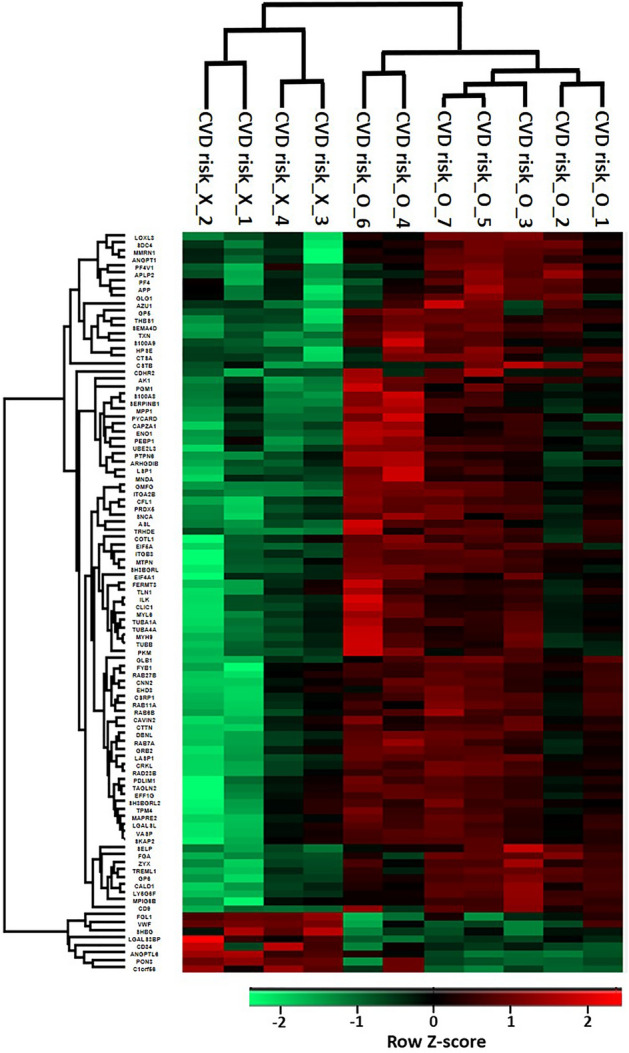
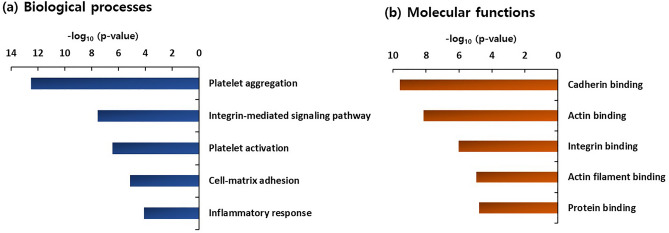
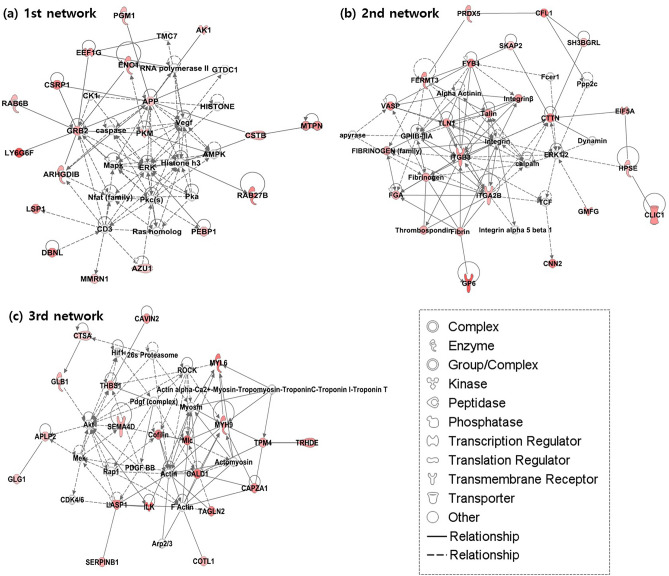
Although biomarker candidates associated with psoriasis have been suggested, those for predicting the risk of cardiovascular disease (CVD) early in patients with psoriasis are lacking. We aimed to identify candidate biomarkers that can predict the occurrence of CVD in psoriasis patients. We pursued quantitative proteomic analysis of serum samples composed of three groups: psoriasis patients with and those without CVD risk factors, and healthy controls. Age/Sex-matched serum samples were selected and labeled with 16-plex tandem mass tag (TMT) and analyzed using liquid chromatography-mass spectrometry and subsequent verification with ELISA. Of the 184 proteins that showed statistical significance (P-value < 0.05) among the three groups according to TMT-based quantitative analysis, 98 proteins showed significant differences (> 2.0-fold) between the psoriasis groups with and without CVD risk factors. Verification by ELISA revealed that caldesmon (CALD1), myeloid cell nuclear differentiation antigen (MNDA), and zyxin (ZYX) levels were significantly increased in the psoriasis group with CVD risk factors. Further network analysis identified pathways including integrin signaling, which could be related to platelet aggregation, and actin cytoskeleton signaling. Three novel candidates (MNDA, ZYX, and CALD1) could be potential biomarkers for predicting CVD risks in psoriasis patients. We expect these biomarker candidates can be used to predict CVD risk in psoriasis patients in clinical settings although further studies including large validation are needed.
虽然已经提出了与银屑病相关的生物标志物候选物,但缺乏预测银屑病患者早期心血管疾病(CVD)风险的生物标志物。我们旨在确定可以预测银屑病患者发生 CVD 的候选生物标志物。我们对由三组组成的血清样本进行了定量蛋白质组学分析:有和没有 CVD 危险因素的银屑病患者,以及健康对照者。选择年龄/性别匹配的血清样本并标记为 16-plex 串联质量标签(TMT),然后使用液相色谱-质谱法进行分析,并使用 ELISA 进行后续验证。根据 TMT 定量分析,三组之间有 184 种蛋白质具有统计学意义(P 值<0.05),其中 98 种蛋白质在有和没有 CVD 危险因素的银屑病组之间存在显著差异(>2.0 倍)。ELISA 验证显示,钙调蛋白(CALD1)、髓样细胞核分化抗原(MNDA)和纽蛋白(ZYX)水平在有 CVD 危险因素的银屑病组中显着增加。进一步的网络分析确定了包括整合素信号在内的途径,这可能与血小板聚集有关,以及肌动蛋白细胞骨架信号。MNDA、ZYX 和 CALD1 这三个新的候选物(MNDA、ZYX 和 CALD1)可能是预测银屑病患者 CVD 风险的潜在生物标志物。虽然需要进一步包括大样本验证的研究,但我们期望这些生物标志物候选物可以在临床环境中用于预测银屑病患者的 CVD 风险。