Center for Advanced Resuscitation Medicine, Department of Emergency Medicine, University of Illinois at Chicago, Chicago, Illinois, USA.
Department of Physiology and Biophysics, University of Illinois at Chicago, Chicago, Illinois, USA.
Physiol Rep. 2023 Feb;11(4):e15611. doi: 10.14814/phy2.15611.
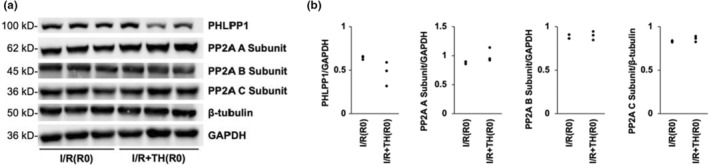
Therapeutic hypothermia (TH) provides cardioprotection from ischemia/reperfusion (I/R) injury. However, it remains unknown how TH regulates metabolic recovery. We tested the hypothesis that TH modulates PTEN, Akt, and ERK1/2, and improves metabolic recovery through mitigation of fatty acid oxidation and taurine release. Left ventricular function was monitored continuously in isolated rat hearts subjected to 20 min of global, no-flow ischemia. Moderate cooling (30°C) was applied at the start of ischemia and hearts were rewarmed after 10 min of reperfusion. The effect of TH on protein phosphorylation and expression at 0 and 30 min of reperfusion was investigated by western blot analysis. Post-ischemic cardiac metabolism was investigated by C-NMR. TH enhanced recovery of cardiac function, reduced taurine release, and enhanced PTEN phosphorylation and expression. Phosphorylation of Akt and ERK1/2 was increased at the end of ischemia but decreased at the end of reperfusion. On NMR analysis, TH-treated hearts displayed decreased fatty acid oxidation. Direct cardioprotection by moderate intra-ischemic TH is associated with decreased fatty acid oxidation, reduced taurine release, enhanced PTEN phosphorylation and expression, and enhanced activation of both Akt and ERK1/2 prior to reperfusion.
治疗性低温(TH)可提供针对缺血/再灌注(I/R)损伤的心脏保护。然而,目前尚不清楚 TH 如何调节代谢恢复。我们检验了以下假说:TH 调节 PTEN、Akt 和 ERK1/2,并通过减轻脂肪酸氧化和牛磺酸释放来改善代谢恢复。在经历 20 分钟全流量缺血的分离大鼠心脏中连续监测左心室功能。在缺血开始时应用中度冷却(30°C),并在再灌注 10 分钟后复温。通过 Western blot 分析研究 TH 对再灌注 0 和 30 分钟时蛋白磷酸化和表达的影响。通过 C-NMR 研究缺血后心脏代谢。TH 增强了心脏功能的恢复,减少了牛磺酸的释放,并增强了 PTEN 的磷酸化和表达。Akt 和 ERK1/2 的磷酸化在缺血末期增加,但在再灌注末期减少。在 NMR 分析中,TH 处理的心脏显示出减少的脂肪酸氧化。适度的缺血期内 TH 的直接心脏保护与减少的脂肪酸氧化、减少的牛磺酸释放、增强的 PTEN 磷酸化和表达以及再灌注前 Akt 和 ERK1/2 的激活增强有关。