Department of Radiation Medicine, Roswell Park Comprehensive Cancer Center, Buffalo, New York.
University at Buffalo, The State University of New York, Buffalo.
JAMA Netw Open. 2023 Feb 1;6(2):e230179. doi: 10.1001/jamanetworkopen.2023.0179.
While low income has been associated with a higher incidence of triple-negative breast cancer, its association with 21-gene recurrence score (RS) among patients with estrogen receptor (ER)-positive breast cancer remains unclear.
To evaluate the association of household income with RS and overall survival (OS) among patients with ER-positive breast cancer.
DESIGN, SETTING, AND PARTICIPANTS: This cohort study used data from the National Cancer Database. Eligible participants included women diagnosed between 2010 and 2018 with ER-positive, pT1-3N0-1aM0 breast cancer who received surgery followed by adjuvant endocrine therapy with or without chemotherapy. Data analysis was performed from July 2022 to September 2022.
Low vs high neighborhood-level household income levels defined as below vs above the median household income of $50 353 based on each patient's zip code.
RS (a score ranged from 0 to 100 based on gene expression signatures indicating the risk of distant metastasis, with RS of 25 or below indicating non-high risk and RS above 25 indicating high risk) and OS.
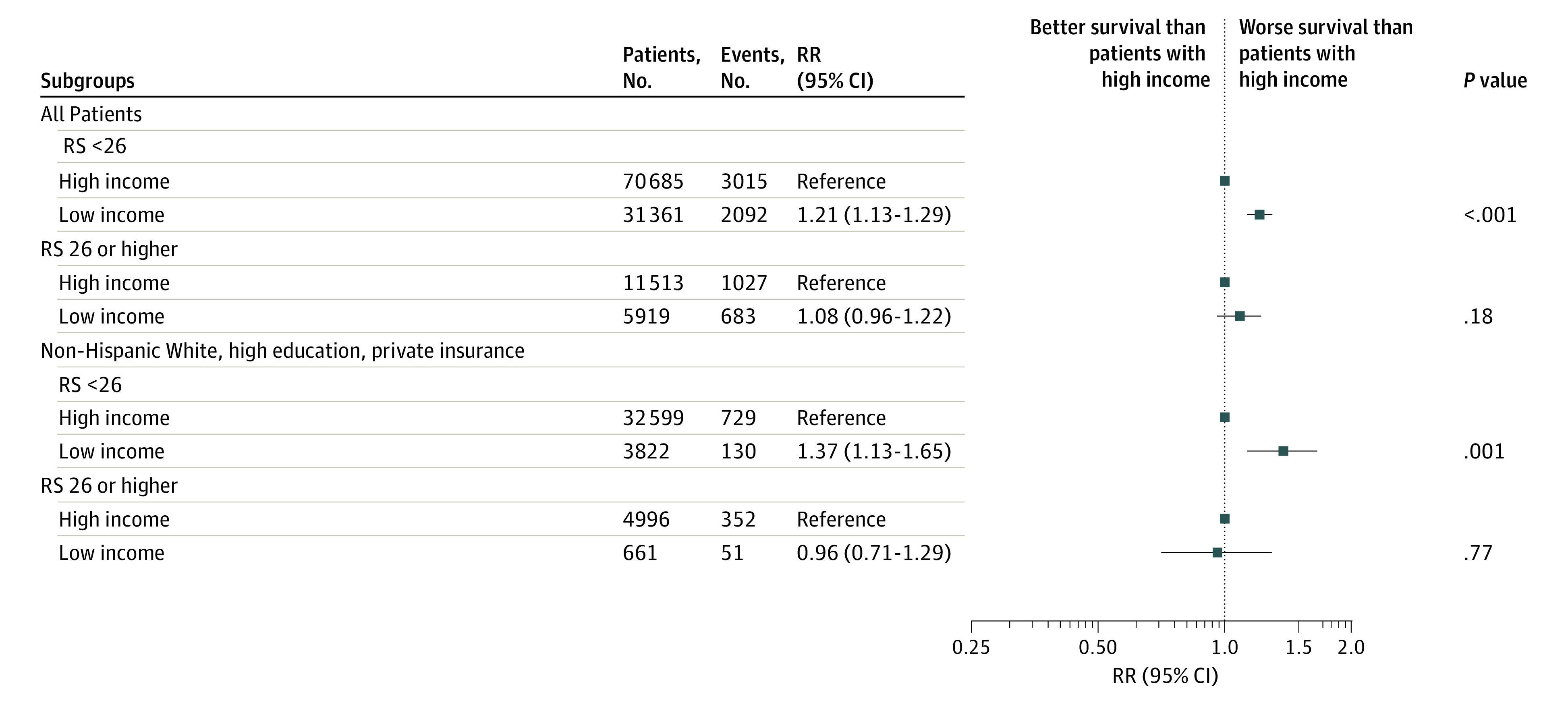
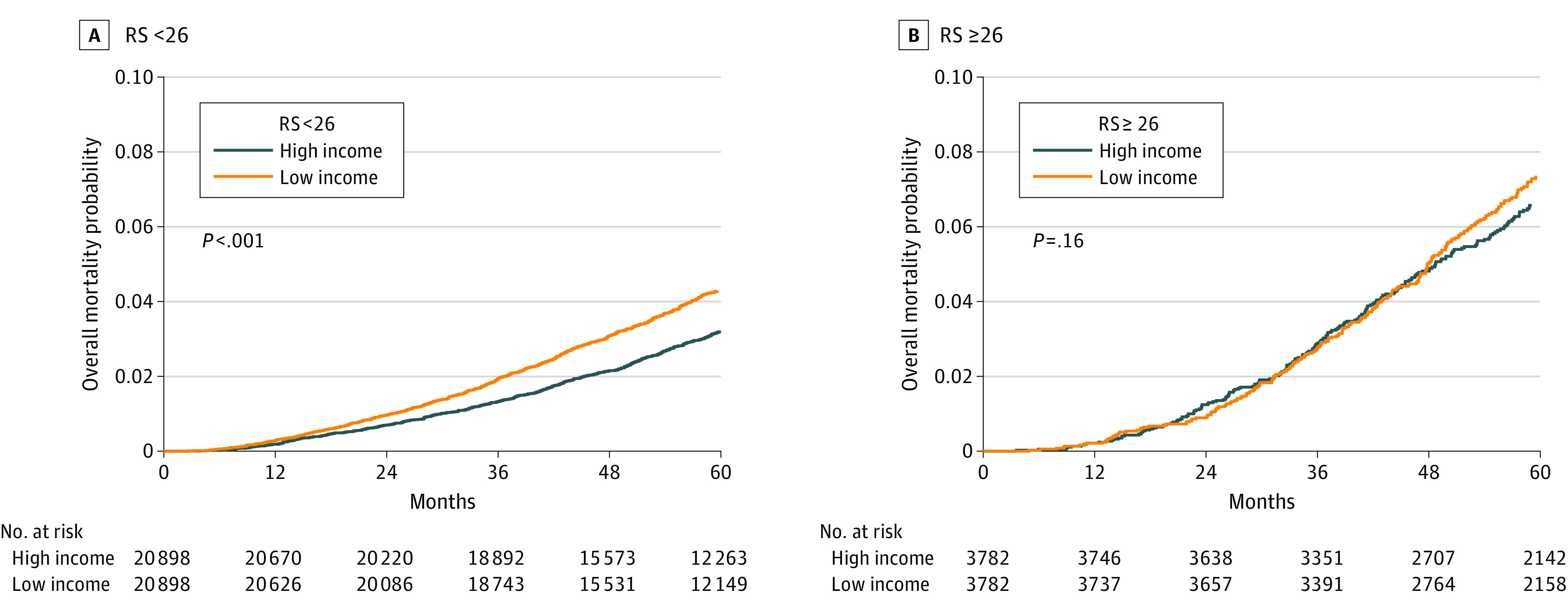
Among 119 478 women (median [IQR] age, 60 [52-67] years; 4737 [4.0%] Asian and Pacific Islander, 9226 [7.7%] Black, 7245 [6.1%] Hispanic, 98 270 [82.2%] non-Hispanic White), 82 198 (68.8%) and 37 280 (31.2%) patients had high and low income, respectively. Logistic multivariable analysis (MVA) showed that, compared with high income, low income was associated with higher RS (adjusted odds ratio [aOR], 1.11; 95% CI, 1.06-1.16). Cox MVA showed that low income was also associated with worse OS (adjusted hazards ratio [aHR], 1.18; 95% CI, 1.11-1.25). Interaction term analysis showed a statistically significant interaction between income levels and RS (interaction P < .001). On subgroup analysis, significant findings were noted among those with RS below 26 (aHR, 1.21; 95% CI, 1.13-1.29), while there was no significant OS difference between income levels among others with RS of 26 or higher (aHR, 1.08; 95% CI, 0.96-1.22).
Our study suggested that low household income was independently associated with higher 21-gene recurrence scores and significantly worse survival outcomes among those with scores below 26, but not 26 or higher. Further studies are warranted to investigate the association between socioeconomic determinants of health and intrinsic tumor biology among patients with breast cancer.
虽然低收入与三阴性乳腺癌的发病率较高有关,但它与雌激素受体 (ER) 阳性乳腺癌患者的 21 基因复发评分 (RS) 之间的关系仍不清楚。
评估家庭收入与 ER 阳性乳腺癌患者 RS 和总生存 (OS) 的关系。
设计、地点和参与者:这项队列研究使用了国家癌症数据库的数据。符合条件的参与者包括 2010 年至 2018 年间诊断为 ER 阳性、pT1-3N0-1aM0 乳腺癌的女性,她们接受了手术,随后接受了辅助内分泌治疗,无论是否联合化疗。数据分析于 2022 年 7 月至 2022 年 9 月进行。
低与高邻里家庭收入水平定义为低于或高于每位患者邮政编码的中位数家庭收入 50353 美元。
RS(基于基因表达特征的评分范围为 0 至 100,表明远处转移的风险,RS 为 25 或以下表示非高风险,RS 高于 25 表示高风险)和 OS。
在 119478 名女性(中位 [IQR] 年龄,60 [52-67] 岁;4737[4.0%]亚裔和太平洋岛民,9226[7.7%]黑人,7245[6.1%]西班牙裔,98270[82.2%]非西班牙裔白人)中,82198 名(68.8%)和 37280 名(31.2%)患者的收入较高和较低。逻辑多变量分析(MVA)显示,与高收入相比,低收入与更高的 RS 相关(调整优势比 [aOR],1.11;95%CI,1.06-1.16)。Cox MVA 还显示,低收入与较差的 OS 相关(调整后的危险比 [aHR],1.18;95%CI,1.11-1.25)。交互项分析显示,收入水平与 RS 之间存在统计学显著的交互作用(交互 P<0.001)。亚组分析显示,在 RS 低于 26 的患者中存在显著差异(aHR,1.21;95%CI,1.13-1.29),而在 RS 为 26 或更高的患者中,收入水平之间的 OS 差异无统计学意义(aHR,1.08;95%CI,0.96-1.22)。
我们的研究表明,低收入与 21 基因复发评分较高以及评分低于 26 的患者的生存结局显著较差独立相关,但与评分 26 或更高的患者无关。需要进一步的研究来探讨健康的社会经济决定因素与乳腺癌患者内在肿瘤生物学之间的关系。