Department of Pharmacy, Beijing Shijitan Hospital, Capital Medical University, Beijing, 100038, China.
Beijing Key Laboratory of Bio-Characteristic Profiling for Evaluation of Rational Drug Use, Beijing, 100038, China.
BMC Health Serv Res. 2023 Feb 21;23(1):176. doi: 10.1186/s12913-023-09164-6.
With the reform of medical system in China, Beijing municipal hospitals explored a new pharmaceutical care model and set up medication therapy management services (MTMs) in ambulatory care since 2019. We were one of the first hospitals to set up this service in China. At the present, there were relatively few reports about the effect of MTMs in China. In this study, we summarized the implementation of MTMs in our hospital, explore the feasibility of pharmacist-led MTMs in ambulatory care and the impact of MTMs on patients' medical costs.
A retrospective study was conducted in a university-affiliated, tertiary comprehensive hospital in Beijing, China. The patients who received at least one MTMs and with complete medical records and pharmaceutical documents from May 2019 to February 2020 were included. Pharmacists provided pharmaceutical care for patients according to the MTMs standards issued by the American Pharmacists Association, identified the numbers and classification of the patients' perceived medication-related demands, identified medication-related problems (MRPs), and developed the medication-related action plans (MAPs). All MRPs found by pharmacists, pharmaceutical interventions, and resolving recommendations were documented, and calculate the cost of treatment drugs that patients can reduce.
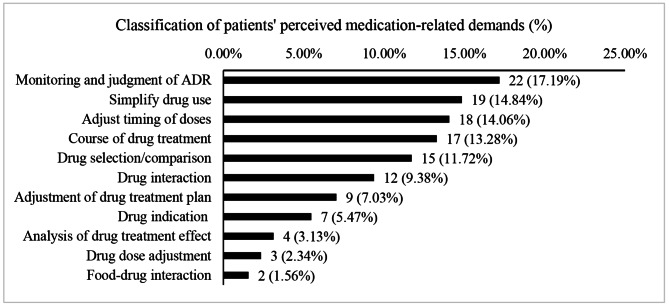
A total of 112 patients received MTMs in ambulatory care, among them 81 cases with the completed record were included in this study. 67.9% of patients had five or more diseases, 83% of them co-took over 5 drugs. While performing MTMs, 128 patients' perceived medication-related demands were recorded in all, monitoring and judgment of adverse drug reaction (ADR) (17.19%) was the most common demand. 181 MRPs were found, with an average of 2.55 MPRs per patient. Nonadherence (38%), excessive drug treatment (20%), and adverse drug events (17.12%) were the top three MRPs. Pharmaceutical care (29.77%), adjustment of drug treatment plan (29.10%) and referral to the clinical department (23.41%) were the top three MAPs. Whereby the MTMs provided by pharmacists, the cost-saving of each patient was about $ 43.2 monthly.
By participating in the MTMs of outpatients, the pharmacists could identify more MRPs and develop personalized MAPs timely for patients, thereby promoting rational drug use and reducing medical expenses.
随着中国医疗体制改革的推进,北京市属医院探索新的药学服务模式,自 2019 年起在门急诊开展用药治疗管理服务(MTM)。我院是国内最早开展此项服务的医院之一。目前,国内关于 MTM 效果的报道较少。本研究总结我院 MTM 的实施情况,探讨药师主导的 MTM 在门急诊中的可行性及对患者医疗费用的影响。
采用回顾性研究方法,选取 2019 年 5 月至 2020 年 2 月在我院接受至少一次 MTM 且病历及药学文档完整的患者。药师依据美国药剂师协会发布的 MTM 标准为患者提供药学服务,识别患者感知的用药相关需求的数量和分类,识别用药相关问题(MRP),制定用药相关行动计划(MAP)。记录药师发现的所有 MRP、药学干预及解决建议,并计算患者可减少的治疗药物费用。
共 112 例患者接受了门急诊 MTM,其中完成记录的 81 例患者纳入本研究。67.9%的患者患有 5 种及以上疾病,83%的患者同时服用 5 种及以上药物。在实施 MTM 的过程中,共记录了 128 例患者的感知用药相关需求,其中监测和判断药物不良反应(ADR)(17.19%)最为常见。共发现 181 例 MRP,平均每位患者 2.55 例。不依从(38%)、过度药物治疗(20%)和药物不良事件(17.12%)是前 3 位的 MRP。药学服务(29.77%)、药物治疗计划调整(29.10%)和转至临床科室(23.41%)是前 3 位的 MAP。通过药师提供的 MTM,每位患者的每月节省费用约为 43.2 美元。
药师参与门急诊 MTM 可以及时发现更多的 MRP,并为患者制定个性化的 MAP,从而促进合理用药,降低医疗费用。