
从人类恐惧条件反射的角度理解临床恐惧与焦虑。
Understanding clinical fear and anxiety through the lens of human fear conditioning.
作者信息
Beckers Tom, Hermans Dirk, Lange Iris, Luyten Laura, Scheveneels Sara, Vervliet Bram
机构信息
Faculty of Psychology and Educational Sciences, KU Leuven, Leuven, Belgium.
Leuven Brain Institute, KU Leuven, Leuven, Belgium.
出版信息
Nat Rev Psychol. 2023;2(4):233-245. doi: 10.1038/s44159-023-00156-1. Epub 2023 Feb 16.
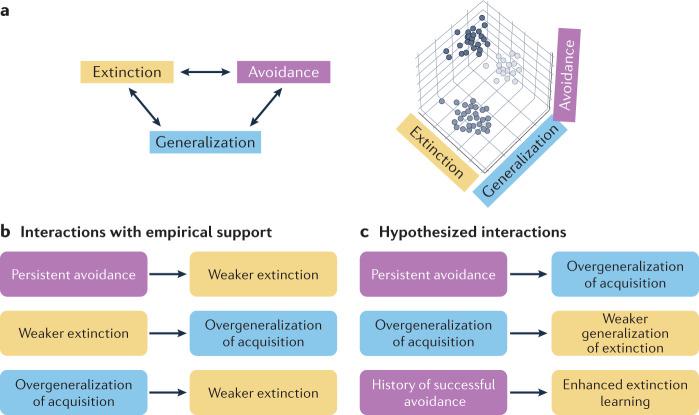
Fear is an adaptive emotion that mobilizes defensive resources upon confrontation with danger. However, fear becomes maladaptive and can give rise to the development of clinical anxiety when it exceeds the degree of threat, generalizes broadly across stimuli and contexts, persists after the danger is gone or promotes excessive avoidance behaviour. Pavlovian fear conditioning has been the prime research instrument that has led to substantial progress in understanding the multi-faceted psychological and neurobiological mechanisms of fear in past decades. In this Perspective, we suggest that fruitful use of Pavlovian fear conditioning as a laboratory model of clinical anxiety requires moving beyond the study of fear acquisition to associated fear conditioning phenomena: fear extinction, generalization of conditioned fear and fearful avoidance. Understanding individual differences in each of these phenomena, not only in isolation but also in how they interact, will further strengthen the external validity of the fear conditioning model as a tool with which to study maladaptive fear as it manifests in clinical anxiety.
恐惧是一种适应性情绪,在面临危险时会调动防御资源。然而,当恐惧超过威胁程度、广泛泛化到各种刺激和情境、在危险消失后仍持续存在或促使过度回避行为时,它就会变得适应不良,并可能导致临床焦虑的发展。在过去几十年里,巴甫洛夫式恐惧条件反射一直是主要的研究工具,在理解恐惧的多方面心理和神经生物学机制方面取得了重大进展。在这篇观点文章中,我们认为,要将巴甫洛夫式恐惧条件反射作为临床焦虑的实验室模型加以有效利用,就需要超越对恐惧习得的研究,转而关注相关的恐惧条件反射现象:恐惧消退、条件性恐惧的泛化和恐惧回避。了解这些现象中每一种现象的个体差异,不仅要孤立地了解,还要了解它们之间的相互作用方式,这将进一步增强恐惧条件反射模型作为一种研究临床焦虑中出现的适应不良恐惧的工具的外部效度。


 Zotero 插件