Department of Psychology, St. Jude Children's Research Hospital, Memphis, Tennessee, USA.
Department of Biostatistics, St. Jude Children's Research Hospital, Memphis, Tennessee, USA.
Pediatr Blood Cancer. 2023 May;70(5):e30259. doi: 10.1002/pbc.30259. Epub 2023 Feb 23.
Sickle cell disease (SCD) is associated with poor neurocognitive outcomes due to biomedical and psychosocial factors. The aims of this study were to investigate associations between household and neighborhood socioeconomic status (SES) with cognitive and academic outcomes in SCD and to determine if these relationships were modified by sickle genotype, fetal hemoglobin, or age.
We prospectively recruited patients to complete a battery of neurocognitive and academic measures. Household SES was measured using the Barratt Simplified Measure of Social Status, a composite index of parent education and occupation. The Social Vulnerability Index was used to classify individuals based on social vulnerabilities at the neighborhood level.
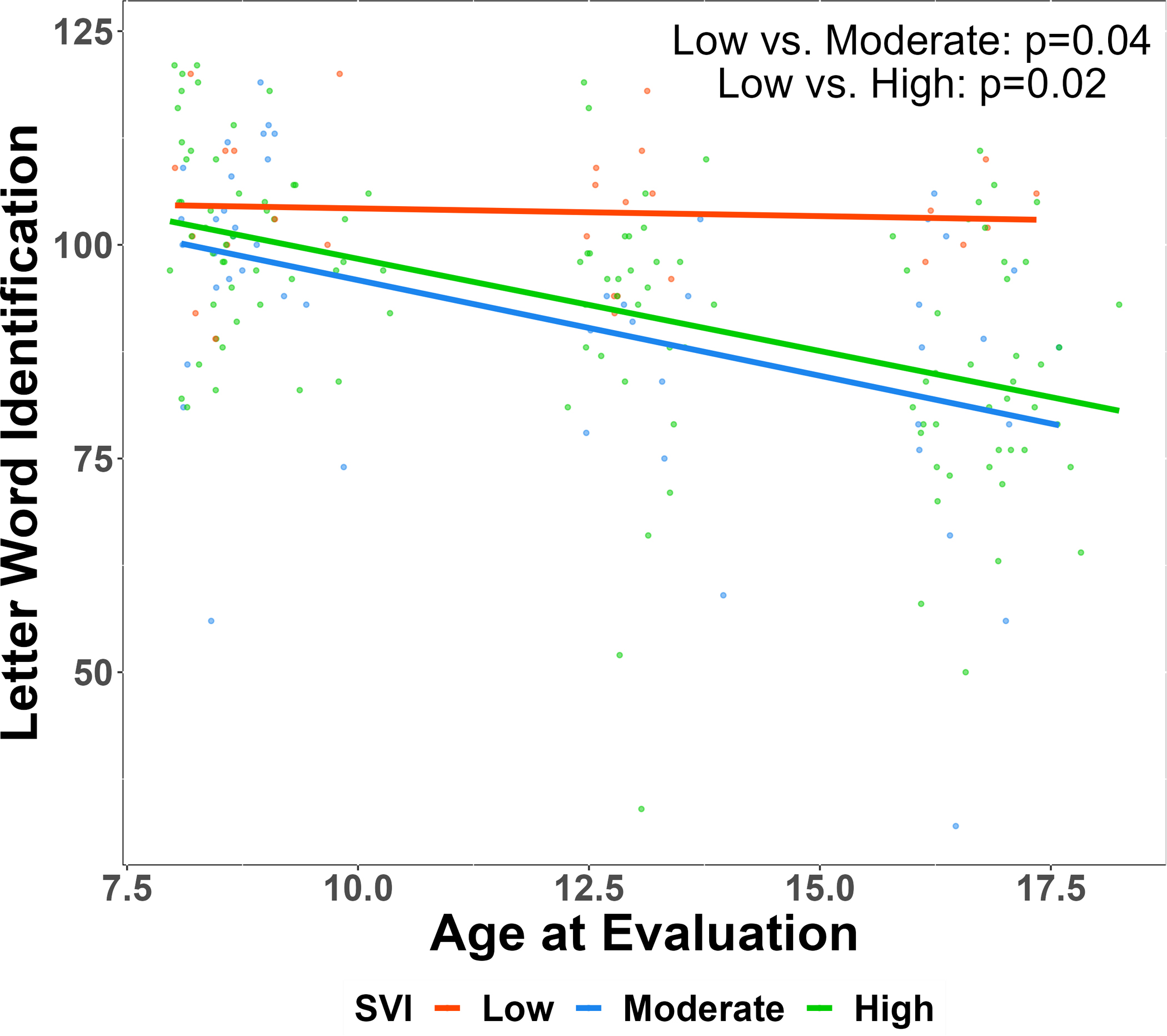
Overall, 299 patients between the ages of 4 and 18 (mean = 11.4, standard deviation = 4.3) years diagnosed with SCD (57% SS/SB -thalassemia) completed testing. Stepwise multivariate models demonstrated that patients with low social vulnerability (i.e., high SES) at the neighborhood level displayed intelligence and math scores that were 4.70 and 7.64 points higher than those living in areas with moderate social vulnerability, respectively (p < .05). Reading performance did not differ based on neighborhood SES; however, the effect of neighborhood SES was dependent on age, such that older participants living in neighborhoods with moderate or high levels of social vulnerability displayed poorer reading scores than those with low social vulnerability (p < .05).
This study identified patients with SCD at higher risk of poor academic performance based on SES. Interventions addressing academic difficulties should be offered to all children with SCD, but should be emergently offered to this subpopulation.
镰状细胞病(SCD)与生物医学和社会心理因素有关,认知结果较差。本研究的目的是调查家庭和邻里社会经济地位(SES)与 SCD 患者认知和学业结果之间的关系,并确定这些关系是否受镰状细胞基因型、胎儿血红蛋白或年龄的影响。
我们前瞻性招募了患者,以完成一系列神经认知和学术测试。家庭 SES 通过使用巴雷特简化社会地位衡量标准来衡量,这是父母教育和职业的综合指数。社会脆弱性指数用于根据社区层面的社会脆弱性对个体进行分类。
总体而言,299 名年龄在 4 至 18 岁之间(平均年龄 11.4 岁,标准差 4.3 岁)诊断为 SCD(57% SS/SB -地中海贫血)的患者完成了测试。逐步多元模型表明,社区层面社会脆弱性低(即 SES 高)的患者智力和数学得分分别比居住在中度社会脆弱性地区的患者高 4.70 和 7.64 分(p <.05)。阅读成绩不因社区 SES 而异;但是,社区 SES 的影响取决于年龄,即居住在中度或高度社会脆弱性社区的年长参与者的阅读成绩比社会脆弱性较低的参与者差(p <.05)。
本研究根据 SES 确定了 SCD 患者中存在阅读成绩较差风险较高的患者。应向所有 SCD 患儿提供解决学业困难的干预措施,但应紧急向这一亚群提供。