Medas Fabio, Moroni Enrico, Deidda Simona, Zorcolo Luigi, Restivo Angelo, Canu Gian Luigi, Cappellacci Federico, Calò Pietro Giorgio, Pintus Stefano, Fantola Giovanni
Department of Surgical Sciences, University of Cagliari, Cagliari, Italy.
Obesity Surgery Unit, Surgical Department, "ARNAS G. Brotzu" Hospital, Cagliari, Italy.
Front Surg. 2023 Feb 2;10:1100483. doi: 10.3389/fsurg.2023.1100483. eCollection 2023.
Superobesity (SO) is defined as a BMI > 50 Kg/m, and represents the extreme severity of the disease, resulting in a challenge for the surgeons.
In this retrospective study we aimed to compare the outcomes of SO patients compared to morbidly obese (MO) patients.
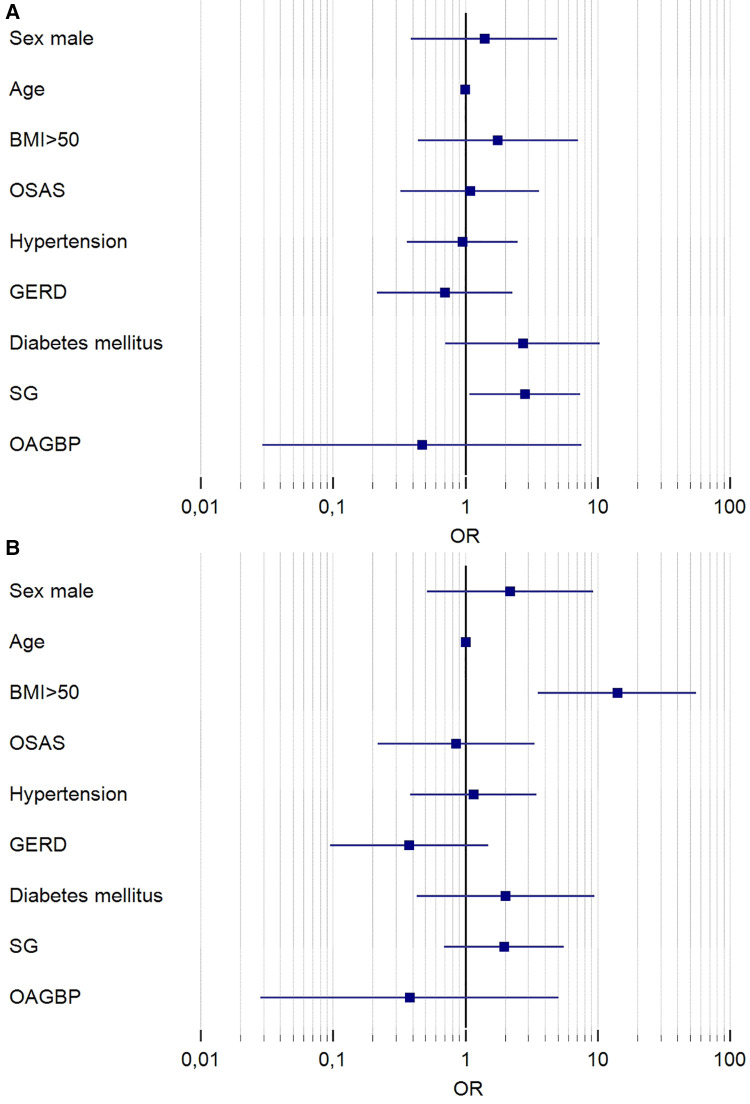
We included in this study 154 MO patients, with a median preoperative BMI of 40.8 kg/m, and 19 SO patients with median preoperative BMI of 54.9 kg/m. The MO patients underwent sleeve gastrectomy (SG) in 62 (40.3%) cases, laparoscopic Roux-and-Y gastric bypass (LRYGBP) in 85 (55.2%) cases and One-Anastomosis Gastric Bypass (OAGB) in 7 (4.5%) cases. underwent OAGB. The patients in the SO group were submitted to SG in 11 (57.9%) cases, LRYGBP in 5 (26.3%) cases, and OAGB in 3 (15.8%). At 24-month follow-up, an excess weight loss (EWL) >50% was achieved in 129 (83.8%) patients in the MO group and in 15 (78.9%) in the SO group ( = 0.53). A BMI < 35 kg/m was achieved in 137 (89%) patients in the MO group and from 8 (42.2%) patients in the SO group ( < 0.001). The total weight loss was significantly directly related to the initial BMI. Superobesity was identified as independent risk factor for surgical failure when considering the outcome of BMI < 35 kg/m.
Our study confirms that, although SO patients tend to gain a greater weight loss than MO patients, they less frequently achieve the desired BMI target. In this setting, it should be necessary to re-consider malabsorptive procedures as first choice.
超级肥胖(SO)定义为体重指数(BMI)>50kg/m²,代表疾病的极端严重程度,给外科医生带来挑战。
在这项回顾性研究中,我们旨在比较超级肥胖患者与病态肥胖(MO)患者的手术结果。
本研究纳入154例病态肥胖患者,术前BMI中位数为40.8kg/m²,以及19例超级肥胖患者,术前BMI中位数为54.9kg/m²。病态肥胖患者中,62例(40.3%)接受袖状胃切除术(SG),85例(55.2%)接受腹腔镜Roux-en-Y胃旁路术(LRYGBP),7例(4.5%)接受单吻合口胃旁路术(OAGB)。超级肥胖组患者中,11例(57.9%)接受SG,5例(26.3%)接受LRYGBP,3例(15.8%)接受OAGB。在24个月的随访中,病态肥胖组129例(83.8%)患者实现了>50%的超重减轻(EWL),超级肥胖组15例(78.9%)患者实现了超重减轻(EWL)(P = 0.53)。病态肥胖组137例(89%)患者的BMI<35kg/m²,超级肥胖组8例(42.2%)患者的BMI<35kg/m²(P<0.001)。总体体重减轻与初始BMI显著直接相关。在考虑BMI<35kg/m²的手术结果时,超级肥胖被确定为手术失败的独立危险因素。
我们的研究证实,尽管超级肥胖患者往往比病态肥胖患者减重更多,但他们达到理想BMI目标的频率较低。在这种情况下,有必要重新考虑将吸收不良手术作为首选。