Kirby James N, Kirkland Kelly, Wilks Matti, Green Mitchell, Tanjitpiyanond Porntida, Chowdhury Nafisa, Nielsen Mark
School of Psychology, The University of Queensland, QLD 4072, Australia.
Melbourne School of Psychological Sciences, University of Melbourne, VIC 3010, Australia.
R Soc Open Sci. 2023 Feb 15;10(2):221448. doi: 10.1098/rsos.221448. eCollection 2023 Feb.
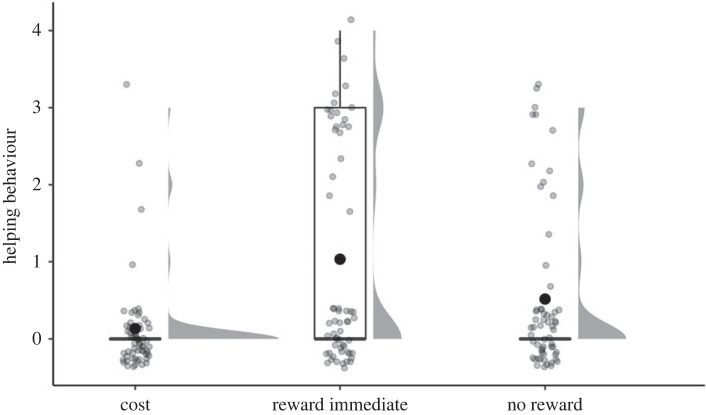
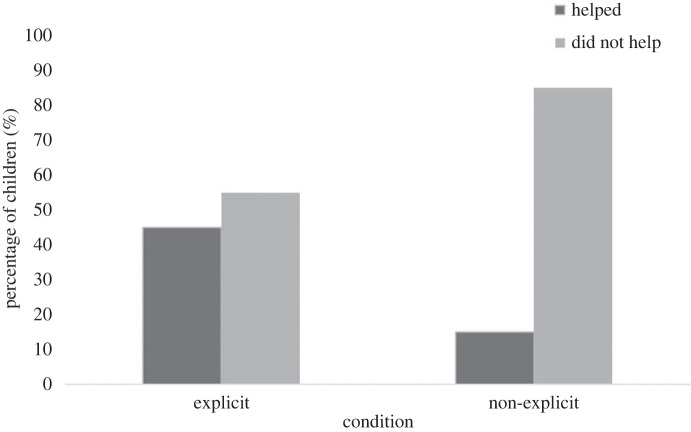
Extensive research shows that, under the right circumstances, children are highly prosocial. Extending an already published paradigm, we aimed here to determine what factors might facilitate and inhibit compassionate behaviour. Across five experiments ( = 285), we provide new insight into the bounds of 4- to 5-year-old children's compassionate behaviour. In the first three experiments, we varied cost of compassion by changing the reward (Study 1), using explicit instructions (Study 2) and ownership (Study 3). In the final two experiments, we varied the target of the compassionate behaviour, examining adults compared with puppet targets (Study 4), and whether the target was an in-group member (Study 5). We found strong evidence that cost reduces compassionate responding. By contrast, the recipient of compassion did not appear to influence responding: children were equally likely to help a human adult and a puppet, and an in-group member and neutral agent. These findings demonstrate that for young children, personal cost appears to be a greater inhibitor to compassionate responding than who compassion is directed toward.
大量研究表明,在适当的情况下,儿童具有高度的亲社会行为。扩展已发表的范式,我们在此旨在确定哪些因素可能促进和抑制同情行为。通过五项实验(N = 285),我们对4至5岁儿童同情行为的范围提供了新的见解。在前三项实验中,我们通过改变奖励(研究1)、使用明确的指示(研究2)和所有权(研究3)来改变同情的代价。在最后两项实验中,我们改变了同情行为的对象,将成年人与木偶对象进行比较(研究4),以及对象是否是内群体成员(研究5)。我们发现有力的证据表明代价会降低同情反应。相比之下,同情的接受者似乎并未影响反应:儿童帮助人类成年人和木偶、内群体成员和中立代理的可能性相同。这些发现表明,对于幼儿来说,个人代价似乎比同情的对象更能抑制同情反应。