Zhao Gangyi, Sun Tianjie, Zhang Zina, Zhang Jingjing, Bian Yinbo, Hou Chunyan, Zhang Dongdong, Han Shengfang, Wang Dongmei
State Key Laboratory of North China Crop Improvement and Regulation, Baoding, China.
Key Laboratory of Hebei Province for Plant Physiology and Molecular Pathology, Baoding, China.
Front Microbiol. 2023 Feb 1;14:1118176. doi: 10.3389/fmicb.2023.1118176. eCollection 2023.
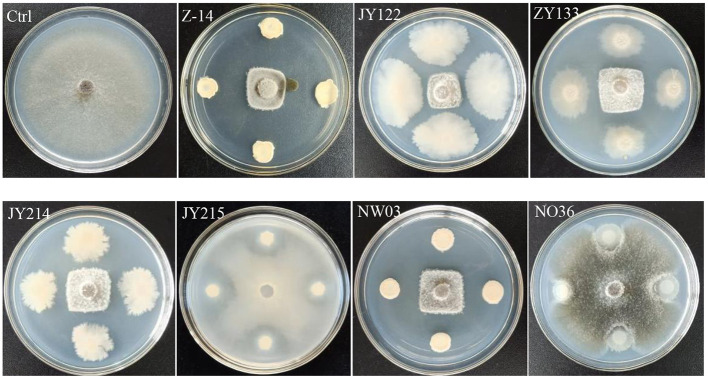
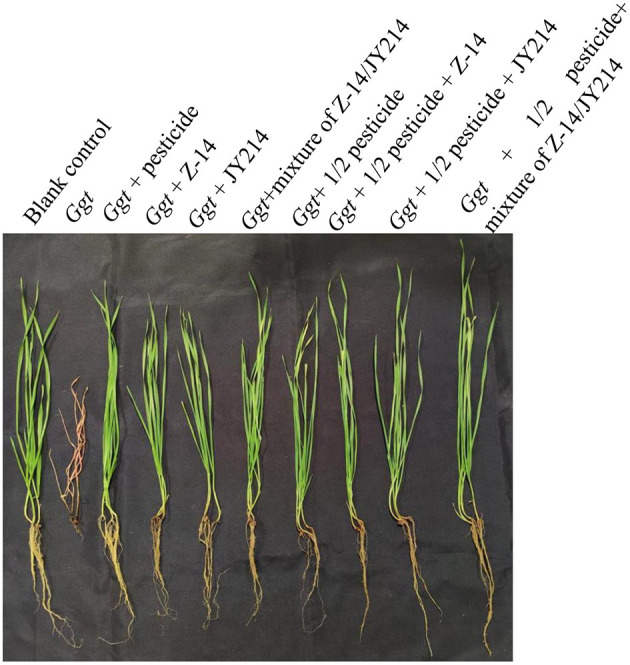
Wheat () is the second largest grain crop worldwide, and one of the three major grain crops produced in China. Take-all disease, caused by var. () infection, is a widespread and devastating soil-borne disease that harms wheat production. At present, the prevention and control of wheat take-all depend largely on the application of chemical pesticides. Chemical pesticides, however, not only lead to increased drug resistance of pathogens but also leave significant residues in the soil, causing serious environmental pollution. In this study, we investigated the application of to achieve take-all disease control in wheat while reducing pesticide application. Antagonistic bacteria were screened by plate test, species identification of strains was performed by Gram staining and sequencing of 16s rDNA, secondary metabolite activity of strains was detected by clear circle method, strain compatibility and effect of compounding on were detected by plate, and the application prospects of specific strains were analyzed by greenhouse and field experiments. We found that five strains, JY122, JY214, ZY133, NW03, Z-14, had significant antagonistic effects against , and could secrete antimicrobial proteins including amylase, protease, and cellulase. Furthermore, Z-14 and JY214 cultures have also been shown to change the morphology of mycelium. These results also showed that Z-14, JY214, and their combination can control take-all disease in wheat at a reduced level of pesticide use. In summary, we screened two spp. strains, Z-14 and JY214, that could act as antagonists that contribute to the biological control of wheat take-all disease. These findings provide resources and ideas for controlling crop diseases in an environmentally friendly manner.
小麦()是全球第二大粮食作物,也是中国种植的三大主要粮食作物之一。由禾顶囊壳小麦变种()感染引起的全蚀病是一种广泛传播且具有毁灭性的土传病害,危害小麦生产。目前,小麦全蚀病的防治在很大程度上依赖于化学农药的使用。然而,化学农药不仅会导致病原体耐药性增加,还会在土壤中留下大量残留,造成严重的环境污染。在本研究中,我们研究了利用来实现小麦全蚀病防治并减少农药使用的方法。通过平板试验筛选拮抗细菌,通过革兰氏染色和16s rDNA测序对菌株进行种类鉴定,采用透明圈法检测菌株的次生代谢产物活性,通过平板检测菌株兼容性及复配剂对的影响,并通过温室和田间试验分析特定菌株的应用前景。我们发现5株菌株JY122、JY214、ZY133、NW03、Z - 14对具有显著的拮抗作用,并且能够分泌包括淀粉酶、蛋白酶和纤维素酶在内的抗菌蛋白。此外,还发现Z - 14和JY214的培养物会改变的菌丝形态。这些结果还表明,Z - 14、JY214及其组合可以在减少农药使用量的情况下控制小麦全蚀病。总之,我们筛选出了两株菌株Z - 14和JY214,它们可作为拮抗物有助于小麦全蚀病的生物防治。这些发现为以环境友好方式控制作物病害提供了资源和思路。