Miranda Baleiras Mafalda, Dias Domingues Tiago, Severino Eduardo, Vasques Carolina, Neves Maria Teresa, Ferreira André, Vasconcelos de Matos Leonor, Ferreira Filipa, Miranda Helena, Martins Ana
Department of Medical Oncology, Centro Hospitalar de Lisboa Ocidental, Lisbon, PRT.
Centre of Statistics and its Applications (CEAUL), Faculdade de Ciências da Universidade de Lisboa, Lisbon, PRT.
Cureus. 2023 Jan 18;15(1):e33916. doi: 10.7759/cureus.33916. eCollection 2023 Jan.
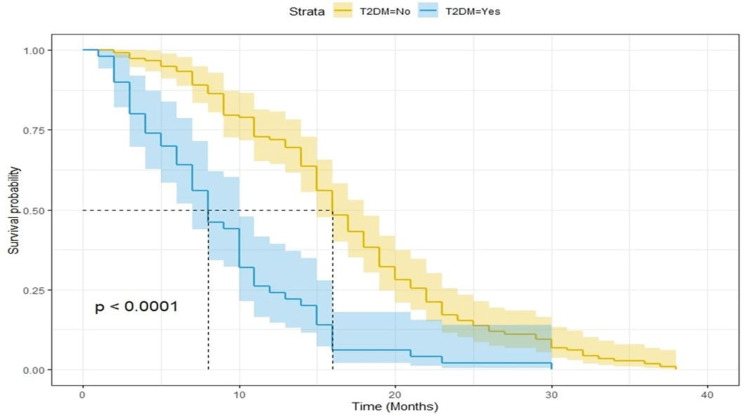
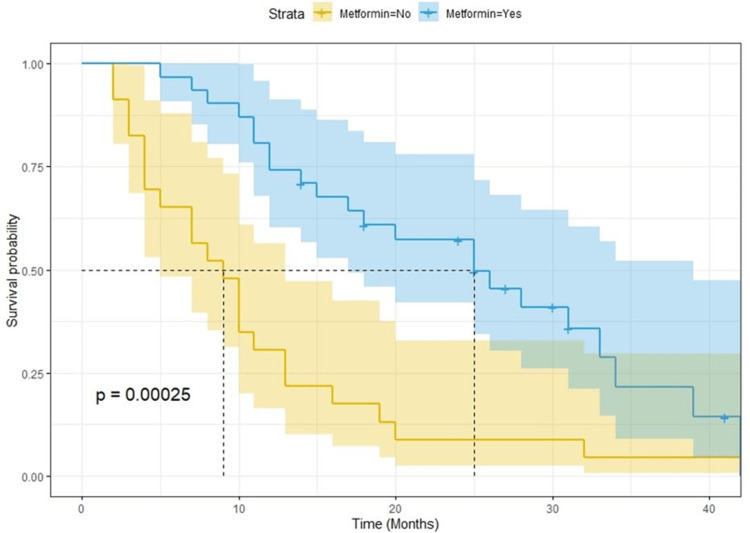
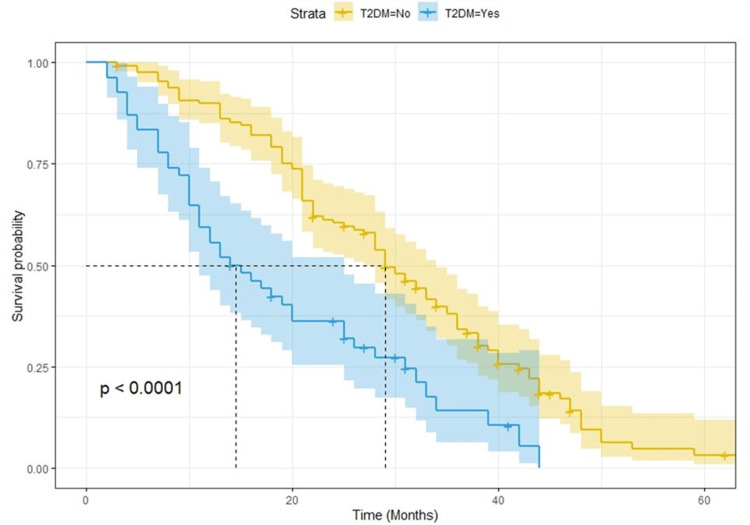
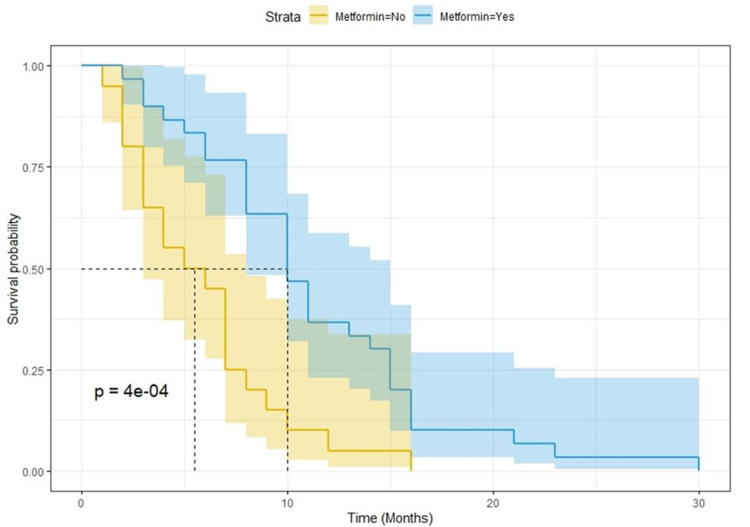
Background Diabetes mellitus (DM) is a prognostic factor for some malignancies, but its clinical implications in metastatic colorectal cancer (mCRC) patients are less clear. Therefore, we conducted a retrospective study to evaluate the impact of pre-existing type 2 diabetes mellitus (T2DM) on the survival outcomes of patients with newly diagnosed mCRC. Methodology We retrospectively included patients with newly diagnosed mCRC between January 2017 and June 2021 and with pre-existing T2DM. Data on the characteristics of patients, clinicopathological features, and drug exposure were collected from the electronic medical records. The primary endpoint was overall survival (OS). Secondary endpoints were progression-free survival (PFS) and treatment-related adverse events (TRAEs). Results Among 187 mCRC patients, 54 (28.8%) had T2DM. The median follow-up was 25 months. We observed 150 OS events and 168 PFS events. Diabetes significantly and negatively impacted PFS and OS. The median for PFS (mPFS) was eight and 16 months for T2DM and no T2DM patients, respectively (p < 0.0001; log-rank test). The median overall survival (mOS) was 15 and 29 months for T2DM and no T2DM patients, respectively (p < 0.0001; log-rank test). Patients with diabetes were more often overweight or obese (59.3% vs. 24.8%; p < 0.01) and had a poorer performance status (53.7% vs. 21.1% with Eastern Cooperative Oncology Group Performance Status 1; p < 0.01). Additionally, T2DM patients had more high-risk pathological features, including G3 grading tumors (27.7% vs. 12.0%; p = 0.01), lymph node involvement (p < 0.01), -mutated (35.1% vs. 6.8%; p < 0.01), and right-sided CRC (63.0% vs. 30.1%; p < 0.01). We found no statistically significant differences in TRAEs. Nevertheless, a significantly higher rate of grade 2-4 peripheral neuropathy (22.2% vs. 5.3%; p < 0.01) was reported in T2DM patients. Conclusions T2DM is a negative prognostic factor for survival in mCRC. The paper provides empirical evidence in favor of the joint control of both pathologies. Further research is needed to establish the robustness of our results.
背景 糖尿病(DM)是某些恶性肿瘤的预后因素,但其在转移性结直肠癌(mCRC)患者中的临床意义尚不清楚。因此,我们进行了一项回顾性研究,以评估既往2型糖尿病(T2DM)对新诊断的mCRC患者生存结局的影响。
方法 我们回顾性纳入了2017年1月至2021年6月期间新诊断的mCRC且患有既往T2DM的患者。从电子病历中收集患者特征、临床病理特征和药物暴露的数据。主要终点是总生存期(OS)。次要终点是无进展生存期(PFS)和治疗相关不良事件(TRAEs)。
结果 在187例mCRC患者中,54例(28.8%)患有T2DM。中位随访时间为25个月。我们观察到150例OS事件和168例PFS事件。糖尿病对PFS和OS有显著的负面影响。T2DM患者和无T2DM患者的PFS中位数(mPFS)分别为8个月和16个月(p<0.0001;对数秩检验)。T2DM患者和无T2DM患者的总生存期中位数(mOS)分别为15个月和29个月(p<0.0001;对数秩检验)。糖尿病患者超重或肥胖的比例更高(59.3%对24.8%;p<0.01),且体能状态较差(东部肿瘤协作组体能状态为1级的患者比例为53.7%对21.1%;p<0.01)。此外,T2DM患者有更多高危病理特征,包括G3级肿瘤(27.7%对12.0%;p=0.01)、淋巴结受累(p<0.01)、-突变(35.1%对6.8%;p<0.01)和右侧结直肠癌(63.0%对30.1%;p<0.01)。我们发现TRAEs在统计学上无显著差异。然而,T2DM患者报告的2-4级周围神经病变发生率显著更高(22.2%对5.3%;p<0.01)。
结论 T2DM是mCRC生存的负性预后因素。本文提供了支持联合控制这两种疾病的经验证据。需要进一步研究以确定我们结果的稳健性。