Chen Peng, Yang Ziye, Fan Zhihua, Wang Ben, Tang Yan, Xiao Yi, Chen Xiang, Luo Dan, Xiao Shuiyuan, Li Ji, Xie Hongfu, Shen Minxue
Department of Dermatology, Xiangya Hospital, Central South University, Changsha, China.
Hunan Engineering Research Center of Skin Health and Disease, Xiangya Hospital, Central South University, Changsha, China.
Front Nutr. 2023 Feb 2;10:1092781. doi: 10.3389/fnut.2023.1092781. eCollection 2023.
Despite of growing evidence on gastrointestinal comorbidities of rosacea, there was a lack of literatures regarding the role of diet on rosacea.
To investigate the relationship between adherence to a Mediterranean-like diet pattern and the risk of incident rosacea.
This was a prospective cohort study of government employees aged >20 years conducted between January 2018 and December 2021 from five cities of Hunan province of China. At baseline, participants completed a food frequency questionnaire and participated in a skin examination. Presence of rosacea was determined by certified dermatologists. Subsequent skin examinations during follow-up were performed every one-year interval since the entry of the study. The Mediterranean diet score (MDS) was generated based on seven food groups (whole grains, red meats, fish, raw vegetables, legumes, fruits and nuts). Binary logistic regression models adjusted for potential confounders were used to estimate risks for incident rosacea.
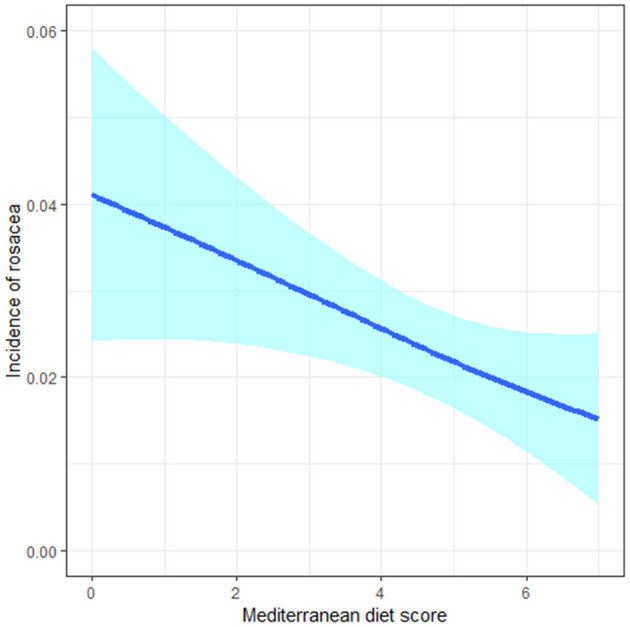
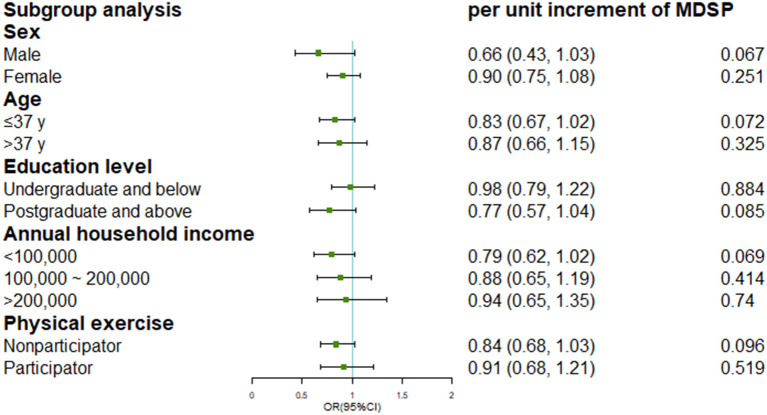
Of the 3,773 participants who completed at least two consecutive skin examinations, 3,496 were eligible for primary analyses. With a total follow-up of 8,668 person-years, we identified 83 incident rosacea cases. After full adjustments for covariates, the MDS was associated a decreased risk of incident rosacea (aOR: 0.84, 95% CI: 0.72, 0.99; = 0.037 for 1-point increment of MDS). In subgroup analyses by body mass index (BMI), this inverse association was consistently observed in the lowest and medium tertiles of BMI (<24.5 kg/m), but not in the highest tertile of BMI (≥24.5 kg/m), with a significant interaction effect ( < 0.001).
Our results suggested that adherence to a Mediterranean-like diet pattern might reduce the risk of incident rosacea among non-overweight individuals.
尽管越来越多的证据表明酒渣鼻存在胃肠道合并症,但关于饮食在酒渣鼻发病中的作用,相关文献却很匮乏。
探讨坚持类似地中海饮食模式与酒渣鼻发病风险之间的关系。
这是一项针对中国湖南省五个城市20岁以上政府雇员的前瞻性队列研究。在基线时,参与者完成一份食物频率问卷并接受皮肤检查。酒渣鼻的诊断由专业皮肤科医生确定。自研究开始后,随访期间每年进行一次后续皮肤检查。地中海饮食评分(MDS)基于七类食物(全谷物、红肉、鱼类、生蔬菜、豆类、水果和坚果)得出。采用调整了潜在混杂因素的二元逻辑回归模型来估计酒渣鼻发病的风险。
在3773名至少连续完成两次皮肤检查的参与者中,3496人符合主要分析条件。总随访人年数为8668人年,我们共识别出83例酒渣鼻新发病例。在对协变量进行全面调整后,MDS与酒渣鼻发病风险降低相关(调整后的比值比:0.84,95%可信区间:0.72,0.99;MDS每增加1分,P = 0.037)。在按体重指数(BMI)进行的亚组分析中,这种负相关在BMI最低和中等三分位数组(<24.5 kg/m²)中始终存在,但在BMI最高三分位数组(≥24.5 kg/m²)中未观察到,且存在显著的交互作用(P < 0.001)。
我们的研究结果表明,坚持类似地中海饮食模式可能会降低非超重个体患酒渣鼻的风险。