Barrea Luigi, Donnarumma Marianna, Cacciapuoti Sara, Muscogiuri Giovanna, De Gregorio Ludovica, Blasio Chiara, Savastano Silvia, Colao Annamaria, Fabbrocini Gabriella
Dipartimento di Scienze Umanistiche, Centro Direzionale, Università Telematica Pegaso, Via Porzio, isola F2, 80143, Napoli, Italy.
Endocrinology Unit, Department of Clinical Medicine and Surgery, Centro Italiano per la cura e il Benessere del paziente con Obesità (C.I.B.O), University Medical School of Naples, Via Sergio Pansini 5, 80131, Naples, Italy.
J Transl Med. 2021 Apr 26;19(1):171. doi: 10.1186/s12967-021-02826-1.
Acne is a chronic, inflammatory and debilitating skin disorder. Dietary factors and nutritional status are among the exacerbating factors of acne. Phase angle (PhA), a direct measure of Bioelectrical Impedance Analysis (BIA), represents an indicator of the chronic inflammatory state. The Mediterranean diet (MD) is a healthy dietary pattern that can exert anti-inflammatory effects in several inflammatory diseases. We aimed to investigate the difference in PhA and adherence to the MD and their associations with the severity of acne in a sample of naïve treatment patients with acne compared to control group.
In this cross-sectional, case-control, observational study, we enrolled 51 patients with acne and 51 control individuals. Body composition was evaluated by a BIA phase-sensitive system (50 kHz BIA 101 RJL, Akern Bioresearch, Florence, Italy, Akern). For adherence to the MD, we have used the PREvención con DIeta MEDiterránea (PREDIMED) questionnaire. The clinical severity of acne was assessed by using the global acne grading system (GAGS), a quantitative scoring system to assess acne severity.
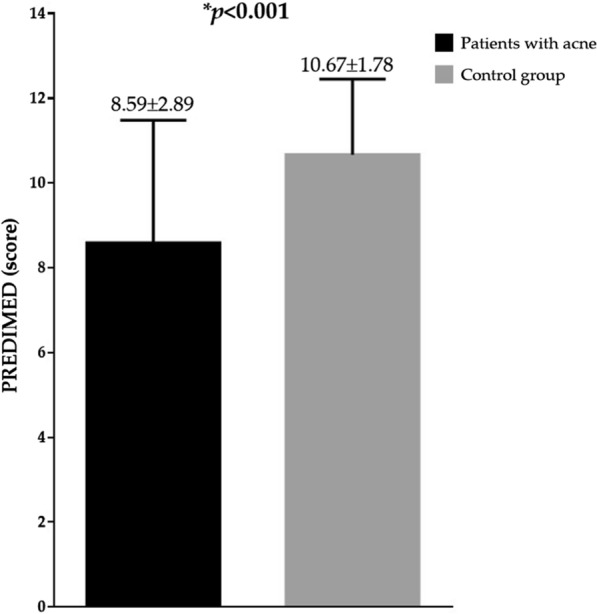
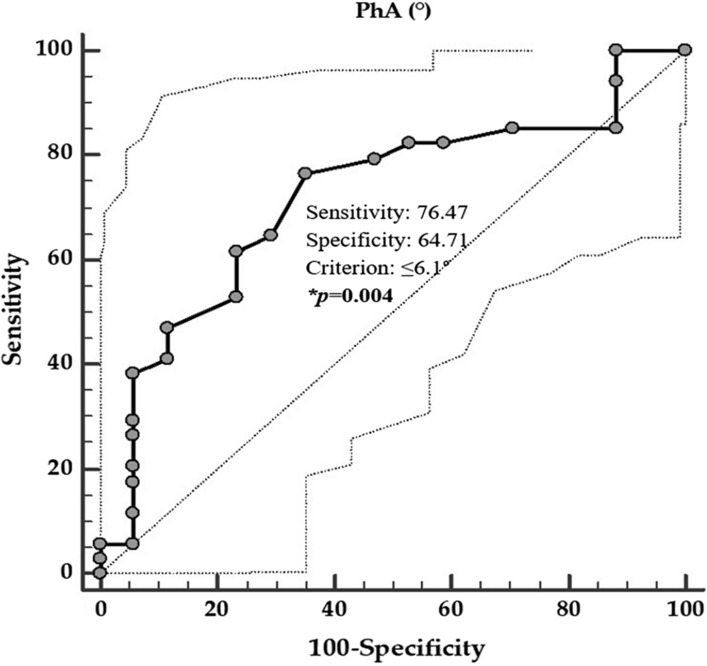
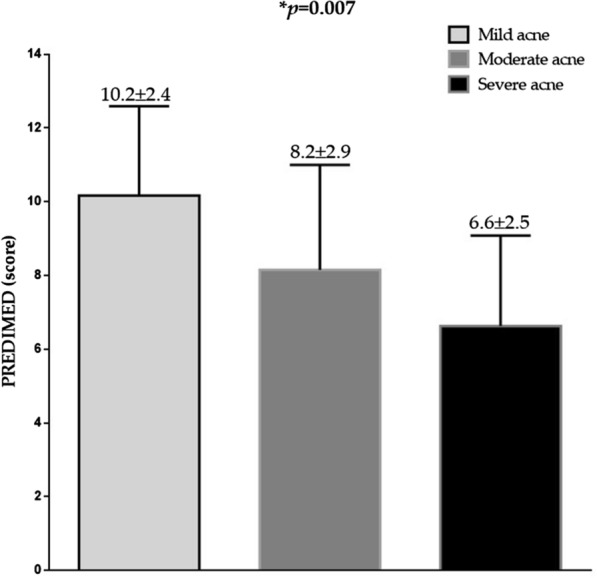
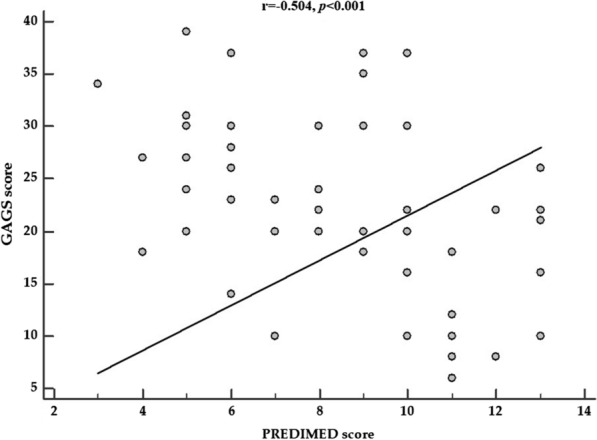
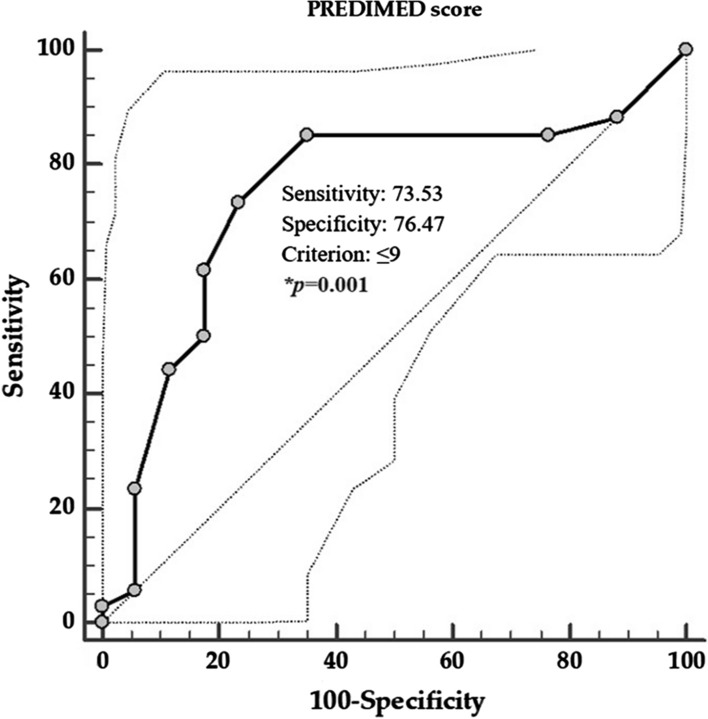
Patients with acne had a worse body composition, in particular smaller PhA (p = 0.003), and a lower adherence to the MD (p < 0.001) than the control group, in spite of no differences in gender, age and BMI between the two groups. Stratifying patients with acne according to GAGS categories, both PhA (p = 0.006) and PREDIMED score (p = 0.007) decreased significantly in severe acne than mild/moderate acne. The GAGS score was negative correlations with PhA (r = - 0.478, p < 0.001) and PREDIMED score (r = - 0.504, p < 0.001). The results of the multivariate analysis showed PhA and PREDIMED score were the major determinants of GAGS score (p < 0.001). The receiver operator characteristic (ROC) analysis reporting a value of PhA of ≤ 6.1° and a PREDIMED score of ≤ 9 identified patients with acne with the highest clinical severity of the disease.
Novel correlations were reported between PhA and the degree of adherence to the MD with acne severity. Of interest, PhA and PREDIMED scores might represent possible markers of the severity of acne in a clinical setting. This study highlights how a cooperation between dermatologist and nutritionists might provide a combination key in the complex management of acne patients.
痤疮是一种慢性、炎症性且使人衰弱的皮肤疾病。饮食因素和营养状况是痤疮的加重因素。相角(PhA)是生物电阻抗分析(BIA)的直接测量指标,代表慢性炎症状态的一个指标。地中海饮食(MD)是一种健康的饮食模式,可在多种炎症性疾病中发挥抗炎作用。我们旨在调查初治痤疮患者样本与对照组相比,相角和对地中海饮食的依从性差异及其与痤疮严重程度的关联。
在这项横断面、病例对照观察性研究中,我们纳入了51例痤疮患者和51名对照个体。通过BIA相敏系统(50kHz BIA 101 RJL,意大利佛罗伦萨的阿克恩生物研究公司,阿克恩)评估身体成分。对于地中海饮食的依从性,我们使用了地中海饮食预防(PREDIMED)问卷。通过全球痤疮分级系统(GAGS)评估痤疮的临床严重程度,GAGS是一种评估痤疮严重程度的定量评分系统。
尽管两组在性别、年龄和BMI方面无差异,但痤疮患者的身体成分较差,尤其是相角较小(p = 0.003),对地中海饮食的依从性较低(p < 0.001)。根据GAGS类别对痤疮患者进行分层,重度痤疮患者的相角(p = 0.006)和PREDIMED评分(p = 0.007)均显著低于轻度/中度痤疮患者。GAGS评分与相角(r = -0.478,p < 0.001)和PREDIMED评分(r = -0.504,p < 0.001)呈负相关。多变量分析结果显示,相角和PREDIMED评分是GAGS评分的主要决定因素(p < 0.001)。受试者工作特征(ROC)分析表明,相角≤6.1°且PREDIMED评分≤9可识别出疾病临床严重程度最高的痤疮患者。
报告了相角和对地中海饮食的依从程度与痤疮严重程度之间的新关联。有趣的是,相角和PREDIMED评分可能代表临床环境中痤疮严重程度的可能标志物。本研究强调了皮肤科医生和营养学家之间的合作如何可能为痤疮患者的综合管理提供一个关键组合。